テーマ:心理・行動
作品形式:物語
用途:英語多読
対象:英検準1級レベルの学習者
英語本文:約550語
英文難易度の評価(推定)
CEFRレベル:B1+〜B2
語彙の難易度:B2中心、一部B2+以上
文法の難易度:B1+〜B2
抽象的な内容の理解:B2
英検:2級〜準1級
Lexile指数:約950L〜1050L
YL:YL 5.0前後
English Text
Jaden was sure everyone would notice. He had to give a short talk in front of his class, and on the morning of the talk he discovered a small ink stain on the sleeve of his favorite hoodie. It was the size of a pea. He tried to wash it, but the stain stayed.
On the bus, he kept pushing his sleeve up to hide the stain. In the hallway, he was certain people were staring. When he stood up to talk, his heart was pounding so loud he thought the microphone would pick it up.
He gave the talk. He said um twice. He forgot one sentence and had to look at his notes. When he sat down, he was convinced it had been a disaster that everyone would remember.
At lunch, he asked his friend Luis, “Did you see the stain?”
Luis frowned. “What stain?”
“On my sleeve. And I messed up the middle part.”
Luis thought for a second. “I remember you talked about Mars rovers. I don’t remember a stain. Were you nervous? You looked fine.”
That afternoon, their teacher, Ms. Alvarez, did an experiment. She asked everyone to write down one thing they thought everyone else would notice about them that day — a bad haircut, a pimple, a weird laugh. Then she asked them to write down one thing they noticed about someone else.
The results were almost funny. Twenty-four kids were worried about being noticed. Only three things were actually noticed by others, and none of them were the things people were worried about. Most papers that asked “What did you notice about someone else?” just said “nothing” or “she wore a blue shirt.”
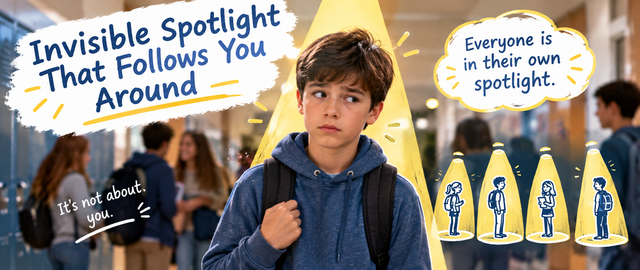
Ms. Alvarez called it the spotlight effect. She said our brains have an egocentric bias. We live inside our own experience all day, so we overestimate how much others are paying attention to us. In our mind, there is a bright spotlight following us around. In reality, everyone else is also standing in their own spotlight, worrying about their own sleeve.
In a 2000 study, psychologists at Cornell examined this effect. They had students wear a silly T-shirt with a big face on it and walk into a room. The students guessed that about half the room would remember the shirt. In fact, only about a quarter did. The gap between what we think people notice and what they actually notice is huge.
That does not mean people do not care about you. It means they are not scanning you for flaws. They are too busy managing their own internal commentary.
Jaden kept the stained hoodie. He wore it the next day on purpose. He walked into class without pushing his sleeve up. No one said anything. One kid asked if he had seen the new rover photo.
The spotlight did not disappear. He still felt it sometimes, warm on the back of his neck. But now he knew the trick. When the light felt bright, he asked himself, “If the roles were flipped, would I even notice?” Usually the answer was no.
Knowing about the spotlight does not make you stop caring what others think. It just makes the light a little less blinding, so you can actually look out and see other people instead of only worrying about how you look to them.
語彙
- overestimate /ˌoʊvərˈɛstɪmeɪt/ to think something is larger or more important than it really is
- disaster /dɪˈzæstər/ a complete failure that feels very bad
- spotlight effect /ˈspɑːtlaɪt ɪˈfɛkt/ スポットライト効果(他人が自分に注目していると過大評価する心理)
- egocentric bias /ˌiːɡoʊˈsɛntrɪk ˈbaɪəs/ 自己中心バイアス
- internal commentary /ɪnˈtɝːnəl ˈkɑːmənteri/ 内的独白、頭の中の実況
句動詞のリスト
- pick up:拾い上げる、(音や声を)拾う
- stand up:立ち上がる
- sit down:座る
- mess up:失敗する、台無しにする
- write down:書き留める
- follow around:ついて回る
- look out:外を見る、周りを見渡す
- think about:〜について考える
構文のリスト
- He was sure everyone would notice.:みんなが気づくだろうと確信していた(be sure+that節の省略)
- She was sure everyone would laugh at her drawing.
- He was sure everyone would forget the meeting.
- They were sure everyone would love the new song.
- When he stood up to talk, his heart was pounding so loud he thought the microphone would pick it up.:話すために立ち上がったとき心臓がとても大きく鼓動してマイクが拾うと思ったほどだった(when節+so〜that構文)
- When she opened the box to check, the light was shining so bright she thought the neighbors would see it.
- When he ran to catch the bus, his bag was swinging wildly, and he thought everyone would turn around.
- When they walked in to present, the room was so quiet that they could hear the clock.
- If the roles were flipped, would I even notice?:もし立場が逆だったら自分は気づくだろうか(仮定法過去+疑問文)
- If the roles were flipped, would you still feel nervous?
- If the lights were turned off, would you find the door?
- If the teams were flipped, would the game feel different?
コロケーションのリスト
- ink stain:インクの染み
- A small ink stain stayed on his sleeve all day.
- She covered the ink stain with a patch.
- An ink stain the size of a pea is easy to miss.
- give a talk:話をする、発表する
- He had to give a short talk in front of the class.
- She will give a talk about Mars rovers tomorrow.
- Giving a talk feels scary but gets easier with practice.
- internal commentary:頭の中の実況、内的独白
- Everyone is busy managing their own internal commentary.
- Your internal commentary can make a small mistake feel huge.
- When you notice your internal commentary, you can turn it down a bit.
- spotlight effect:スポットライト効果
- The spotlight effect makes us overestimate how much others notice.
- Psychologists first measured the spotlight effect in the 1990s.
- Knowing about the spotlight effect helps you feel less nervous.
- roles were flipped:立場が逆だったら
- If the roles were flipped, would I even notice his hoodie?
- Think what you would see if the roles were flipped.
- When roles were flipped in the game, they laughed at the same joke.
日本語対訳
あなたについて回る見えないスポットライト
ジェイデンはみんなが気づくだろうと確信していました。クラスの前で短い発表をしなければならず、その日の朝、お気に入りのパーカーの袖に小さなインクの染みを見つけたのです。エンドウ豆ほどの大きさでした。洗ってみましたが、染みは残りました。
バスの中では染みを隠そうとずっと袖をまくり上げていました。廊下ではみんながじろじろ見ていると確信していました。話すために立ち上がったとき、心臓がうるさくドキドキしてマイクが拾ってしまうのではないかと思いました。
発表中に「えっと」を2回言いました。一文忘れてメモを見なければなりませんでした。座ったとき、みんなの記憶に残るような大失敗だったと確信しました。
昼食のとき、友だちのルイスに尋ねました。「染み見た?」
ルイスは不思議そうな顔をしました。「何の染み?」
「袖の。真ん中の部分も失敗したし」
ルイスは少し考えました。「君が火星探査車の話をしたのは覚えてる。染みは覚えてないよ。緊張してたの?大丈夫に見えたけど」
その午後、担任のアルバレス先生がある実験をしました。みんなに、その日他のみんなが気づくだろうと思ったことを一つ書き出すように言いました。変な髪型、ニキビ、変な笑い方などです。それから他の誰かについて気づいたことを一つ書き出すように言いました。
結果は、思わず笑ってしまうようなものでした。24人の子が気づかれることを心配していました。実際に他の人に気づかれたのは3つだけで、しかもそれらは心配されていたことではありませんでした。「他の誰かについて何に気づきましたか?」という質問への答えのほとんどは「何もない」か「青いシャツを着ていた」でした。
アルバレス先生はそれをスポットライト効果と呼びました。脳には自己中心バイアスがあるのだと言いました。私たちは一日中自分の経験の中に生きているので、他人が自分にどれだけ注意を払っているかを過大評価してしまうのです。心の中では明るいスポットライトが私たちについて回っています。実際には他のみんなもそれぞれ自分のスポットライトの中にいて、自分自身のことを心配しているのです。
コーネル大学の心理学者たちは、2000年の研究でこの効果を調べました。彼らは学生たちに、大きな顔が描かれたばかばかしいTシャツを着せ、部屋に入らせました。学生たちは部屋にいる人の約半数がそのシャツに気づくだろうと予想しました。実際には約4分の1しか覚えていませんでした。私たちが思う「人が気づく量」と実際に気づかれる量の差は巨大です。
それは人々があなたのことを気にかけていないという意味ではありません。彼らがあなたの欠点を探して見張っているわけではないという意味です。彼らは自分の頭の中の実況を管理するのに忙しいのです。
ジェイデンは染みの付いたパーカーを取っておきました。翌日わざとそれを着て、袖をまくり上げずに教室に入りました。誰も何も言いませんでした。一人の子が新しい探査車の写真を見たかと尋ねました。
スポットライトは消えませんでした。時々まだ首の後ろが温かく感じることがありました。でも今はコツを知っていました。光が明るく感じられたとき、自分に問いかけました。「立場が逆だったら、自分は気づくだろうか?」たいてい答えはノーでした。
スポットライトについて知ることで、他人の目が気にならなくなるわけではありません。光が少しだけまぶしくなくなるので、どう見られているかだけを心配するのではなく、実際に外を見て他の人を見ることができるようになるのです。
この英文はどのような英語学習者におすすめか? ~ by AI
この英文は、英検2級程度の英語力を持ち、準1級レベルの読解力を目指している人におすすめの多読教材です。
約549語の物語で、学校生活を題材にしながら、「スポットライト効果(Spotlight Effect)」という心理学の概念を扱っています。
英文は、主人公の少年が自分の服の小さな染みを周囲の人に見られていると思い込み、発表の失敗を気にする場面から始まります。その後、友人との会話や教師が行った実験を通して、自分が思っているほど他人は自分に注目していないという心理現象が説明されます。
このように、具体的な出来事から始まり、心理学的な概念の説明へと進み、最後に主人公自身の考え方や行動が変化する構成になっています。
特に、次のような人に適しています。
- 英検2級レベルの英文読解に慣れてきた人:基本的な英文だけでなく、心理学や人間の行動を扱った少し抽象的な文章に挑戦したい人。
- 英検準1級を目指している人:心理学に関する語彙や抽象的な表現を、実際の文章の中で学びたい人。
- CEFR B1〜B2レベルの多読教材を探している人:具体的なエピソードと抽象的な説明が組み合わされた英文を読みたい人。
- 大人向けの英語多読に取り組んでいる人:子ども向けの簡単な物語では物足りず、知的な興味を満たせるテーマを英語で読みたい人。
- 英語で文章の論理展開を理解する力を伸ばしたい人:具体例、実験結果、心理学的な説明、結論という情報のつながりを追いながら読解する練習をしたい人。
- 英語を日本語に逐一翻訳せずに理解したい人:登場人物の心理や状況の変化を追いながら、英語のまま内容を理解する力を養いたい人。
この教材の特徴は、単に英語の語彙や文法を学ぶだけでなく、人間の心理について考えながら読めることです。
例えば、The spotlight did not disappear. という一文は、心理学的な知識を得ても、人の目が気になる感情が完全になくなるわけではないことを表しています。こうした表現は、前後の文脈を踏まえて意味を理解する必要があります。
また、文章の中では、主人公の個人的な経験と、教師が示す実験結果が結びつけられています。個別の出来事から一般的な心理現象を理解するという、英語の説明文や論説文にもつながる文章構成を学ぶことができます。
英語の多読では、単語や文法を理解することに加えて、複数の文や段落の情報を結びつけ、文章全体の意味をつかむ力も重要です。このような物語は、その練習にも活用できます。
英検2級から準1級へのステップアップを目指す人や、英語で心理学・人間の行動について読むことに興味がある人は、ぜひ挑戦してみてください。
なお、CEFRや英検のレベルは推定であり、公式な判定ではありません。特に心理学の専門用語や抽象的な表現については、個人の知識や読書経験によって理解のしやすさが変わります。
制作について
本記事の英文・日本語訳・英語難易度の評価は、AIを活用して作成したものです。
内容の正確性を保証するものではありません。
AIによるチェックを行っていますが、論理的な矛盾・文脈の破綻などが含まれている可能性や、歴史的事実・科学的な正確性・一般常識などに合致しない事柄が含まれている可能性があります。あくまでも英文を読む練習用の素材として考えて下さい。
なお、英文難易度の評価は目安であり、公式な判定ではありません。