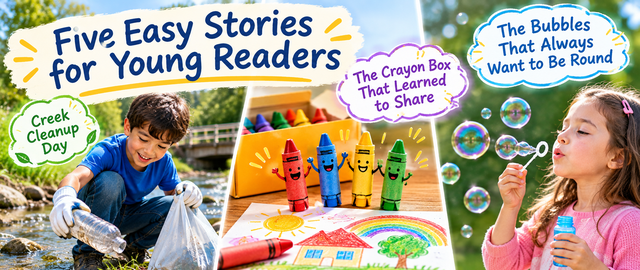
AIで生成したやさしい英文5話をまとめて掲載しています。
英文の難易度
CEFR:Pre-A1(1話目:A1)
英検:5級
語数:5話合計約1,294語
制作について
本記事の英文・日本語訳・英語難易度の評価は、AIを活用して作成したものです。
内容の正確性を保証するものではありません。
論理的な矛盾・文脈の破綻などが含まれている可能性や、歴史的事実・科学的な正確性・一般常識などに合致しない事柄が含まれている可能性があります。あくまでも英文を読む練習用の素材として考えて下さい。
「んっ?」と思うところがあっても、無視して読み続ける能力を獲得していただければ幸いです…
なお、難易度の評価は目安であり、CEFRや英検による公式な判定ではありません。
Creek Cleanup Day
英語本文:約258語
I am seven. I live near a creek. The creek is small. It is behind our school.
One day, our teacher said, “The creek is dirty. Let’s clean it.”
We went to the creek after school. We wore gloves. We had big trash bags.
I saw plastic bottles in the water. I saw paper on the ground. I saw an old shoe. Yuck! It smelled bad.
We picked up the trash. I picked up three bottles. My friend Sam found a toy car. It was muddy and brown. My friend Lily found a blue bag. It was stuck in the mud.
We put all the trash in the bags. The bags got big and heavy. We worked as a team.
After one hour, the creek looked clean. The water looked clear. We could see small fish swimming. We could see rocks on the bottom. The sun made the water sparkle.
Then a duck came. The duck swam in the clean water. Quack, quack! We laughed. We were so happy.
Our teacher said, “Good job! You helped nature. You helped the town.”
I felt proud. I felt like a hero for the creek. My heart felt big and warm.
Now we clean the creek every month. It is our creek team. We keep it clean. We tell other kids, “Please do not throw trash in the creek. The fish and ducks live there.”
I like the creek. It is our neighborhood’s little river. When it is clean, all the animals and people are happy. Clean water makes everyone smile.
日本語対訳
小川そうじの日
私は7歳です。小川の近くに住んでいます。小川は小さいです。学校の裏にあります。
ある日、先生が言いました。「小川が汚れています。そうじしましょう」。
私たちは放課後に小川に行きました。手袋をしました。大きなゴミ袋を持ちました。
水の中にペットボトルが見えました。地面に紙が見えました。古い靴も見えました。うわっ。嫌なにおいがしました。
私たちはゴミを拾いました。私はボトルを3本拾いました。友だちのサムはおもちゃの車を見つけました。泥だらけで茶色でした。友だちのリリーは青い袋を見つけました。泥にはまっていました。
すべてのゴミを袋に入れました。袋は大きくて重くなりました。チームで働きました。
一時間後、小川はきれいに見えました。水は澄んで見えました。小さな魚が泳いでいるのが見えました。底にある石が見えました。太陽が水をキラキラさせました。
それからアヒルが来ました。アヒルはきれいな水で泳ぎました。ガーガー。私たちは笑いました。とても嬉しかったです。
先生は言いました。「よくやったね。自然を助けたね。町を助けたね」。
私は誇らしく感じました。小川のヒーローになった気分でした。心が大きく温かく感じました。
今では毎月小川をそうじしています。私たちの小川チームです。きれいに保っています。他の子たちに言います。「小川にゴミを捨てないでね。魚やアヒルがそこに住んでいるんだよ」。
私は小川が好きです。それは私たちの近所の小さな川です。きれいなとき、動物も人もみんな幸せです。きれいな水はみんなを笑顔にします。
The Crayon Box That Learned to Share
英語本文:約270語
On the table there was a box of crayons. The red crayon liked to stay in the front. The blue crayon liked to stay next to red. The green crayon hid in the back.
One day a girl opened the box. She wanted to draw a big sky. She picked up the blue crayon. She drew and drew. The sky was so big and blue.
Then she wanted to draw the sun. She picked up the yellow crayon. The yellow crayon was happy. It made a big round sun.
The red crayon waited. No one picked red. The red crayon said in a small voice, “No one needs me.”
The blue crayon heard it. Blue said, “We need you. A picture needs many colors.”
The girl wanted to draw an apple. She looked for red. She found the red crayon in the corner. She picked it up and drew a red apple. The red was so bright and pretty.
The green crayon saw that. Green came out from the back. The girl used green to draw grass and leaves.
Soon all the crayons were out on the table. They were not hiding. They were helping.
The girl drew a house, a tree, a dog, and a rainbow. She used every color. Red, blue, yellow, green, orange, and purple. All the colors worked together.
At the end, the box was empty, but the paper was full. The crayons looked at the picture and smiled. They learned something that day.
A box is happy not when it is full. It is happy when all its colors get to come out and help.
日本語対訳
分け合うことを学んだクレヨンの箱
テーブルの上にクレヨンの箱がありました。赤いクレヨンは前にいるのが好きでした。青いクレヨンは赤の隣にいるのが好きでした。緑のクレヨンは後ろに隠れていました。
ある日、女の子が箱を開けました。大きな空を描きたいと思いました。青いクレヨンを手に取りました。描いて、描いて。空はとても大きくて青くなりました。
それから太陽を描きたくなりました。黄色いクレヨンを手に取りました。黄色いクレヨンは嬉しそうでした。大きくて丸い太陽を描きました。
赤いクレヨンは待っていました。誰も赤を選びません。赤いクレヨンは小さな声で言いました。「誰も僕を必要としないんだ」
青いクレヨンがそれを聞きました。青は言いました。「僕たちには君が必要だよ。絵にはたくさんの色が必要なんだ」
女の子はりんごを描きたくなりました。赤を探しました。隅っこに赤いクレヨンを見つけました。手に取って赤いりんごを描きました。赤はとても明るくてきれいでした。
緑のクレヨンはそれを見ました。緑は後ろから出てきました。女の子は緑を使って草と葉っぱを描きました。
すぐにすべてのクレヨンがテーブルの上に出ました。隠れてはいませんでした。手伝っていたのです。
女の子は家と木と犬と虹を描きました。すべての色を使いました。赤、青、黄、緑、オレンジ、紫。すべての色が一緒に働きました。
最後には、箱は空っぽでしたが、紙はいっぱいになりました。クレヨンたちは絵を見て微笑みました。その日、彼らは何かを学びました。
箱は、いっぱいのときではなく、すべての色が出てきて手伝うことができたときに幸せなのです。
The Bubbles That Always Want to Be Round
英語本文:約255語
Mia had a little bottle of bubbles. She loved bubbles.
She blew one bubble. It was round. She blew another one. It was round too. She blew a big one and a small one. All of them were round.
She said, “Why are you all round? Why not square?”
The bubbles could not answer, but the air and the water could.
A bubble is made of soapy water. The soapy water is like a soft skin. The air inside pushes out. The skin pulls in. The skin wants to be as small as it can be.
A round shape is the smallest skin for the air inside. A square would need more skin. A triangle would need more skin too. So the bubble makes itself round. It is the best way to hold the air.
Mia blew a bubble that touched the table. The bubble became half round, like a little dome.
She blew two bubbles that touched each other. They shared a wall in the middle. That wall was flat.
She blew many bubbles in the sink. They all pushed on each other. They made many flat walls inside, but the outside was still round.
Mia laughed. The bubbles were trying so hard to be small and round.
Then pop! The bubble broke. The soapy skin fell. The air ran away.
Mia dipped her wand again. She blew and blew. More round bubbles flew up into the sky.
She said, “Bye, round bubbles!”
And the bubbles floated away, all round, all the way up.
日本語対訳
いつも丸くなりたがるシャボン玉
ミアはシャボン玉の小さなボトルを持っていました。シャボン玉が大好きでした。
一つ吹きました。丸かったです。もう一つ吹きました。それも丸かったです。大きいのと小さいのを吹きました。どれも丸かったです。
彼女は言いました。「どうしてみんな丸いの?四角じゃないの?」
シャボン玉は答えられませんでしたが、空気と水は答えを知っていました。
シャボン玉は石けん水でできています。石けん水は柔らかい皮のようです。中の空気が外に押します。皮は中に引っ張ります。皮はできるだけ小さくなりたいのです。
丸い形は中の空気にとって一番小さな皮です。四角ならもっと皮が必要になります。三角でももっと皮が必要になります。だからシャボン玉は自分を丸くするのです。空気を包むのに一番良い方法なのです。
ミアはテーブルに触れるシャボン玉を吹きました。シャボン玉は小さなドームのように半分丸くなりました。
二つのシャボン玉が触れ合うように吹きました。真ん中で壁を共有しました。その壁は平らでした。
流しの中にたくさんのシャボン玉を吹きました。みんながお互いを押し合いました。中にたくさんの平らな壁ができましたが、外側はやっぱり丸かったです。
ミアは笑いました。シャボン玉は小さく丸くなろうと一生懸命でした。
それからパチン!シャボン玉は割れました。石けんの膜が落ちました。空気は逃げていきました。
ミアはまた棒を浸しました。吹いて、吹いて。もっと丸いシャボン玉が空へ飛んでいきました。
彼女は言いました。「バイバイ、丸いシャボン玉!」
そしてシャボン玉は浮かんでいきました。ずっと丸いまま、空の上まで。
The Big Feelings That Come and Go Like Weather
英語本文:約247語
Sometimes you feel big feelings. You feel very mad. Or very sad. Or very, very happy. The feeling feels so big inside.
It is like weather.
When you are mad, it is like a storm. Your face gets hot. Your hands make fists. You want to shout. That is the storm.
When you are sad, it is like rain. Your eyes get wet. Your chest feels heavy. You want to sit and be quiet. That is the rain.
When you are happy, it is like the sun. Your whole body feels light. You want to jump and laugh. That is the sun.
Weather comes and goes. Feelings come and go too.
A storm does not stay all day. The rain stops. The sun comes back. Your big feeling will also move on.
What can you do when the storm comes?
You can breathe. Breathe in, breathe out. Four times.
You can name it. Say, “I feel mad right now.”
You can move. Push the wall. Squeeze a pillow. Run to the fence and back.
You can talk. Tell a big person, “I need help.”
You can wait. Sit with the feeling. It will get smaller.
You are not the storm. You are the sky. The sky holds all the weather. Sun, rain, and storm all pass through the sky, but the sky stays.
So next time a big feeling comes, remember. It is just weather. It will come. It will go. And you will still be here.
日本語対訳
天気のように来ては去っていく大きな気持ち
ときどき、大きな気持ちを感じます。とても怒っていると感じます。とても悲しいと感じます。とても、とても幸せだと感じます。その気持ちは中でとても大きく感じられます。
それは天気のようなものです。
怒っているときは、嵐のようなものです。顔が熱くなります。手は拳を作ります。叫びたくなります。それが嵐です。
悲しいときは、雨のようなものです。目が濡れます。胸が重く感じます。座って静かにしたくなります。それが雨です。
幸せなときは、太陽のようなものです。体全体が軽く感じます。跳んだり笑ったりしたくなります。それが太陽です。
天気は来ては去っていきます。気持ちも来ては去っていきます。
嵐は一日中続きません。雨は止みます。太陽が戻ってきます。あなたの大きな気持ちもまた移ろいでいきます。
嵐が来たとき、何ができるでしょう?
呼吸ができます。吸って、吐いて。4回。
名前を付けることができます。「今、怒ってる」と言ってみましょう。
体を動かすことができます。壁を押してみましょう。枕をぎゅっと握りましょう。フェンスまで走って戻ってきましょう。
話すことができます。大人に「助けて」と言いましょう。
待つことができます。その気持ちと一緒に座りましょう。小さくなっていきます。
あなたは嵐ではありません。あなたは空です。空はすべての天気を抱えています。太陽も雨も嵐もすべて空を通り過ぎますが、空はそこに残ります。
だから次に大きな気持ちが来たとき、思い出してください。それはただの天気です。来て、去っていきます。そしてあなたはここに残ります。
The Hello That Makes the Day Start
英語本文:約264語
In the morning, the door opens. Someone says, “Hello!”
That small word does a big job.
Hello is like a key. It opens the day.
When you say hello, you tell the other person, “I see you. You are here. I am happy you are here.”
You do not need a long speech. Just one word. Hello.
Think about how it works.
At school, you walk in. You say hello to your teacher. Your teacher smiles. Now the day feels warm.
At the store, you say hello to the person at the desk. They smile back. Now you both feel good.
At home, you say hello when you come in. Mom or Dad hears your voice. They know you are back. They feel happy.
Hello is also a little brave.
Sometimes you feel shy. You want to hide. But you say hello anyway. Soft and small. And the other person says hello back. Now you are not so shy.
Sometimes you can say hello in other ways.
You can wave your hand.
You can nod your head.
You can smile with your eyes.
But the best hello is with a word and a smile together.
It is easy to forget hello when you are busy. You run in. You look down. You forget.
So try this. Tomorrow morning, say hello first. Before you ask for food. Before you talk about toys. Just hello.
Say it slow. Say it with your eyes up.
“Hello!”
You will see. The other person lights up. And your own heart feels light too.
One small word. It starts everything.
日本語対訳
一日を始めさせる「こんにちは」
朝、ドアが開きます。誰かが言います。「こんにちは!」
その小さな言葉は大きな仕事をします。
こんにちはは鍵のようなものです。一日を開けます。
こんにちはと言うとき、あなたは相手にこう伝えているのです。「あなたが見えています。あなたはここにいます。あなたがここにいて嬉しいです」
長い話は必要ありません。たった一言。こんにちは。
どうやって働くか考えてみましょう。
学校で、中に入ります。先生にこんにちはと言います。先生は微笑みます。すると一日が温かく感じられます。
お店で、机の向こうの人にこんにちはと言います。相手も笑顔を返します。すると二人とも良い気分になります。
家で、入ってきたときにこんにちはと言います。お母さんやお父さんがあなたの声を聞きます。あなたが帰ったことがわかります。嬉しく感じます。
こんにちはは少し勇気もいります。
ときどき恥ずかしく感じます。隠れたくなります。でもそれでもこんにちはと言います。小さく柔らかく。そして相手もこんにちはと返します。もうそんなに恥ずかしくありません。
ときどき他の方法でもこんにちはと言えます。
手を振ることができます。
頭をうなずくことができます。
目で微笑むことができます。
でも一番良いこんにちはは、言葉と笑顔が一緒になったものです。
忙しいときはこんにちはを忘れがちです。走って入ってきます。下を向きます。忘れてしまいます。
だからこれをやってみましょう。明日の朝、最初にこんにちはと言いましょう。食べ物を求める前に。おもちゃの話をする前に。ただこんにちはと。
ゆっくり言いましょう。目を上げて言いましょう。
「こんにちは!」
わかるでしょう。相手の顔がぱっと明るくなります。そしてあなた自身の心も軽く感じられます。
たった一つの小さな言葉。それがすべてを始めます。