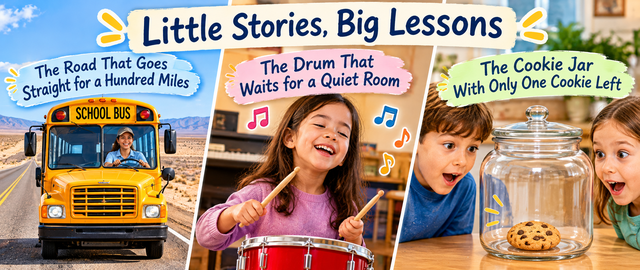
AIで生成したやさしい英文5話をまとめて掲載しています。
英文の難易度
CEFR:Pre-A1
英検:5級
語数:5話合計約1,448語
制作について
本記事の英文・日本語訳・英語難易度の評価は、AIを活用して作成したものです。
内容の正確性を保証するものではありません。
論理的な矛盾・文脈の破綻などが含まれている可能性や、歴史的事実・科学的な正確性・一般常識などに合致しない事柄が含まれている可能性があります。あくまでも英文を読む練習用の素材として考えて下さい。
「んっ?」と思うところがあっても、無視して読み続ける能力を獲得していただければ幸いです…
なお、難易度の評価は目安であり、CEFRや英検による公式な判定ではありません。
The Road That Goes Straight for a Hundred Miles
英語本文:約282語
Far away, there is a desert. The desert is flat and wide. Sand everywhere.
Through the desert goes a road. It goes straight. Not a little straight. Very straight. For a hundred miles.
A small bus drives on that road every day.
The bus driver is named Rosa. She knows every bump. She knows where the wind blows sand onto the road.
On the bus are people going to town. A man with a hat. A mom with a baby. A kid with a big bag.
They look out the window. All they see is sand and sky.
At first, the road feels boring. No turns. Just straight.
But Rosa says, “Look closer.”
So they look closer.
They see a rock that looks like a turtle.
They see a plant with a red flower in all that sand.
They see a lizard run fast across the road.
Rosa stops the bus for a minute. Everyone gets out. The air is hot and quiet.
She says, “This road is straight, but the desert is not empty.”
The kid with the big bag finds a smooth stone. He puts it in his pocket.
The mom points to clouds far away. They look like mountains.
Then they get back on the bus. Rosa drives again. Straight and straight.
The bus hums. Hum, hum, hum.
The straight road helps. It helps people get across. No hills. No turns to get lost. Just go.
After a long time, they see houses. Then a store. Then town.
They are here.
The kid says, “The road was straight, but we saw so many things!”
Rosa smiles. “That is the secret,” she says. “A straight road lets you look around.”
日本語対訳
100マイルまっすぐ続く道
遠くに、砂漠があります。砂漠は平らで広いです。どこもかしこも砂です。
砂漠を貫いて一本の道が通っています。まっすぐに進んでいます。少しだけまっすぐなのではありません。とてもまっすぐです。100マイルも。
小さなバスが毎日その道を走っています。
運転手の名前はローザ。彼女はでこぼこをすべて知っています。風が砂を道に吹き付ける場所も知っています。
バスには町へ行く人たちが乗っています。帽子をかぶった男性。赤ちゃんを抱えたお母さん。大きな袋を持った子ども。
彼らは窓の外を見ます。見えるのは砂と空だけです。
最初は、その道は退屈に感じられます。曲がり角がありません。ただまっすぐなだけ。
でもローザは言います。「もっとよく見てごらん」
そこで彼らはもっとよく見ます。
カメのように見える岩が見えます。
たくさんの砂の中に赤い花を咲かせた植物が見えます。
トカゲが道を素早く走っていくのが見えます。
ローザは1分間バスを止めます。みんな降ります。空気は暑くて静かです。
彼女は言います。「この道はまっすぐだけど、砂漠は空っぽじゃないのよ」
大きな袋を持った子どもは滑らかな石を見つけます。ポケットに入れます。
お母さんは遠くの雲を指さします。山のように見えます。
それから彼らはバスに戻ります。ローザはまた運転します。まっすぐ、まっすぐ。
バスはブーンと音を立てます。ブーン、ブーン、ブーン。
まっすぐな道は助けになります。渡るのを助けてくれます。丘もありません。迷うような曲がり角もありません。ただ進むだけ。
長い時間が経って、家々が見えてきます。それから店。それから町。
着きました。
子どもは言います。「道はまっすぐだったけど、たくさんのものが見えたよ!」
ローザは微笑みます。「それが秘密なの」と彼女は言います。「まっすぐな道だからこそ、周りを見渡せるのよ」
The Drum That Waits for a Quiet Room
英語本文:約281語
In the corner of the music room, there is a small drum. It is round and red. Two sticks sit on top of it.
The drum is quiet all day. It waits.
In the morning, kids come in. They play the piano. Plink, plink. The drum listens.
They play the bells. Ding, ding. The drum listens.
The drum wants to play too. But it waits for the right time.
One day, a little girl comes in. She is new. She looks shy.
The music teacher says, “You can try any sound.”
The girl looks at the piano. Too many keys.
She looks at the bells. Too high.
She looks at the drum. Just one sound. Boom.
She picks up the sticks. She holds them tight.
She hits the drum. Boom!
The sound is big and warm. It fills the room.
She smiles. She hits it again. Boom. Boom.
Now she makes a beat. Boom, boom, tap, boom.
Other kids hear it. They start to clap. Clap, clap.
One kid shakes a shaker. Shhh, shhh.
The piano plays again. Plink, plink, but now with the drum.
The whole room plays together. The drum is not alone. It is the heart.
It goes boom, boom, boom. Everyone moves to its beat.
After the song, the girl hugs the drum. “You are easy,” she says. “And strong.”
The drum does not talk. But if it could, it would say, “I was waiting for you.”
At the end of the day, the room is quiet again. The drum sits in the corner. Round and red. Two sticks on top.
It waits for tomorrow. For the next kid who needs one easy, strong sound to start.
日本語対訳
静かな部屋を待つ太鼓
音楽室の隅に、小さな太鼓があります。丸くて赤いです。2本のバチが上に乗っています。
太鼓は一日中静かです。待っています。
朝、子どもたちが入ってきます。ピアノを弾きます。ポロン、ポロン。太鼓は聞いています。
ベルを鳴らします。チーン、チーン。太鼓は聞いています。
太鼓も演奏したくてたまりません。でもちょうど良い時を待っています。
ある日、小さな女の子が入ってきます。彼女は新入りです。恥ずかしそうに見えます。
音楽の先生は言います。「どんな音でも試していいよ」
女の子はピアノを見ます。鍵盤が多すぎます。
ベルを見ます。高すぎます。
太鼓を見ます。たった一つの音。ドン。
バチを手に取ります。ぎゅっと握ります。
太鼓を叩きます。ドン!
音は大きくて温かいです。部屋いっぱいに広がります。
彼女は微笑みます。もう一度叩きます。ドン。ドン。
今度はビートを作ります。ドン、ドン、タン、ドン。
他の子どもたちが聞きます。手を叩き始めます。パン、パン。
一人の子がシェイカーを振ります。シャー、シャー。
ピアノがまた鳴ります。ポロン、ポロン、でも今度は太鼓と一緒に。
部屋全体が一緒に演奏します。太鼓は一人ではありません。心臓です。
ドン、ドン、ドンと鳴ります。みんなそのビートに合わせて動きます。
曲が終わった後、女の子は太鼓を抱きしめます。「あなたは簡単だし、強いね」と彼女は言います。
太鼓は話しません。でももし話せたら、こう言うでしょう。「君を待っていたんだ」
一日の終わりに、部屋はまた静かになります。太鼓は隅に座っています。丸くて赤い。2本のバチが上に。
明日を待ちます。簡単で強い一つの音で始めることを必要とする次の子どものために。
The Cookie Jar With Only One Cookie Left
英語本文:約289語
On the kitchen counter, there is a cookie jar. Today, there is only one cookie left inside.
Two kids see it. Ben and Maya.
Ben says, “I want it!”
Maya says, “I want it too!”
Who should get it? There is only one cookie. Two kids want it.
This is a small problem, but it is about being fair.
Here are some ideas.
Idea one: First come, first served. Who saw it first? If Ben saw it first, he gets it. That is simple. But is it always fair? Maya is just as hungry.
Idea two: Share it. Break the cookie in half. One half for Ben, one half for Maya. Now both get some. But the cookie is small. Half feels small.
Idea three: Take turns. Ben got the last cookie yesterday. So today, Maya gets it. Tomorrow, Ben gets it. This feels fair over time.
Idea four: Ask. “Do you want it more than me?” Sometimes one person says, “You can have it.” That is kind. That is giving.
What is the best idea?
It depends.
If you are very hungry and your friend just ate, maybe you get it.
If you are both just as hungry, share it.
If you want to be kind, let your friend have it.
Being fair does not always mean the same thing. Sometimes fair means equal. Half and half. Sometimes fair means kind. You give.
The best way is to talk. Say, “There is one cookie. What should we do?”
When you talk, you show you care about the other person, not just the cookie.
Ben and Maya talked. They broke the cookie. Crunch. Two small pieces.
They both smiled. The cookie was sweet. But being fair felt even sweeter.
日本語対訳
クッキーが1つだけ残ったクッキージャー
キッチンのカウンターに、クッキージャーがあります。今日は、中にクッキーが1つだけ残っています。
2人の子どもがそれを見ます。ベンとマヤです。
ベンは言います。「欲しい!」
マヤも言います。「私も欲しい!」
誰がもらうべきでしょう?クッキーは1つだけです。2人の子どもが欲しがっています。
これは小さな問題ですが、公平であることについての問題です。
いくつか考えがあります。
考え1:早い者勝ち。誰が最初に見つけましたか?もしベンが最初に見つけたなら、彼がもらいます。それはシンプルです。でもいつも公平でしょうか?マヤも同じくらいお腹が空いています。
考え2:分け合う。クッキーを半分に割ります。ベンに半分、マヤに半分。今度は二人とも少しもらえます。でもクッキーは小さいです。半分は小さく感じます。
考え3:順番に交代する。昨日はベンが最後のクッキーをもらいました。だから今日はマヤがもらいます。明日はベンがもらいます。これは時間が経てば公平に感じられます。
考え4:尋ねる。「私より君の方が欲しい?」ときどき一人が言います。「君が食べていいよ」それは親切です。それは譲ることです。
一番良い考えは何でしょう?
それは場合によります。
もしあなたがとてもお腹が空いていて、友だちが食べたばかりなら、あなたがもらうのかもしれません。
もし二人が同じくらいお腹が空いているなら、分け合いましょう。
親切にしたいなら、友だちにあげましょう。
公平であることは、いつも同じことを意味するわけではありません。ときどき公平とは平等を意味します。半分ずつ。ときどき公平とは親切を意味します。譲るのです。
一番良い方法は話し合うことです。「クッキーが1つあるよ。どうしよう?」と言いましょう。
話し合うとき、あなたはクッキーだけでなく、相手のことも気にかけていることを示しています。
ベンとマヤは話し合いました。クッキーを割りました。カリッ。2つの小さなかけら。
二人は微笑みました。クッキーは甘かったです。でも公平であることは、さらに甘く感じられました。
The Blue Bin That Eats Paper
英語本文:約290語
In the classroom, there are two bins. One is gray. One is blue.
The gray bin is for trash. Old food, broken pens, tape.
The blue bin is for paper. Old paper, new paper, big paper, small paper. The blue bin loves paper.
Every day, kids put paper in the blue bin.
Maya puts in a paper with a wobbly A. “I tried again,” she says.
Ben puts in a paper with a cut-out star. Little bits fall in too.
Sam puts in a whole stack. “Oops, too many,” he says.
The blue bin gets full. So full it goes munch, munch.
At the end of the week, a big truck comes. It takes the blue bin away. Not far. Just to a big building.
In the big building, paper becomes water and mush. Like oatmeal.
The mush is pressed flat. Thin, thin, thin. Then dry. Now it is new paper!
White and clean. No A, no star, no wobbly lines.
The new paper comes back to the classroom. In a big box.
The teacher says, “Look! New paper from old paper.”
Maya draws on it. A new A. So straight!
Ben cuts a new star. So sharp!
Sam writes his name. So big!
The blue bin is empty now. Ready to eat again.
Maya says, “The blue bin ate my old A and gave me a new A!”
Ben says, “It ate my star and gave me a new star!”
The teacher smiles. “That is called recycling. We use paper again and again.”
The gray bin says nothing. It is still full of old tape.
The blue bin sits quiet. But it is happy. It knows tomorrow, more paper will come. Munch, munch. And it will become new again.
日本語対訳
紙を食べる青い箱
教室には2つの箱があります。1つは灰色。1つは青です。
灰色の箱はゴミ用です。古い食べ物、壊れたペン、テープ。
青い箱は紙用です。古い紙、新しい紙、大きな紙、小さな紙。青い箱は紙が大好きです。
毎日、子どもたちは青い箱に紙を入れます。
マヤはぐらついたAが書かれた紙を入れます。「もう一回やってみたの」と彼女は言います。
ベンは星を切り抜いた紙を入れます。小さな切れ端も中へ落ちます。
サムは紙の束をまるごと入れます。「おっと、多すぎた」と彼は言います。
青い箱はいっぱいになります。とてもいっぱいになって、ムシャムシャと音を立てます。
週の終わりに、大きなトラックが来ます。青い箱を持っていきます。遠くではありません。ただ大きな建物まで。
大きな建物では、紙は水とどろどろしたものになります。オートミールのようなものです。
どろどろしたものは平らに押しつぶされます。薄く、薄く、薄く。それから乾かされます。今やそれは新しい紙です!
白くてきれい。Aも星もぐらついた線もありません。
新しい紙が教室に戻ってきます。大きな箱の中に。
先生は言います。「見て!古い紙からできた新しい紙よ」
マヤはその上に絵を描きます。新しいA。とてもまっすぐ!
ベンは新しい星を切り抜きます。とても鋭い!
サムは自分の名前を書きます。とても大きく!
青い箱は今は空っぽです。また食べる準備ができています。
マヤは言います。「青い箱が私の古いAを食べて、新しいAをくれた!」
ベンは言います。「僕の星を食べて、新しい星をくれた!」
先生は微笑みます。「それをリサイクルって言うの。紙を何度も何度も使うのよ」
灰色の箱は何も言いません。まだ古いテープでいっぱいです。
青い箱は静かに座っています。でも幸せです。明日、またたくさんの紙が来ることを知っています。ムシャムシャ。そしてまた新しくなるのです。
The Bell That Tells the Whole Town When to Wake
英語本文:約306語
In the middle of town, there is a tall tower. At the top of the tower, there is a big bell. The bell is old and gold.
Every morning, the bell rings. Ding, dong, ding, dong.
When the bell rings, the town wakes up.
Mrs. Lee opens her bakery. She makes bread.
Mr. Brown opens his shop. He puts apples outside.
The kids hear the bell and get up. They eat breakfast.
At eight, the bell rings again. Ding, dong.
That means school starts. The kids grab their bags. They run to school.
At twelve, the bell rings. Ding, dong, ding.
That means lunch time. Everyone stops to eat. The bakery smells so good.
At five, the bell rings. Ding, dong, ding, dong, ding.
That means work is done. Shops close. People go home.
One day, the bell did not ring.
In the morning, no ding, dong.
Mrs. Lee stayed in bed. “Is it not morning?” she said.
Mr. Brown did not open his shop.
The kids stayed in bed too.
The town was quiet. Too quiet.
A little girl named Ana went to the tower. She climbed up. Up, up, up.
At the top, she saw the bell. A bird had made a nest on it. A small nest with two blue eggs.
“Oh!” said Ana. “You are keeping it quiet.”
She went down and told the town. “The bell is a nest now!”
The town did not ring the bell that week. They used a small drum instead. Boom, boom.
Mrs. Lee baked. Mr. Brown sold apples. Kids went to school. All to the drum.
After a week, the eggs cracked. Tiny birds came out.
The birds flew away. The nest was empty.
Ana climbed up and cleaned the bell.
The next morning, ding, dong, ding, dong!
The town smiled. The bell was back.
日本語対訳
町全体に起きる時を告げる鐘
町の真ん中に、高い塔があります。塔のてっぺんには大きな鐘があります。鐘は古くて金色です。
毎朝、鐘が鳴ります。ディン、ドン、ディン、ドン。
鐘が鳴ると、町は目を覚まします。
リーさんがパン屋を開けます。パンを作ります。
ブラウンさんが店を開けます。リンゴを外に並べます。
子どもたちは鐘を聞いて起きます。朝ごはんを食べます。
8時に、鐘はまた鳴ります。ディン、ドン。
それは学校が始まるという意味です。子どもたちはかばんをつかみます。学校へ走っていきます。
12時に、鐘が鳴ります。ディン、ドン、ディン。
それはお昼ごはんの時間という意味です。みんな手を止めて食べます。パン屋はとても良い匂いがします。
5時に、鐘が鳴ります。ディン、ドン、ディン、ドン、ディン。
それは仕事が終わったという意味です。店は閉まります。人々は家に帰ります。
ある日、鐘が鳴りませんでした。
朝、ディン、ドンという音がありません。
リーさんはベッドの中にいました。「朝じゃないの?」と彼女は言いました。
ブラウンさんは店を開けませんでした。
子どもたちもベッドの中にいました。
町は静かでした。静かすぎました。
アナという小さな女の子が塔に行きました。登りました。上へ、上へ、上へ。
てっぺんで、鐘を見ました。鳥がその上に巣を作っていました。2つの青い卵がある小さな巣でした。
「あら!」とアナは言いました。「あなたが静かにさせていたのね」
降りて行って町のみんなに言いました。「鐘が今は巣になっているの!」
その週、町は鐘を鳴らしませんでした。代わりに小さな太鼓を使いました。ブーン、ブーン。
リーさんはパンを焼きました。ブラウンさんはリンゴを売りました。子どもたちは学校へ行きました。みんな太鼓の音に合わせて。
一週間後、卵が割れました。小さな鳥が出てきました。
鳥たちは飛び去りました。巣は空っぽになりました。
アナは登って鐘をきれいにしました。
次の朝、ディン、ドン、ディン、ドン!
町は微笑みました。鐘が戻ってきたのです。