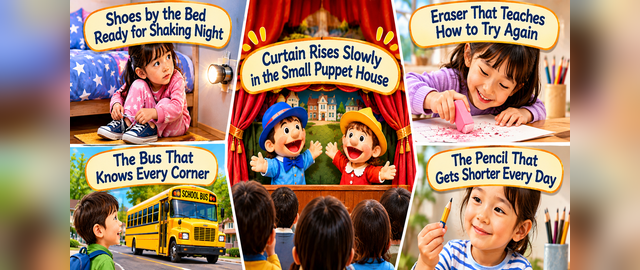
AIで生成したやさしい英文5話をまとめて掲載しています。
英文の難易度
CEFR:Pre-A1
英検:5級
語数:5話合計約1,477語
制作について
本記事の英文・日本語訳・英語難易度の評価は、AIを活用して作成したものです。
内容の正確性を保証するものではありません。
論理的な矛盾・文脈の破綻などが含まれている可能性や、歴史的事実・科学的な正確性・一般常識などに合致しない事柄が含まれている可能性があります。あくまでも英文を読む練習用の素材として考えて下さい。
「んっ?」と思うところがあっても、無視して読み続ける能力を獲得していただければ幸いです…
なお、難易度の評価は目安であり、CEFRや英検による公式な判定ではありません。
Shoes by the Bed Ready for Shaking Night
英語本文:約288語
Mika lives in a town where the ground sometimes shakes. The shake is called an earthquake.
In Mika’s room, there is a small flashlight on the wall. The flashlight is taped low, near the floor. Next to the bed, there are shoes. The shoes are closed with laces. They are not pretty. They are strong. Every night, Mika puts the shoes by the bed, with the toes facing out.
Mom says, “After a big shake, the floor may have glass. You do not want bare feet on glass. So shoes first, then light, then stand.”
One night, the house makes a soft rumble. The bed shakes left and right. The books on the shelf shake, too. Mika holds the edge of the bed. She counts to ten in her head. The shake stops.
The room is dark. The power went out. Mika does not get up with bare feet. She sits on the bed. She puts her hand down to the floor. She finds her shoes by touch. She puts them on. She pulls the laces tight.
Now she reaches for the flashlight on the wall. It is low, so she can find it even in the dark. She clicks it on. Light fills the room.
She looks at the floor. No glass this time. She stands up slowly. She walks to the door. Mom is in the hall with her own flashlight.
Mom says, “Good job. Shoes, then light, then stand.”
The next morning, they put the flashlight back on the wall, low near the floor. They put the shoes back by the bed, toes facing out. They are ready again.
Mika draws a small sign and tapes it near her bed. It says: SHOES, LIGHT, STAND.
日本語対訳
揺れる夜に備えてベッドのそばに置かれた靴
ミカは時々地面が揺れる町に住んでいます。その揺れは地震と呼ばれます。
ミカの部屋には、壁に小さな懐中電灯があります。懐中電灯は床の近くの低い場所にテープで貼られています。ベッドの横には靴があります。靴は紐で閉まるものです。きれいではありません。丈夫です。毎晩、ミカはつま先を外向きにして靴をベッドのそばに置きます。
ママが言います。「大きな揺れの後、床にガラスがあるかもしれないわ。ガラスの上で素足になりたくないでしょ。だからまず靴、次に明かり、それから立つ、よ」
ある夜、家が柔らかくゴロゴロ鳴ります。ベッドが左右に揺れます。本棚の本も揺れます。ミカはベッドの縁をつかみます。頭の中で十まで数えます。揺れが止まります。
部屋は暗いです。電気が消えました。ミカは素足で起き上がりません。ベッドに座ります。手を床へ下ろします。触って靴を見つけます。履きます。紐をきつく締めます。
次に壁の懐中電灯に手を伸ばします。低い場所にあるので暗闇でも見つけられます。カチッとつけます。光が部屋を満たします。
床を見ます。今回はガラスはありません。ゆっくり立ち上がります。ドアまで歩きます。ママが自分の懐中電灯を持って廊下にいます。
ママが言います。「よくできたわ。靴、明かり、それから立つ、ね」
翌朝、懐中電灯を壁の床近くの低い場所に戻します。靴をつま先を外向きにしてベッドのそばに戻します。また準備ができました。
ミカは小さな標識を描いてベッドの近くに貼ります。そこにはこう書かれています。靴、明かり、立つ。
Eraser That Teaches How to Try Again
英語本文:約302語
Lila has a new pencil and a big pink eraser. The eraser is as big as her thumb. It lives at the end of the pencil, but she can take it off and hold it.
She wants to write her name. She writes L I L A. The L is too tall. The A leans to the left. She does not like it.
She pushes the eraser down on the paper. She rubs hard. The paper makes a soft sound. The pink dust falls. The letters go away, but the paper gets a little rough. If she rubs too hard, the paper will tear.
Mom shows her. “Light and slow,” Mom says. Mom holds Lila’s hand. They push the eraser lightly. They move it in small circles. The letters fade. The paper stays smooth.
Lila tries again. She writes L I L A. The L is still tall, but less tall. She erases only the L. She does not erase the whole name. She pushes lightly in small circles. The L goes away. She writes the L again, shorter this time.
She writes her name five times. Each time she erases one letter, not all. Each time the letters get a little straighter.
The big pink eraser gets smaller. Pink dust covers the desk. Lila brushes the dust into her hand and drops it in the trash.
Mom looks at the paper. The last L I L A is clear and straight. Under it there are light gray marks where she erased. Mom says, “You can see your tries. That is good. Erasing is not hiding a mistake. It is showing where you learned.”
Lila puts the pencil and the small pink eraser back in her box. The paper still has her name, and underneath, soft gray shadows of the tries before.
日本語対訳
やり直し方を教える消しゴム
リラは新しい鉛筆と大きなピンクの消しゴムを持っています。消しゴムは親指ほどの大きさです。鉛筆の先に住んでいますが、取り外して持つこともできます。
自分の名前を書きたいと思っています。L I L Aと書きます。Lが高すぎます。Aが左に傾いています。気に入りません。
消しゴムを紙に押し付けます。強くこすります。紙が柔らかい音を立てます。ピンクのカスが落ちます。文字は消えますが、紙が少しざらざらになります。強くこすりすぎると紙は破れます。
ママが見せます。「優しくゆっくり」とママは言います。ママはリラの手を持ちます。消しゴムを軽く押します。小さな円を描くように動かします。文字が薄くなります。紙は滑らかなままです。
リラはもう一度試します。L I L Aと書きます。Lはまだ高いですが、前より低くなりました。Lだけを消します。名前全部は消しません。小さな円を描くように軽く押します。Lが消えます。今回はもっと短くLを書き直します。
名前を五回書きます。毎回一文字だけ消し、全部は消しません。毎回文字が少しずつまっすぐになります。
大きなピンクの消しゴムは小さくなります。ピンクのカスが机を覆います。リラはカスを手の中に掃き入れ、ゴミ箱に落とします。
ママは紙を見ます。最後のL I L Aははっきりまっすぐです。その下には消した跡の薄い灰色の跡があります。ママが言います。「頑張った跡が見えるわ。それは良いことよ。消すことは間違いを隠すことじゃない。学んだ場所を示すことなのよ」
リラは鉛筆と小さくなったピンクの消しゴムを箱に戻します。紙にはまだ名前があり、その下には前の挑戦の柔らかい灰色の影があります。
Curtain Rises Slowly in the Small Puppet House
英語本文:約270語
The little theater on Main Street is only as big as a garage. It has twenty chairs. All the chairs face one small stage. The stage has a red curtain.
At three o’clock, the lights go down in the room. The curtain goes up on the stage. Behind the curtain there is a tiny street with tiny houses.
Two puppets pop up from below the stage. One puppet has a blue hat. The other has a yellow hat. You cannot see the hands that hold them. The hands stay below the wooden floor of the stage.
The puppet with the blue hat bows. The puppet with the yellow hat bows. Then they talk. Their mouths do not move, but their heads nod up and down. A man behind the stage speaks for both. He uses a high voice for one and a low voice for the other.
The story is short. The blue-hat puppet loses a shoe. The yellow-hat puppet finds the shoe under a tiny bench. The blue-hat puppet says thank you. They walk off the stage to the left and to the right. They do not walk up. They slide down below the stage where hands can hold them.
The curtain goes down. The lights go up in the room. People clap. The puppets do not hear the clap from below, but the man who speaks for them smiles.
Outside, a sign says, “Show again at four.” The theater is small, but the work is big. One curtain, two puppets, one voice, and twenty chairs are enough to make a street where shoes can be lost and found.
日本語対訳
小さな人形の家で緞帳はゆっくり上がる
メインストリートにある小さな劇場はガレージほどの大きさしかありません。椅子が二十脚あります。すべての椅子が一つの小さな舞台に面しています。舞台には赤い緞帳があります。
三時になると、部屋の明かりが落ちます。舞台で緞帳が上がります。緞帳の後ろには小さな家が並ぶ小さな通りがあります。
二つの人形が舞台の下からぴょこんと出てきます。一つの人形は青い帽子をかぶっています。もう一つは黄色い帽子をかぶっています。それらを持つ手は見えません。手は舞台の木の床の下にあります。
青い帽子の人形がお辞儀をします。黄色い帽子の人形がお辞儀をします。それから話します。口は動きませんが、頭が上下にうなずきます。舞台の後ろにいる一人の男性が二体のために話します。一方には高い声を、もう一方には低い声を使います。
物語は短いです。青い帽子の人形が靴をなくします。黄色い帽子の人形が小さなベンチの下で靴を見つけます。青い帽子の人形がありがとうと言います。彼らは舞台から左と右へ退場します。上へは歩きません。手が持つことができる舞台の下へ滑り降ります。
緞帳が下がります。部屋の明かりがつきます。人々が拍手します。人形たちは下からは拍手は聞こえませんが、代わりに話す男性は微笑みます。
外には「四時に再上演」と書かれた看板があります。劇場は小さいですが、仕事は大きいです。カーテン一つ、人形二つ、声一つ、椅子二十脚で、靴がなくなり、そして見つかる通りを作るのに十分なのです。
The Bus That Knows Every Corner
英語本文:約347語
Early in the morning the town is still quiet. In the big lot behind the school, a yellow bus wakes up. Its driver comes. She checks the wheels. She checks the lights. She says, “Good morning, bus.” The bus cannot talk, but it is ready to roll.
The bus rolls out onto the road. It knows every corner in town. First corner, near the bakery. The bread smells good. A mom and two kids wait there. The bus stops. The door opens with a whoosh. The kids get on. They sit down and hold the seat. The bus closes the door and rolls on.
Second corner, near the park. An old man waits with a small dog. The bus stops again. The man gets on slow. The dog sits by his feet. The bus waits until they sit down. Then it moves again.
The bus does not go fast. It goes slow and safe. At each corner it goes squeak and stops. Open, close, roll. Open, close, roll. The same again and again. That is its job and it is good at it.
Sometimes the bus sees other cars. They go zoom, very fast. The bus does not try to go fast. It knows kids are inside. Safe is better than fast.
At the end of the street there is a big hill. The bus puffs and climbs up. Puff, puff, puff. At the top you can see the whole town. Houses, trees, the school, the park. Then the bus goes down slow and careful.
In the afternoon the bus does the same trip again, but the other way. It picks up kids from school and brings them home. One by one, corner by corner. “Bye!” says a kid. “See you tomorrow!” says the driver.
At night the bus goes back to the big lot. The driver turns off the lights. She locks the door. The bus rests in the dark. It will dream about all the corners it knows. Tomorrow morning it will wake up, say good morning, and roll out again to help the town.
日本語対訳
どの角も知っているバス
朝早く、町はまだ静かです。学校の裏の大きな駐車場で、黄色いバスが目を覚まします。運転手さんがやって来ます。タイヤを点検します。ライトを点検します。「おはよう、バス」と言います。バスはしゃべれませんが、出発の準備はできています。
バスは道路へ転がり出ます。町のどの角も知っています。最初の角はパン屋の近く。パンのいい匂いがします。ママと子ども二人がそこで待っています。バスが止まります。ドアがヒューっと開きます。子どもたちが乗り込みます。座って席をつかみます。バスはドアを閉めてまた走り出します。
二つ目の角は公園の近く。おじいさんが小さな犬と待っています。バスはまた止まります。おじいさんはゆっくり乗り込みます。犬は足元に座ります。バスは二人が座るまで待ちます。それからまた動き出します。
バスは速く走りません。ゆっくり安全に走ります。角ごとにキーキーと音を立てて止まります。開く、閉まる、走る。開く、閉まる、走る。何度も同じこと。それが仕事で、バスはそれが得意です。
ときどきバスは他の車を見ます。彼らはビューンと、とても速く走ります。バスは速く走ろうとはしません。中に子どもたちがいることを知っているからです。安全は速いことより大切です。
通りの終わりに大きな丘があります。バスはプシュープシュー言いながら登ります。プシュー、プシュー、プシュー。頂上からは町全体が見えます。家、木、学校、公園。それからバスはゆっくり慎重に下ります。
午後にはバスは同じ道のりをまた走りますが、今度は逆方向です。学校から子どもたちを拾って家まで連れて帰ります。一人ずつ、角ごとに。「バイバイ!」と子どもが言います。「また明日ね!」と運転手さんが言います。
夜になるとバスは大きな駐車場に戻ります。運転手さんがライトを消します。ドアに鍵をかけます。バスは暗闇で休みます。知っているすべての角の夢を見るでしょう。明日の朝、また目を覚まし、おはようと言って、町を助けるためにまた走り出します。
The Pencil That Gets Shorter Every Day
英語本文:約270語
Look at your pencil. Today it is long. It has a sharp point and a pink top.
Every day, you use it. You write your name. You draw a sun. You make a wobbly A, then a straight A.
Every day, it gets a little shorter.
Why? Because the point gets dull. You put it in the sharpener. Turn, turn, turn. Little wood curls fall out. The point is sharp again, but the pencil is shorter.
The pencil is not sad. It is doing its job.
A pencil is made to get shorter. Inside, there is a thin line of black stuff. It is called graphite. When you write, a tiny bit of graphite comes off and stays on the paper. That is your letter. Your drawing.
So your A is made from your pencil. Your sun is made from your pencil. The pencil gives a little of itself every time.
A long pencil can write many, many letters. A short pencil can still write. Even a very short pencil, too short to hold, can still make a mark.
Some people put a small holder on the short pencil. Now they can hold it again and write more.
One day, the pencil will be gone. All graphite, all on paper. In your name, in your suns, in your wobbly As.
Then you get a new pencil. Long again. Sharp again. Ready to get shorter again.
The old pencil is not gone. It is just spread out. On many pages. In your desk. In your class.
Look at your pencil now. Shorter than yesterday. That means you did a lot today.
日本語対訳
毎日短くなる鉛筆
あなたの鉛筆を見てください。今日は長いです。鋭い先とピンクのトップがあります。
毎日、あなたはそれを使います。自分の名前を書きます。太陽を描きます。ぐらついたAを描き、それからまっすぐなAを描きます。
毎日、少しずつ短くなります。
なぜ?先が丸くなるからです。削り器に入れます。くるくる、くるくる回します。小さな木の削りくずが落ちてきます。先はまた鋭くなりますが、鉛筆は短くなります。
鉛筆は悲しくありません。仕事をしているのです。
鉛筆は短くなるように作られています。中には黒いものの細い線があります。黒鉛と呼ばれます。書くとき、ごく小さな黒鉛がはがれて紙に残ります。それがあなたの文字です。あなたの絵です。
だからあなたのAはあなたの鉛筆からできています。あなたの太陽はあなたの鉛筆からできています。鉛筆は毎回少しずつ自分自身を与えているのです。
長い鉛筆はたくさんのたくさんの文字を書けます。短い鉛筆でもまだ書けます。持てないほどとても短い鉛筆でさえ、まだ跡をつけられます。
短い鉛筆に小さなホルダーをつける人もいます。そうすればまた持てて、もっと書けます。
いつか、鉛筆はなくなります。すべて黒鉛が、すべて紙の上に。あなたの名前に、あなたの太陽たちに、あなたのぐらついたAたちの中に。
それから新しい鉛筆を手に入れます。また長く。また鋭く。また短くなる準備ができています。
古い鉛筆はなくなったのではありません。ただ広がっただけです。たくさんのページに。あなたの机の中に。あなたのクラスの中に。
今、あなたの鉛筆を見てください。昨日より短い。それは今日あなたがたくさんやったということです。