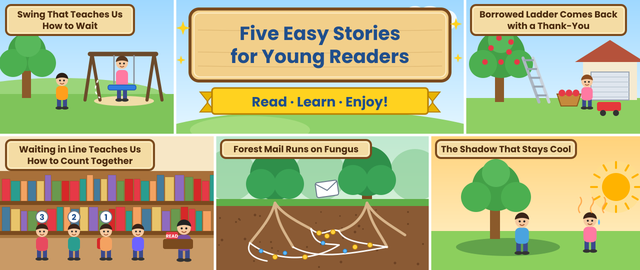
AIで生成したやさしい英文5話をまとめて掲載しています。
英文の難易度
CEFR:Pre-A1
英検:5級
語数:5話合計約1,341語
制作について
本記事の英文・日本語訳・英語難易度の評価は、AIを活用して作成したものです。
内容の正確性を保証するものではありません。
論理的な矛盾・文脈の破綻などが含まれている可能性や、歴史的事実・科学的な正確性・一般常識などに合致しない事柄が含まれている可能性があります。あくまでも英文を読む練習用の素材として考えて下さい。
「んっ?」と思うところがあっても、無視して読み続ける能力を獲得していただければ幸いです…
なお、難易度の評価は目安であり、CEFRや英検による公式な判定ではありません。
Swing That Teaches Us How to Wait
英語本文:約269語
At the park, there is one blue swing that goes very high. Many kids want it. There is no bell that tells you when to stop. So kids use counting.
Lena sits on the swing. She holds the chains. She kicks her feet. One, two, three. She swings forward and back. Her friend Sam stands near the tree. Sam waits.
They have a rule. Twenty swings, then change. Lena counts out loud so Sam can hear. “Eighteen, nineteen, twenty.” She slows down. She drags her feet on the sand to stop. She gets off.
Now Sam sits on the swing. Lena stands near the tree. Sam counts. Lena waits. Waiting is not doing nothing. While Lena waits, she picks up a leaf. She looks at the clouds. She watches how Sam swings a little differently.
Sometimes a new kid comes and does not know the rule. He tries to push past. Lena says, “We count to twenty, then change. You can be next after Sam.” The new kid nods. He stands behind Lena. He learns the line is not a crowd, but a row.
When it is Lena’s turn again, she swings higher than before. She learned from watching Sam how to kick later.
The blue swing does not move by itself. Kids make it move. And the waiting makes the swinging better. If you swing all day with no wait, you get bored. If you wait and watch and count, your turn feels bright.
At home, Mom asks, “Did you swing a lot?” Lena says, “We took turns. Twenty swings, then change. Waiting was part of the fun.”
日本語対訳
待つことを教えてくれるブランコ
公園には、とても高く上がる一つの青いブランコがあります。たくさんの子がそれに乗りたがります。いつ止まるかを教えてくれるベルはありません。だから子どもたちは数を数えます。
レナがブランコに座ります。鎖を握ります。足を蹴り出します。一、二、三。前後に揺れます。友だちのサムが木の近くに立っています。サムは待ちます。
ルールがあります。二十回揺れたら交代です。レナはサムに聞こえるように声に出して数えます。「十八、十九、二十」ゆっくりになります。砂の上で足を引きずって止めます。降ります。
今度はサムがブランコに座ります。レナは木の近くに立ちます。サムが数えます。レナは待ちます。待つことは何もしないことではありません。レナは待っている間に葉を拾います。雲を見ます。サムが少し違う揺れ方をする様子を見ます。
時々新しい子が来てルールを知りません。押しのけて通り過ぎようとします。レナは言います。「二十回数えたら交代だよ。サムの次はあなたの番だよ」新しい子はうなずきます。レナの後ろに立ちます。列は群れではなく一列だということを学びます。
再びレナの番が来ると、前よりも高く揺れます。サムを見ていて、蹴るタイミングを学んだからです。
青いブランコは勝手には動きません。子どもたちが動かします。そして待つことが揺れることをより良くします。一日中待ちなしで揺れれば退屈になります。待って、見て、数えれば、自分の番が輝いて感じられます。
家でママが聞きます。「たくさんブランコこいだ?」レナは言います。「交代でやったの。二十回揺れたら交代。待つのも楽しみの一部だったよ」
Borrowed Ladder Comes Back with a Thank-You
英語本文:約262語
On Maple Street, people do not own every tool. They borrow.
Maya needs a ladder to get apples. Her tree is tall. Her arms are short. She does not have a ladder. She goes to Mr. Kim next door.
Mr. Kim has a silver ladder. It stands against his garage. Maya asks, “Can I borrow your ladder? I will bring it back today.”
Mr. Kim smiles. “Yes. Carry it with two hands. Put it flat on the ground when you move it.”
Maya carries the ladder with two hands. It is light but long. She puts it flat, then lifts it again near her tree. She leans it against the trunk. She climbs up three steps. She picks apples. She puts the apples in her basket.
Then she carries the ladder back. She puts it against Mr. Kim’s garage, just where it was. She says, “Thank you. I brought it back clean.”
Next week, Mr. Kim needs a basket for his plums. He does not have a basket. He comes to Maya. Maya gives him her basket. He brings it back with two plums inside as a thank you.
Borrowing is not just taking. It has four steps. Ask, carry with care, use, and bring it back to where it was. If you follow the steps, people trust you.
On Maple Street, the ladder, the basket, and the small red wagon all move from house to house. They never get lost. They go out empty and come back with a thank you, a plum, or a small note that says, “I brought it back.”
日本語対訳
借りたはしごはありがとうと一緒に帰ってくる
メープル通りでは、人々はすべての道具を持っているわけではありません。借ります。
マヤはリンゴを取るためにはしごが必要です。木は高いです。腕は短いです。はしごを持っていません。隣のキムさんのところへ行きます。
キムさんは銀色のはしごを持っています。ガレージに立てかけてあります。マヤは尋ねます。「はしごを借りてもいいですか。今日返します」
キムさんは微笑みます。「どうぞ。両手で運んでね。動かすときは地面に平らに置いてね」
マヤは両手ではしごを運びます。軽いですが長いです。平らに置いてから、木の近くで再び持ち上げます。幹に立てかけます。三段登ります。リンゴを摘みます。リンゴをかごに入れます。
それから、はしごを運んで戻します。キムさんのガレージに、あった場所に立てかけます。「ありがとう。きれいにして返しました」と言います。
翌週、キムさんはプラムのためにかごが必要です。かごを持っていません。マヤのところへ来ます。マヤはかごを渡します。彼はお礼として中に二つのプラムを入れて返します。
借りることは、ただ取ることではありません。四つのステップがあります。尋ねる、丁寧に運ぶ、使う、そしてあった場所に戻す。その手順に従えば、人々はあなたを信頼します。
メープル通りでは、はしご、かご、そして小さな赤いワゴンが家から家へ移動します。決してなくなりません。空で出かけて、ありがとう、プラム、あるいは「返しました」と書かれた小さなメモと共に戻ってきます。
Waiting in Line Teaches Us How to Count Together
英語本文:約256語
There is a line at the library every Saturday. Kids stand in line to get a stamp for reading.
The line is long. It moves slow. Some kids want to push ahead. But the librarian says, “A line is fair. First here, first stamped.”
Standing in line looks like doing nothing. But it is learning.
First, you learn to count. You count how many kids are ahead. “One, two, three.” Then you count how many are behind. “One, two.” You learn that numbers tell you where you are.
Second, you learn to wait. Waiting is not easy. Your feet want to move. Your hands want to touch the wall. You learn to stand still and breathe. You look at the books on the shelf while you wait. The waiting time becomes reading time in your head.
Third, you learn to see other people. The kid ahead has a red backpack. He has been waiting longer than you. The kid behind has a small sister. She is tired. When you see them, you do not want to push. You want to keep the line straight and fair.
When it is your turn, the librarian smiles and stamps your paper. The stamp says READ. You step out of the line and sit down with a book.
The line is still there behind you. New kids join the end. They start counting too.
A line is not just a line. It is a short lesson in numbers, patience, and fairness that you learn with your feet on the floor.
日本語対訳
列に並ぶことで一緒に数えることを学ぶ
毎週土曜日、図書館には列ができます。子どもたちは読書のスタンプをもらうために列に並びます。
列は長いです。ゆっくり進みます。前に割り込みたい子もいます。しかし図書館員が言います。「列は公平です。先に来た人が先にスタンプをもらえます」
列に並ぶことは何もしていないように見えます。しかしそれは学びです。
一つ目、数えることを学びます。前に何人の子がいるか数えます。「一、二、三」それから後ろに何人いるか数えます。「一、二」数字が自分のいる場所を教えてくれることを学びます。
二つ目、待つことを学びます。待つのは簡単ではありません。足は動きたがります。手は壁を触りたがります。じっと立って呼吸することを学びます。待っている間、本棚の本を見ます。待ち時間が頭の中の読書時間になります。
三つ目、他の人を見ることを学びます。前の子は赤いリュックを背負っています。彼はあなたより長く待っています。後ろの子は小さな妹を連れています。妹は疲れています。彼らを見ると、割り込もうとは思わなくなります。列をまっすぐに公平に保ちたいと思います。
順番が来ると、図書館員が微笑んで紙にスタンプを押します。スタンプにはREADと書かれています。あなたは列から出て、本を持って座ります。
列はまだあなたの後ろにあります。新しい子たちが最後尾に加わります。彼らも数え始めます。
列は単なる列ではありません。床に足をつけて学ぶ、数と忍耐と公平さについての短い授業なのです。
Forest Mail Runs on Fungus
英語本文:約278語
Deep under your feet in a forest, there is a kind of mail system. You cannot see it with your eyes. It is made of fungus.
Fungus is not a plant. It is like a web of tiny white threads. These threads are called hyphae. They grow in the soil and wrap around the roots of trees.
Tree roots make sugar from sun and air. That sugar is food. The tree gives some of its sugar to the fungus. In return, the fungus brings water and small bits from the soil that the tree cannot get alone, like phosphorus. It is a trade.
The threads do more. One fungus can link two trees. Then sugar and bits can move from one tree to another. If a big tree has a lot of sun, it can send extra food to a small tree in the shade. Scientists have watched this happen. They call it the wood wide web.
Does the big tree mean to be kind? Not like people. The fungus moves things where they help the fungus grow. But the result looks kind. Young trees near a big old tree often grow better.
When a tree is sick or dying, it may send out some of its stored food through the threads. Other trees can use it. Nothing is wasted.
You can think of the forest not as many single trees, but as a group that shares. The fungus is the road. The sugar is the mail.
Next time you step on soft forest ground, remember. Under your shoes, thin white roads are busy. They carry water one way and sugar the other. They keep the forest fed.
日本語対訳
菌類で動く森の郵便
森の中、あなたの足のずっと下に、ある種の郵便システムがあります。目では見えません。それは菌類でできています。
菌類は植物ではありません。小さな白い糸のウェブのようなものです。これらの糸は菌糸と呼ばれます。土の中で育ち、木の根に巻き付きます。
木の根は太陽と空気から糖を作ります。その糖が食べ物です。木はその糖の一部を菌類に与えます。そのお返しに、菌類は木が単独では手に入れられない水や土の中の小さなかけら、例えばリンを運んできます。それは取引です。
糸はもっと多くのことをします。一つの菌類が二本の木をつなぐことがあります。そうすると糖やかけらが一本の木からもう一本へ移動できます。もし大きな木がたくさん日を浴びていれば、陰にある小さな木に余分な食べ物を送ることができます。科学者たちはこれが起こるのを見てきました。彼らはそれをウッド・ワイド・ウェブと呼びます。
大きな木は親切にするつもりなのでしょうか?人のようではありません。菌類は自分が育つのを助ける場所へ物を動かします。でも結果は親切に見えます。大きな古い木の近くの若い木は、しばしばよく育ちます。
木が病気になったり枯れかけたりすると、蓄えていた食べ物の一部を糸を通して送り出すことがあります。他の木がそれを使えます。何も無駄になりません。
森をたくさんの単独の木としてではなく、分け合う一つの集まりとして考えることができます。菌類が道路です。糖が郵便物です。
次に柔らかな森の地面を踏むとき、思い出してください。あなたの靴の下で、細い白い道路が忙しく働いています。一方に水を、もう一方に糖を運んでいます。それらが森を養っているのです。
The Shadow That Stays Cool
英語本文:約276語
On a hot day, you feel hot in the sun. Then you step under a tree. Ah! Cool.
That cool place is a shadow.
What is a shadow? It is not a thing. It is a place where light does not go.
Sunlight comes down. It hits you. It makes you warm. It hits the ground. It makes the ground warm.
When you stand in the way, you block the light. Light cannot go through you. So behind you, there is a dark shape on the ground. That shape is your shadow.
Under a tree, it is the same. Leaves block the sun. Light cannot get through all the leaves. So under the tree, it is dark and cool.
Why is a shadow cool?
Sunlight brings heat. When light hits something, it gives it heat. Your shirt gets warm. Your skin gets warm. The ground gets warm.
In shadow, less light hits you. Less heat comes. So you feel cool.
At noon, the sun is high. Your shadow is short. It hides under your feet.
In the morning, the sun is low. Your shadow is long. It goes far across the grass.
In the evening, it is long again, but on the other side.
You can play with shadows. Make a bird with your hands. The shadow bird flies on the wall.
But you cannot pick up a shadow. You cannot put it in a box.
Shadow is just less light. And less light means cool. That is why everyone wants to sit under a tree on a hot day.
So next time you feel too hot, look for a shadow. Step in. Ah! Cool.
日本語対訳
涼しいままの影
暑い日に、日なたでは暑く感じます。それから木の下へ一歩入ります。ああ!涼しい。
その涼しい場所は影です。
影とは何でしょう?それは物ではありません。光が行かない場所です。
太陽の光が降り注ぎます。あなたに当たります。あなたを温かくします。地面に当たります。地面を温かくします。
あなたが光の通り道に立つと、光をさえぎります。光はあなたを通り抜けられません。だからあなたの後ろには地面に暗い形ができます。その形があなたの影です。
木の下でも同じです。葉が太陽をさえぎります。光はすべての葉を通り抜けることができません。だから木の下は暗くて涼しいのです。
なぜ影は涼しいのでしょう?
太陽の光は熱を運んできます。光が何かに当たると、熱を与えます。シャツが温まります。肌が温まります。地面が温まります。
影の中では、あなたに当たる光が少なくなります。届く熱が少なくなります。だから涼しく感じます。
正午には太陽は高い所にあります。あなたの影は短いです。足元に隠れます。
朝には太陽は低い所にあります。あなたの影は長いです。草の上を遠くまで伸びます。
夕方にはまた長くなりますが、反対側に伸びます。
影で遊ぶこともできます。手で鳥を作ります。影の鳥が壁の上を飛びます。
でも影を拾い上げることはできません。箱に入れることもできません。
影はただ光が少ないだけです。そして光が少ないということは涼しいということです。だから暑い日にはみんな木の下に座りたくなるのです。
だから次に暑すぎると感じたら、影を探してください。中へ一歩。ああ!涼しい。