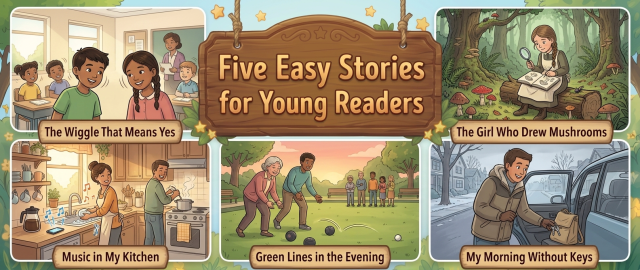
AIで生成した少しやさしい英文5話をまとめて掲載しています。
英文の難易度
CEFR:A1
英検:4級
語数:5話合計約1,451語
制作について
本記事の英文・日本語訳・英語難易度の評価は、AIを活用して作成したものです。
内容の正確性を保証するものではありません。
論理的な矛盾・文脈の破綻などが含まれている可能性や、歴史的事実・科学的な正確性・一般常識などに合致しない事柄が含まれている可能性があります。あくまでも英文を読む練習用の素材として考えて下さい。
「んっ?」と思うところがあっても、無視して読み続ける能力を獲得していただければ幸いです…
なお、難易度の評価は目安であり、CEFRや英検による公式な判定ではありません。
The Wiggle That Means Yes
英語本文:約272語
There was a new kid in class. His name was Arjun.
He did something different with his head. When the teacher asked, do you understand, he moved his head side to side. Like a wiggle.
Some kids thought that meant no. But Arjun said, yes, I understand. Then he smiled.
A girl named Maya was puzzled. She asked, why do you move your head side to side for yes?
Arjun said, in my house, we do this. It means yes, okay, I hear you.
Maya said, in my house, side to side means no.
Arjun said, both can be true. Same move, different place, different meaning.
He showed her more. He put his hand to his chest. That means thank you in his home.
Maya put her hand up. That means hi in her home.
They laughed. Two ways to say hi.
Next day, Maya tried the wiggle. When Arjun said, want to play blocks? Maya wiggled her head side to side. Arjun laughed. Yes! That is yes!
Other kids saw. They tried too. Soon half the class wiggled for yes.
The teacher saw. The teacher said, what is this wiggle?
Maya said, Arjun’s yes.
The teacher said, can yes wiggle? Why not?
The teacher wiggled too. Then the whole class wiggled yes.
No one was confused now. They knew. In this room, up and down means yes. Side to side wiggle also means yes.
Two yeses. Both okay. Both kind.
Arjun felt at home. Maya felt she learned a new yes. A wiggle yes she can keep.
Same heads. New way to talk. More ways to say yes in one room.
日本語対訳
はいを意味する揺れ
クラスに新しい子がいた。名前はアルジュンといった。
彼は頭で違うことをした。先生が、分かる?と聞くと、彼は頭を横に動かした。くねくねするように。
何人かの子はそれがいいえを意味すると思った。でもアルジュンは言った。はい、分かります、と。それから微笑んだ。
マヤという女の子は困惑した。聞いた。なぜはいのために頭を横に動かすの?と。
アルジュンは言った。うちではこうするんだ。はい、大丈夫、聞こえてるよ、という意味だよ。
マヤは言った。うちでは横に動かすのはいいえという意味よ。
アルジュンは言った。どちらも本当だよ。同じ動きでも場所が違えば意味が違うんだ。
もっと見せてくれた。胸に手を当てた。それは彼の家ではありがとうという意味だ。
マヤは手を上げた。それは彼女の家ではやあという意味だ。
彼らは笑った。やあを言う二つの方法だ。
次の日、マヤは揺れを試してみた。アルジュンが、積み木で遊ぶ?と言ったとき、マヤは頭を横にくねくねさせた。アルジュンは笑った。そう!それがはいだ!
他の子たちも見た。彼らも試した。すぐにクラスの半分がはいのためにくねくねさせた。
先生が見た。先生が言った。このくねくねは何?
マヤが言った。アルジュンのはいだよ。
先生が言った。はいはくねくねしてもいいの?どうしていけないの?
先生もくねくねさせた。それからクラス全員がはいでくねくねさせた。
もう誰も混乱しなかった。彼らは知っていた。この部屋では上下ははいを意味する。横のくねくねもはいを意味する。
二つのはい。どちらも大丈夫。どちらも優しい。
アルジュンは家にいるように感じた。マヤは新しいはいを学んだと感じた。取っておけるくねくねのはいを。
同じ頭。新しい話し方。一つの部屋ではいを言う方法がもっと増えた。
The Girl Who Drew Mushrooms
英語本文:約266語
There was a girl who loved mushrooms.
Not to eat. To draw.
Her name was Beatrix. She lived a long time ago. More than one hundred years ago.
She lived in a big house. In the city. But she loved small things. Bugs. Leaves. Bones. And mushrooms.
She had a little brother. They found mushrooms in the woods. Big ones. Small ones. Red ones. Brown ones.
Beatrix looked close. She saw how they grow. She saw the dots under the top. Those dots make more mushrooms.
She drew them. Her drawings were very good. So good you could see the dots. So good you could count them.
At that time, most men drew mushrooms. Not many girls. But Beatrix drew and drew.
She wanted to know more. She looked with a glass that makes small things big. She saw seeds. Tiny seeds you need a glass to see.
She wrote about it. She sent her work to smart men who study plants. They said, this is good. This girl knows a lot.
But they did not let her talk at their big meeting. Because she was a girl.
So she drew more. And she wrote stories. Stories about a bunny. That bunny was Peter Rabbit.
Later, people loved her bunny stories. They still love them.
But long before the bunny, she loved mushrooms. She drew them when no one else looked close.
Now we know her for bunnies. But she was also a girl who loved mushrooms. And she drew them so well that we can still learn from them today.
Look close. Like Beatrix did.
日本語対訳
きのこを描いた女の子
きのこが大好きな女の子がいた。
食べるためではない。描くためだ。
名前はビアトリクスといった。ずっと昔に生きていた。百年以上前のことだ。
大きな家に住んでいた。街の中に。でも小さなものが大好きだった。虫。葉っぱ。骨。そしてきのこ。
弟が一人いた。二人で森できのこを見つけた。大きなもの。小さなもの。赤いもの。茶色のもの。
ビアトリクスは近くでよく見た。どうやって育つかを見た。傘の下の点々を見た。その点々がもっときのこを作るのだ。
彼女はそれを描いた。絵はとても上手だった。点々が見えるほど上手だった。数えられるほど上手だった。
当時、きのこを描くのはほとんどが男性だった。女の子はあまりいなかった。でもビアトリクスは描いて描いて描き続けた。
もっと知りたくなった。小さなものを大きく見せるガラスで見た。種を見た。ガラスがないと見えないほど小さな種だ。
それについて書いた。植物を研究する賢い男性たちに作品を送った。彼らは言った。これは良い。この子はよく知っている、と。
でも彼らは大きな会議で彼女に話させなかった。女の子だったからだ。
だから彼女はもっと描いた。そして物語を書いた。うさぎの物語だ。そのうさぎがピーターラビットだった。
後になって、人々は彼女のうさぎの物語を大好きになった。今でも大好きだ。
でもうさぎよりもずっと前から、彼女はきのこが大好きだった。誰も近くで見ないときに、彼女はきのこを描いたのだ。
今私たちはうさぎで彼女を知っている。でも彼女はきのこが大好きな女の子でもあった。そしてとても上手に描いたので、今でも私たちはそこから学べるのだ。
近くで見てみよう。ビアトリクスがしたように。
Music in My Kitchen
英語本文:約301語
I love music. I listen to music every day. I listen in my kitchen.
In the morning, I make coffee. I listen to soft music. The music is slow and quiet. It helps me start the day. I feel calm. I sit at the table and drink coffee. The music is like a soft light.
At lunch, I make food. I listen to happy music. The music is fast. I move my body. I sing a little. Cooking is more fun with happy music. My husband hears the music and comes to the kitchen. He dances a little. We laugh.
At night, I wash dishes. I listen to old songs. Songs from when I was young. I know the words. I sing with the music. I think of old times. I think of my family and friends. I think of my mother. She also loved old songs.
Some people think music is only for shows or parties. But music is also for normal life. Music can make small work fun. Music can make you feel better when you are tired. It can make a boring job a happy job.
My friend does not listen to music at home. She says, “The house is quiet. I like quiet.” That is okay. Quiet is also good. We are different.
But for me, music is like a friend in the house. It is always there. It does not talk, but it helps me. It makes me feel not alone.
You do not need big speakers. You can listen on your phone. You can listen for 5 minutes or 50 minutes. You can choose what you like. You can choose soft music, fast music, or old songs.
In my kitchen, music makes every day a little better. A little music can make a big change.
日本語対訳
私の台所の音楽
私は音楽が大好きです。毎日音楽を聴きます。台所で聴きます。
朝、コーヒーを淹れます。柔らかい音楽を聴きます。音楽はゆっくりで静かです。一日を始める助けになります。穏やかな気持ちになります。テーブルに座ってコーヒーを飲みます。音楽は柔らかい光のようです。
昼は食事を作ります。楽しい音楽を聴きます。音楽は速いです。体を動かします。少し歌います。楽しい音楽があると料理はもっと楽しくなります。夫が音楽を聞いて台所に来ます。少し踊ります。私たちは笑います。
夜は皿洗いをします。古い歌を聴きます。若かった頃の歌です。歌詞を知っています。音楽と一緒に歌います。昔のことを思います。家族や友だちのことを思います。母のことも思います。母も古い歌が大好きでした。
音楽はショーやパーティーのためだけだと思う人もいます。しかし音楽は普通の生活のためでもあります。音楽は小さな仕事を楽しくすることができます。疲れているとき気分を良くすることができます。退屈な仕事を楽しい仕事に変えることができます。
私の友人は家で音楽を聴きません。「家は静かです。静かが好き」と言います。それで大丈夫です。静けさもまた良いものです。私たちは違います。
でも私にとって音楽は家の中の友だちのようなものです。いつもそこにあります。話はしませんが、助けてくれます。一人ではないと感じさせてくれます。
大きなスピーカーは必要ありません。携帯電話で聴くことができます。5分でも50分でも聴くことができます。好きなものを選べます。柔らかい音楽、速い音楽、古い歌を選べます。
私の台所では音楽が毎日を少し良くしてくれます。少しの音楽が大きな変化をもたらすことがあります。
Green Lines in the Evening
英語本文:約367語
On a warm evening, Daniel walked past the small park near his home. He heard a soft sound on the grass. A few people stood in a line, rolling round balls toward a little white ball.
Daniel stopped to watch. He had played baseball when he was young, but he had never seen this game. An older woman saw him and smiled.
“Would you like to try?” she asked.
She told him the game was called lawn bowls. Each player rolled a large ball across the grass and tried to stop it near the small white ball. The large balls were not quite round in the usual way, so they curved as they moved. It looked easy, but Daniel soon learned that it was not.
His first ball went too far. The next one stopped behind a bench. The players laughed, but not at him. They laughed because they had all made the same mistakes when they began.
The woman, whose name was Ruth, showed him how to stand and swing his arm. “Don’t try to be strong,” she said. “Think about where you want the ball to go.”
Daniel tried again. This time, his ball rolled slowly and stopped close to the white one. Ruth nodded. It was only one good shot, but he felt proud.
He came back the next week, and then the week after that. Some evenings, he played well. On other evenings, every ball seemed to go the wrong way. Still, the group always made room for him. They talked about work, family, and the weather while they waited for their turns.
After a month, Daniel brought his own set of bowls. He was not the best player, and he did not need to be. The game gave him a reason to leave his house, move his body, and meet people he might never have known.
One evening, Ruth missed an easy shot and shook her head. Daniel smiled. “It happens to everyone,” he said.
She laughed. The sun went down, and the small white ball shone in the last light. Daniel knew he would return. He had come to learn a game, but he had found a place among friends.
日本語対訳
夕暮れの芝生に引かれた線
暖かい夕方、ダニエルは家の近くにある小さな公園のそばを歩いていた。芝生の上から、かすかな音が聞こえた。数人が一列に並び、大きな丸い球を小さな白い球に向かって転がしていた。
ダニエルは立ち止まって見た。若いころに野球をしていたが、この競技は見たことがなかった。年配の女性が彼に気づき、ほほ笑んだ。
「やってみませんか」と彼女は尋ねた。
彼女は、その競技がローンボウルズという名前だと教えてくれた。各選手は芝生の上で大きな球を転がし、小さな白い球の近くで止めようとする。大きな球は普通の球のように完全な丸形ではないため、転がるにつれて曲がっていく。簡単そうに見えたが、ダニエルはすぐに、そうではないと分かった。
最初の球は遠くまで転がりすぎた。次の球はベンチの後ろで止まった。ほかの選手たちは笑ったが、彼を笑ったのではなかった。自分たちも始めたころに同じ失敗をしていたので、笑ったのだ。
ルースという名前のその女性は、立ち方や腕の振り方を教えてくれた。「力を入れようとしないで」と彼女は言った。「球をどこに転がしたいのかを考えてみて」
ダニエルはもう一度挑戦した。今度は球がゆっくり転がり、白い球の近くで止まった。ルースはうなずいた。たった一度うまく投げられただけだったが、彼は誇らしい気持ちになった。
彼は翌週も戻ってきた。その次の週も来た。うまくプレーできる夕方もあった。一方で、どの球も思いどおりに転がらない夕方もあった。それでも、仲間たちはいつも彼のために場所を空けてくれた。順番を待つ間、彼らは仕事や家族、天気について話した。
1か月後、ダニエルは自分用のボウルを持ってきた。彼は一番うまい選手ではなかったし、一番になる必要もなかった。この競技のおかげで、家を出て体を動かし、これまで知り合うことがなかったかもしれない人々と出会えるようになった。
ある夕方、ルースは簡単なショットを失敗し、首を横に振った。ダニエルはほほ笑んだ。「誰にでもあることですよ」と彼は言った。
彼女は笑った。太陽が沈み、小さな白い球が最後の光の中で輝いていた。ダニエルには、またここへ戻ってくることが分かっていた。彼は競技を覚えるために来たのだが、友人たちの中に自分の居場所を見つけていた。
My Morning Without Keys
英語本文:約245語
Yesterday morning was very busy. I got up at six thirty. I had coffee and made some toast. Then I tried to go to work, but I could not find my keys. I looked for them everywhere in my house.
First, I looked on the table in the living room. My keys were not there. Then I looked under the sofa and in my bag. I also checked the small box next to the door. I always put my keys there, but this time they were not there.
I called my wife. She was at work. She said, “Did you put them in your coat? Or did you leave them in the car?” I checked my coat, but it was empty. Then I thought about last night. I went out to buy bread and milk at the big store near my house. I came home late and I was very tired.
I ran out to my car. It was cold outside. I opened the door and looked in the car. There they were! My keys were on the back seat under a bag. I picked them up quickly and came back into the house. I was so happy.
In the evening, my wife came home. I told her about my morning. She laughed and said, “You always do this!” We laughed together. Now I have a new rule. I always put my keys in the box next to the door before I go to bed.
日本語対訳
鍵のない朝
昨日の朝はとても忙しかった。六時半に起きた。コーヒーを飲み、トーストを作った。それから仕事に行こうとしたが、鍵が見つからなかった。家の中をあちこち探した。
まず、リビングのテーブルの上を見た。鍵はそこにはなかった。次に、ソファの下やかばんの中を見た。ドアの横にある小さな箱も確認した。いつもそこに鍵を置くのだが、今回はそこにはなかった。
妻に電話をした。彼女は職場にいた。彼女は「コートの中に入れたんじゃない?それとも車の中に置いてきたんじゃない?」と言った。コートを確認したが、空だった。それから昨夜のことを思い出した。家の近くの大きな店にパンと牛乳を買いに出かけたのだ。帰りが遅くなり、とても疲れていた。
私は車まで走って行った。外は寒かった。ドアを開けて車の中を見た。あった!鍵は後部座席の袋の下にあった。すぐに拾い上げて、家の中に戻ってきた。とてもうれしかった。
夕方、妻が帰ってきた。朝のことを話した。彼女は笑って「あなたはいつもそうなのよ!」と言った。私たちは一緒に笑った。今では新しい決まりがある。寝る前に必ずドアの横の箱に鍵を入れるのだ。