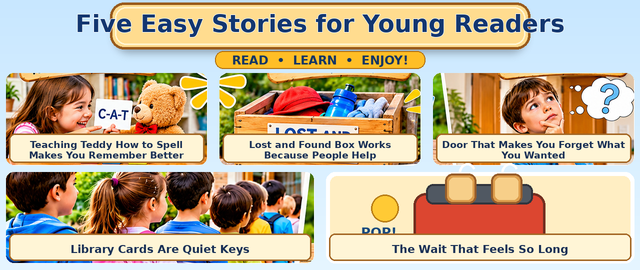
AIで生成したやさしい英文5話をまとめて掲載しています。
英文の難易度
CEFR:Pre-A1
英検:5級
語数:5話合計約1,460語
制作について
本記事の英文・日本語訳・英語難易度の評価は、AIを活用して作成したものです。
内容の正確性を保証するものではありません。
論理的な矛盾・文脈の破綻などが含まれている可能性や、歴史的事実・科学的な正確性・一般常識などに合致しない事柄が含まれている可能性があります。あくまでも英文を読む練習用の素材として考えて下さい。
「んっ?」と思うところがあっても、無視して読み続ける能力を獲得していただければ幸いです…
なお、難易度の評価は目安であり、CEFRや英検による公式な判定ではありません。
Teaching Teddy How to Spell Makes You Remember Better
英語本文:約282語
Lena knows how to spell cat. She learned it at school. At home, she has a teddy bear. The bear sits on her desk. The bear does not know how to spell cat.
Mom says, “Teach Teddy how to spell cat.”
Lena looks at the bear. She says, “Teddy, cat is spelled C, A, T.” She writes C on paper. She shows it to Teddy. She says, “See, this is C. It makes the kuh sound.”
She writes A. She says, “This is A. It says ah.” She writes T. “This is T. It says tuh.”
Then she puts the three letters together. C-A-T. She reads them slow, then fast. Cat.
Teaching is different from just knowing. When you know, you can say it once. When you teach, you must say it step by step. You must show where to start. You must say why.
Lena finds a part she did not know well. She knew C makes kuh, but she did not know why A in cat says ah, not ay. She asks Mom. Mom says, “A can say different sounds. In cat, it says ah.”
Now Lena can tell Teddy, “A here says ah because cat is a short word.”
She teaches Teddy again, from the start. C, A, T. She does not look at her school paper this time. She remembers.
At night, Mom asks, “Did Teddy learn?” Lena says, “Teddy did. And I did, too. When I taught Teddy, I found the part I missed. And now I remember better.”
Teaching a toy does not help the toy. The toy is cloth. Teaching helps the teacher. When you explain slow and show each step, your brain keeps the steps.
日本語対訳
テディに綴りを教えるとよりよく覚えられる
レナはcatの綴りを知っています。学校で習いました。家にはテディベアがあります。クマは机の上に座っています。クマはcatの綴りを知りません。
ママが言います。「テディにcatの綴りを教えてあげて」
レナはクマを見ます。「テディ、catはC、A、Tよ」と言います。紙にCと書きます。テディに見せます。「ほら、これはCよ。クッという音がするの」
Aと書きます。「これはAよ。アって言うの」Tと書きます。「これはTよ。トゥッて言うの」
それから三つの文字を一緒にします。C-A-T。ゆっくり、それから速く読みます。Cat。
教えることは単に知っていることとは違います。知っているときは一度言えばよいです。教えるときは段階を追って言わなければなりません。どこから始めるかを示さなければなりません。なぜかも言わなければなりません。
レナはよく知らなかった部分に気づきます。Cがクッという音になることは知っていましたが、なぜcatの中のAがエイではなくアと言うのかは知りませんでした。ママに尋ねます。ママが言います。「Aは違う音を出すことがあるの。catの中ではアって言うのよ」
今度はレナはテディにこう言えます。「ここでのAはアって言うの。catは短い単語だからよ」
最初から再びテディに教えます。C、A、T。今度は学校のプリントを見ません。覚えています。
夜、ママが尋ねます。「テディは覚えた?」レナは言います。「覚えたよ。私も覚えた。テディに教えたときに自分が抜けていた部分を見つけたの。そして今はもっとよく覚えているよ」
おもちゃに教えることはおもちゃの役には立ちません。おもちゃは布です。教えることは教える人の役に立つのです。ゆっくり説明し各段階を示すとき、脳はその段階を保持するのです。
Lost and Found Box Works Because People Help
英語本文:約290語
At the community center, there is a big wooden box near the door. It has a sign that says LOST AND FOUND. The box is not locked. Anyone can open it.
When a kid loses a red hat on the playground, the hat does not stay lost for long. Another kid finds it on the bench. She picks it up. She does not put it in her bag. She walks to the wooden box. She drops the hat inside.
Later, the first kid comes back. He looks sad. He says, “I lost my hat.” The woman at the desk says, “Look in the box.” He opens the box. He sees his red hat on top. He takes it out. He smiles.
The box works because of two small rules that everyone follows. Rule one: if you find something that is not yours, put it in the box. Rule two: if you lose something, look in the box first.
No one has to watch the box all day. No money is needed. The box does not know who owns what. People do.
Sometimes the box is full. There are gloves, water bottles, small toys, and one blue shoe. Sometimes it is empty. Empty is good, too. It means everyone has what they need.
Once, a man lost his keys. He looked in the box. The keys were not there. He wrote a note that said, “Lost keys with a green tag.” He taped the note to the box. The next day, a girl found the keys near the swings. She saw the note. She put the keys in the box.
The box is just wood. But with two rules and kind people, it becomes a system that brings lost things home.
日本語対訳
落とし物箱は人々が助けるから機能する
コミュニティセンターには、ドアの近くに大きな木の箱があります。LOST AND FOUNDと書かれた看板があります。箱には鍵がかかっていません。誰でも開けられます。
子どもが遊び場で赤い帽子をなくしても、帽子は長くなくしたままではありません。別の子がベンチの上でそれを見つけます。拾い上げます。自分のカバンには入れません。木の箱まで歩きます。帽子を中に入れます。
後で、最初の子が戻ってきます。悲しそうな顔をしています。「帽子をなくしました」と言います。受付の女性が言います。「箱の中を見てごらん」彼は箱を開けます。一番上に赤い帽子が見えます。取り出します。微笑みます。
箱が機能するのは、みんなが守る二つの小さなルールがあるからです。ルール一、自分のものではない何かを見つけたら箱に入れる。ルール二、何かをなくしたらまず箱の中を探す。
誰かが一日中箱を見張る必要はありません。お金も必要ありません。箱は誰が何を持っているかを知りません。人々が知っています。
時々箱はいっぱいです。手袋、水筒、小さなおもちゃ、そして片方の青い靴があります。時々空っぽです。空っぽもまた良いことです。みんなが必要な物を持っているという意味だからです。
ある時、男性が鍵をなくしました。箱の中を探しました。鍵はそこにありませんでした。「緑のタグのついた鍵をなくしました」と書かれたメモを書きました。メモを箱にテープで貼りました。翌日、女の子がブランコの近くで鍵を見つけました。メモを見ました。鍵を箱に入れました。
箱はただの木です。しかし二つのルールと親切な人々と共に、なくした物を家に持ち帰らせる仕組みになるのです。
Door That Makes You Forget What You Wanted
英語本文:約260語
Ben sits on the rug in the living room. He has a cup of yogurt. He wants a spoon.
He gets up and walks to the kitchen. The kitchen has spoons in the top drawer. He walks through the door between the two rooms.
In the kitchen, he stops. He looks around. He cannot remember why he came. Did he want water? Did he want a napkin? He rubs his head.
He walks back to the living room. As soon as he steps onto the rug, he remembers. “Oh! A spoon for my yogurt!”
He walks to the kitchen again. He holds the word “spoon” in his head like a small ball. He says it out loud. “Spoon, spoon, spoon.” He walks through the door and goes straight to the top drawer. He opens the drawer. He takes out a spoon.
He carries the spoon back to the living room. He sits down. He eats his yogurt.
Later, Mom says, “This happens to everyone. When you go through a door, your brain makes a little cut, like turning a page. It thinks the new room is a new story. So it puts the old story away.”
Ben laughs. “My brain put the spoon away?”
Mom nods. “So next time, hold the word or write it on your hand.”
The next day, Ben wants an apple from the kitchen. He writes APPLE on his hand. He walks through the door. He looks at his hand. He still knows. He opens the fridge and takes out an apple. No forgetting this time.
日本語対訳
欲しかったものを忘れさせるドア
ベンは居間の絨毯に座っています。ヨーグルトのカップを持っています。スプーンが欲しいです。
立ち上がって台所へ歩きます。台所ではスプーンが一番上の引き出しに入っています。二つの部屋の間のドアを通り抜けて歩きます。
台所で彼は止まります。周りを見回します。なぜ来たのか思い出せません。水が欲しかったのか?ナプキンが欲しかったのか?頭をかきます。
居間に戻ります。絨毯に足を踏み出すやいなや思い出します。「あ!ヨーグルトのスプーンだ!」
再び台所へ歩きます。「スプーン」という言葉を頭の中に小さなボールのように持ちます。声に出して言います。「スプーン、スプーン、スプーン」ドアを通り抜けてまっすぐ一番上の引き出しへ行きます。引き出しを開けます。スプーンを取り出します。
スプーンを持って居間に戻ります。座ります。ヨーグルトを食べます。
後でママが言います。「誰にでもあることよ。ドアを通ると、脳がページをめくるように小さな切れ目を作るの。新しい部屋は新しい物語だと思うの。だから古い物語をしまってしまうのよ」
ベンは笑います。「脳がスプーンをしまっちゃったの?」
ママはうなずきます。「だから次は言葉をしっかり持つか、手に書くのよ」
翌日、ベンは台所からリンゴが欲しくなります。手にAPPLEと書きます。ドアを通り抜けて歩きます。手を見ます。まだ覚えています。冷蔵庫を開けてリンゴを取り出します。今度は忘れませんでした。
Library Cards Are Quiet Keys
英語本文:約276語
The library has many books. More than you could read in a whole year. How do you take one home?
You use a library card. It is small, like a playing card. It has your name on it. It is a quiet key.
You go to the front desk. You show your card. Beep. The computer knows it is you. The librarian smiles and says, “You can borrow this.” Borrow means take it home for a while, then bring it back for someone else.
Why not keep it? Because books like to travel. One book can make ten kids smile. If you keep it forever, the next kid cannot read it. So we share.
The card keeps track. It says, “This book is at your house until next Tuesday.” That helps you remember. If you forget, the library sends a little note. “Please bring it back when you can.”
If you lose a book, you tell the librarian. She will not be mad. She will say, “Let’s look for it together.” Libraries are kind places.
You can also use the card for more than books. You can borrow music, movies, even a small tool kit or a puzzle. Some libraries let you borrow a seed packet. You grow a plant, then you bring new seeds back.
One small card opens many doors. It does not need batteries. It does not make noise. It just says, “This person is part of our town, and we trust them.”
Next time you go, put the card in your pocket. Feel how light it is. That light card can carry a whole shelf of stories home, one at a time.
日本語対訳
図書館カードは静かな鍵
図書館にはたくさんの本があります。一年かけても読みきれないほどです。どうやって一冊を家に持ち帰るのでしょう?
図書館カードを使います。トランプのように小さく、あなたの名前が書かれています。それは静かな鍵です。
受付カウンターに行きます。カードを見せます。ピッ。コンピューターがあなただと分かります。司書さんが微笑んで「借りられますよ」と言います。借りるとは、しばらく家に持ち帰って、それから他の誰かのために返すということです。
なぜ取っておかないのでしょう?本は旅をするのが好きだからです。一冊の本で十人の子どもが笑顔になれます。ずっと取っておいたら、次の子は読めません。だから分け合うのです。
カードは記録してくれます。この本は次の火曜日まであなたのお家にありますよ、と教えてくれます。思い出すのに役立ちます。忘れたら、図書館が小さなメモを送ってくれます。「できるときに返してくださいね」。
もし本をなくしたら、司書さんに伝えます。怒ったりしません。「一緒に探しましょう」と言ってくれます。図書館は親切な場所です。
カードは本以外にも使えます。音楽や映画、小さな工具セットやパズルも借りられます。種の小袋を貸し出してくれる図書館もあります。植物を育てて、新しい種を返します。
小さなカード一つでたくさんのドアが開きます。電池は要りません。音もしません。ただ「この人は私たちの町の仲間で、私たちはその人を信頼しています」と言ってくれます。
次に行く時は、カードをポケットに入れてください。どれだけ軽いか感じてみてください。その軽いカードは、一度に一冊ずつ、本棚一列分の物語を家まで運ぶことができるのです。
The Wait That Feels So Long
英語本文:約352語
You want toast. Mom puts bread in the toaster. You stand and wait. The toaster is quiet. You look at it. You think, why is it so slow? You want it now.
Waiting is hard. Your chest feels tight. Your feet want to move. You want to say, “Is it done yet? Is it done yet?” That feeling is normal. Everyone feels it. Even grown-ups feel it when they wait for coffee or for a bus.
Inside your head there is a little alarm. It says, “I want it now! Now! Now!” That alarm is very loud when you are six. It is hard to turn it down. But you can learn how.
Here is a trick you can try. While you wait, breathe in through your nose. Then breathe out through your mouth. Count one, two, three. Now look around the room. What do you see? You see a spoon on the table. You see a blue cup. You see a cat sleeping on the floor. You see light on the wall. When you look and count, your brain starts to calm down. The loud alarm gets quiet.
The toaster is still working. It is making heat. It is turning white bread brown. It needs time. If you pull the toast out too soon, it will not be yummy.
Then you hear it. Pop! The toast jumps up. It is hot and brown and smells so good. You waited. You did it all by yourself. The toast tastes even better because you waited.
Waiting shows you are strong. You did not push the toaster. You did not cry. You just stood and waited. That is a big skill. Grown-ups call it patience. Patience means you can wait even when it feels hard.
Next time you wait in line for the slide at the park, or wait for Mom to tie your shoe, or wait for your turn with the crayons, you can do the same thing. Breathe in. Breathe out. Look around. Count to three. The wait will feel shorter. And when it is over, you will feel proud and calm.
日本語対訳
とても長く感じる待ち時間
トーストが食べたい。ママがパンをトースターに入れます。あなたは立って待ちます。トースターは静かです。じっと見つめます。どうしてこんなに遅いのだろうと思います。今すぐ欲しいのです。
待つのは大変です。胸がきゅっとなります。足がむずむず動きたくなります。「もうできた?もうできた?」と言いたくなります。その気持ちは普通のことです。みんな感じます。大人でさえ、コーヒーやバスを待つときに感じます。
頭の中には小さな警報機があります。「今すぐ欲しい!今!今!」と言います。その警報機は6歳のときはとてもうるさいのです。小さくするのは難しい。でも、やり方を学ぶことができます。
試せるコツがあります。待っている間、鼻から息を吸い込みます。それから口から息を吐き出します。一、二、三と数えます。今度は部屋の中を見回してみましょう。何が見えますか?テーブルの上にスプーンが見えます。青いコップが見えます。床で寝ているネコが見えます。壁の光が見えます。見回して数えると、脳が落ち着き始めます。うるさい警報機が静かになります。
トースターはまだ動いています。熱を作っています。白いパンを茶色にしています。時間が必要なのです。トーストを早く取り出しすぎると、おいしくありません。
それから聞こえます。ポン!トーストが飛び出します。熱くて茶色で、とてもいいにおいがします。あなたは待ちました。自分一人でやり遂げました。待ったから、トーストはもっとおいしく感じます。
待つことは、あなたが強いことを示します。トースターを押したりしませんでした。泣きもしませんでした。ただ立って待ちました。それは大きなスキルです。大人はそれを patience(忍耐、我慢)と呼びます。Patience とは、つらく感じても待つことができるということです。
次に公園のすべり台の列に並んで待つときや、ママが靴ひもを結んでくれるのを待つときや、クレヨンの順番を待つときも、同じことができます。息を吸って。息を吐いて。周りを見回して。三つ数えます。待ち時間は短く感じます。そして終わったとき、誇らしくて落ち着いた気持ちになります。