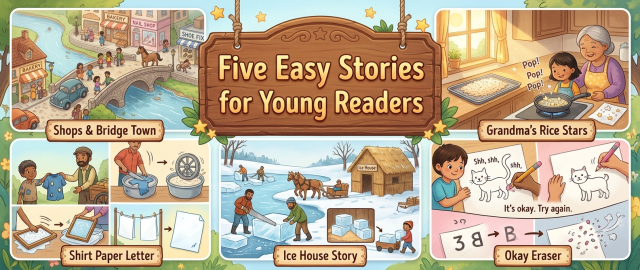
AIで生成したやさしい英文5話をまとめて掲載しています。
英文の難易度
CEFR:Pre-A1
英検:5級
語数:5話合計約1,448語
制作について
本記事の英文・日本語訳・英語難易度の評価は、AIを活用して作成したものです。
内容の正確性を保証するものではありません。
論理的な矛盾・文脈の破綻などが含まれている可能性や、歴史的事実・科学的な正確性・一般常識などに合致しない事柄が含まれている可能性があります。あくまでも英文を読む練習用の素材として考えて下さい。
「んっ?」と思うところがあっても、無視して読み続ける能力を獲得していただければ幸いです…
なお、難易度の評価は目安であり、CEFRや英検による公式な判定ではありません。
Shops Gather Where Bridge Meets Road
英語本文:約266語
Look at a map of the old town. The river runs across the map. One bridge crosses it. Near that bridge, many shops crowd together. Far from the bridge, there are few shops.
Why do shops gather near a bridge?
A bridge is a narrow place. To cross the river, everyone must use it. People walk to the bridge. Horses walked there long ago. Cars drive there now. All feet and wheels go to one spot.
If you have a shop, you want many feet to pass your door. Near a bridge, many feet pass. So you build your shop near the bridge.
Then more shops come. One sells bread. One sells nails. One fixes shoes. People say, “While I cross the bridge, I will buy bread.” The bridge makes a market.
Far from the bridge, the river is wide and no one crosses. Few feet pass. Shops there would be lonely. No one would see them.
Lena walks over the bridge with Grandma. Grandma points. “See, the bakery is here because the bridge is here. Long ago, the baker built close to the crossing.”
Lena looks at the map again. The bridge is like a knot that pulls strings together. The strings are roads. Roads meet at the bridge. Where roads meet, people meet. Where people meet, shops grow.
Some bridges are gone now. Cars use a new big bridge far away. But the old shops stay near the old bridge. They remember why they came.
So a town map tells a story. A river, a narrow crossing, and many feet make a busy corner.
日本語対訳
橋が道路と出会うところに店が集まる
古い町の地図を見てください。川が地図を横切って流れています。一つの橋がそれを渡しています。その橋の近くではたくさんの店が集まっています。橋から遠いところでは店はわずかです。
なぜ店は橋の近くに集まるのでしょうか?
橋は狭い場所です。川を渡るには誰もがそれを使わなければなりません。人々は橋へ歩いて行きます。昔は馬もそこを歩きました。今は車がそこを通ります。すべての足と車輪が一箇所へ向かいます。
店を持っているなら、多くの足が店先を通ってほしいものです。橋の近くでは多くの足が通ります。だから橋の近くに店を建てるのです。
それからさらに多くの店がやって来ます。一つはパンを売ります。一つは釘を売ります。一つは靴を直します。人々は言います。「橋を渡るついでにパンを買おう」橋が市場を作るのです。
橋から遠いところでは川は広く誰も渡りません。わずかな足しか通りません。そこの店は寂しいでしょう。誰も見てくれません。
レナはおばあちゃんと一緒に橋を渡って歩きます。おばあちゃんが指さします。「ほら、橋があるからここにパン屋があるのよ。昔、パン屋は渡り場の近くに建てたの」
レナは再び地図を見ます。橋はひもを一緒に引き寄せる結び目のようです。ひもは道路です。道路は橋で出会います。道路が出会うところでは人が出会います。人が出会うところでは店が育ちます。
今ではなくなった橋もあります。車は遠くの新しい大きな橋を使います。しかし古い店は古い橋の近くに残っています。なぜ来たのかを覚えているのです。
だから町の地図は物語を語ります。川と狭い渡り場と多くの足がにぎやかな角を作るのです。
Grandma Turns Cold Rice Into Crunchy Stars
英語本文:約281語
Mika has a bowl of cold rice from last night. The rice is hard and clumps together. She does not want to eat it cold.
Grandma says, “We will make it crunchy.”
Grandma takes the cold rice and spreads it on a flat tray. The grains lie apart, not in a big lump. She puts the tray by the window where the sun comes in. The sun dries the rice. The grains get hard and loose.
Mika touches one grain. It feels like a tiny hard bead.
Grandma heats oil in a small pan. The oil is shallow, not deep. She puts a few dry grains into the hot oil. Pop! The grains puff up. They turn white and big, like little stars. They float.
Mika says, “They popped like popcorn!”
Grandma scoops the puffed stars out with a slotted spoon. She puts them on paper to soak up oil. She sprinkles a little salt.
Mika eats one. Crunch! It is light and salty. The inside is full of air.
Grandma says, “Long ago, people did not have fridges. Cold rice got hard. They dried it and puffed it so it would not go to waste. Travelers took it on long journeys because it was light and did not spoil.”
Mika puts more dry grains into the oil, a few at a time. Pop, pop, pop. More stars. She puts them in a small bag.
Later, she walks to the park. She opens the bag. She eats crunchy rice stars. One grain that was cold and hard last night is now many stars that crunch and float.
She saves some for Grandma. Grandma smiles and says, “No waste, just new shape.”
日本語対訳
おばあちゃんが冷やご飯をカリカリの星に変える
ミカは昨夜の冷やご飯が入ったお椀を持っています。ご飯は硬くて固まっています。冷たいまま食べたくありません。
おばあちゃんが言います。「カリカリにしましょう」
おばあちゃんは冷やご飯を取り、平らなトレーに広げます。粒は大きな塊ではなく離れて横たわります。太陽が差し込む窓のそばにトレーを置きます。太陽がご飯を乾かします。粒は硬くばらばらになります。
ミカは一粒に触ります。小さな硬いつぶつぶのように感じます。
おばあちゃんは小さな鍋で油を熱します。油は浅く、深くありません。乾いた粒を数粒熱い油に入れます。ポン!粒は膨らみます。白く大きく、小さな星のようになります。浮かびます。
ミカが言います。「ポップコーンみたいに弾けた!」
おばあちゃんは穴あきお玉で膨らんだ星をすくい出します。油を吸い取るために紙の上に置きます。少し塩を振りかけます。
ミカは一つ食べます。カリッ!軽くて塩味があります。中は空気でいっぱいです。
おばあちゃんが言います。「昔は冷蔵庫がなかったの。冷やご飯は硬くなったわ。それを乾かして膨らませて無駄にならないようにしたの。旅人たちは軽くて傷まないから長い道に持って行ったのよ」
ミカはさらに乾いた粒を一度に数粒ずつ油に入れます。ポンポンポン。さらに星が増えます。小さな袋に入れます。
後で公園へ歩いて行きます。袋を開けます。カリカリの米の星を食べます。昨夜冷たく硬かった一粒が今やカリッと浮かぶたくさんの星になっています。
おばあちゃんの分も取っておきます。おばあちゃんは微笑んで言います。「無駄なし、ただ新しい形よ」
Shirt That Became Paper for a Letter
英語本文:約259語
Long ago, paper was not made from trees. It was made from old clothes.
Mrs. Patel tells her class, “Bring one old shirt you do not wear.” The kids bring shirts with holes. Some shirts are soft and thin from many washes.
A man from the old mill comes with a big cart. He takes the shirts. He cuts them into small pieces with sharp scissors. Snip, snip. The pieces look like snow.
He puts the pieces in a big tub of water. The tub has a wheel that beats the pieces. Beat, beat, beat. The cloth turns into mush. The mush looks like thin soup.
He lifts a flat frame with a screen. He dips the frame into the mush. He lifts it up. Water runs out through the screen. On the screen, a thin white sheet stays.
He presses the sheet with a cloth to take out more water. He peels the sheet off the screen. He hangs it on a line to dry. The sun dries it. The sheet becomes paper.
Mrs. Patel writes a short letter on the new paper. She writes, “Thank you for your old shirts. This paper was made from your shirts. Now it is a letter.”
One boy asks, “Is my blue shirt now paper?” Mrs. Patel says, “Yes. Part of it is in this sheet. You can see a tiny blue thread if you look close.”
The boy looks close. He sees one small blue thread in the white paper. He smiles. His old shirt became paper for a new story.
日本語対訳
手紙になったシャツ
昔、紙は木から作られていませんでした。古い服から作られていました。
パテル先生はクラスに言います。「着ない古いシャツを一枚持ってきて」子どもたちは穴の開いたシャツを持ってきます。何度も洗われて柔らかく薄くなったシャツもあります。
古い製紙所の男性が大きなカートを持って来ます。シャツを受け取ります。鋭いハサミで小さな切れ端に切ります。チョキ、チョキ。切れ端は雪のように見えます。
切れ端を水の入った大きな桶に入れます。桶には切れ端を叩く車輪があります。トントントン。布はどろどろになります。どろどろは薄いスープのように見えます。
網のついた平らな枠を持ち上げます。枠をどろどろの中に浸します。持ち上げます。水は網から流れ出ます。網の上に薄い白いシートが残ります。
布でシートを押してさらに水を取り出します。シートを網からはがします。乾かすために紐に掛けます。太陽が乾かします。シートは紙になります。
パテル先生は新しい紙に短い手紙を書きます。「古いシャツをありがとう。この紙はあなたたちのシャツから作られました。今は手紙です」と書きます。
一人の男の子が尋ねます。「僕の青いシャツは今紙になったの?」パテル先生は言います。「ええ。その一部がこのシートの中にあるわ。近くで見れば小さな青い糸が見えるわよ」
男の子は近くで見ます。白い紙の中に一本の小さな青い糸を見つけます。微笑みます。古いシャツが新しい物語のための紙になったのです。
Ice House That Saved Winter for Summer
英語本文:約290語
Long ago, before there were fridges, there was an ice house at the edge of town.
In winter, men went to the frozen pond. They cut big blocks of ice with long saws. Each block was as big as a chair. They put the blocks on sleds. Horses pulled the sleds to the ice house.
The ice house had thick walls made of wood and straw. No windows. One small door. Inside, the men stacked the ice blocks like bricks. Between each block they put sawdust. Sawdust kept the cold in and the warm out.
When spring came, flowers grew. When summer came, it was hot. But inside the ice house, it was still winter. The ice did not melt fast because the thick walls and sawdust held the cold.
People came with buckets. They paid one coin for one block. They carried the block home on their shoulders or in a wagon. They put the block in a wooden box in the kitchen. The box was called an icebox. Cold air from the ice kept milk and meat cold for one day.
Mira lives near the old ice house now. The pond still freezes in winter, but no one cuts ice. The ice house is empty. Its door hangs open. Sawdust still sits on the floor.
Mira’s grandpa shows her a photo. In the photo, men stand on the pond with saws. Horses wait with sleds. He says, “We saved winter to use in summer. That was our fridge.”
Mira looks at the empty house. She can almost feel the cold air from long ago. She picks up a handful of old sawdust. It is soft and dry. It once kept ice from melting. Now it keeps a story.
日本語対訳
冬を夏のために取っておいた氷室
昔、冷蔵庫がなかった頃、町の端に氷室がありました。
冬になると、男たちは凍った池へ行きました。長い鋸で大きな氷の塊を切りました。一つの塊は椅子ほどの大きさでした。彼らは塊をそりに載せました。馬がそりを氷室まで引きました。
氷室は木と藁でできた厚い壁を持っていました。窓はありません。小さなドアが一つです。中では男たちが氷の塊をレンガのように積み上げました。それぞれの塊の間に彼らはおがくずを入れました。おがくずは冷たさを中に保ち、暖かさを外に保ちました。
春が来ると花が咲きました。夏が来ると暑くなりました。しかし氷室の中はまだ冬でした。厚い壁とおがくずが冷たさを保ったので、氷は速く溶けませんでした。
人々はバケツを持って来ました。一つの塊に一枚のコインを払いました。彼らは塊を肩や荷車で家まで運びました。台所にある木の箱に塊を入れました。その箱はアイスボックスと呼ばれました。氷からの冷たい空気が牛乳や肉を一日冷たく保ちました。
ミラは今、その古い氷室の近くに住んでいます。池は冬にはまだ凍りますが、誰も氷を切りません。氷室は空っぽです。ドアは開いたままぶら下がっています。おがくずがまだ床にあります。
ミラのおじいちゃんは写真を見せます。写真では男たちが鋸を持って池の上に立っています。馬がそりと共に待っています。彼は言います。「冬を取っておいて夏に使ったんだ。それが冷蔵庫だったんだよ」
ミラは空っぽの家を見ます。昔の冷たい空気をほとんど感じられる気がします。古いおがくずを一掴み拾い上げます。柔らかくて乾いています。かつては氷が溶けるのを防いでいました。今は物語を保っています。
The Eraser That Says It’s Okay
英語本文:約352語
At the top of your pencil there is a little pink hat. It is the eraser. It is soft and round. When you draw a line you do not like, the eraser can help you.
You draw a cat. The tail is too long. You take the eraser and rub it gently. Shh, shh, shh. The long tail goes away. Now you can try again. You draw a short tail. That looks much better.
The eraser does not get mad. It does not say, “You made a bad line!” It just says, “It’s okay. Try again.” That is its job. It is there to help you learn.
In school you write letters. Sometimes the B looks funny. Sometimes the 3 is backward. That is normal. Everyone makes funny letters when they are six. The eraser helps you fix it. Rub, rub, and the funny letter is gone. You write it again, nice and slow.
Some people think erasers are for mistakes. But mistakes are how you learn. If you never made a mistake, you would never learn new things. So the eraser is really for learning, not just for fixing.
When you rub, little bits fall off. They are pink and gray. Some fall on your paper. You can brush them off with your hand. Puff! They go away. The paper is clean again.
Look at your eraser after a week. It gets small. It gets a little dirty. It has little black dots on it. Those dots are all the times you tried, fixed, and tried again. Each dot is one try. Each try makes you better.
At the end of the month your eraser may be all gone. That means you used it a lot. That means you learned a lot. That is good! You can put a new eraser on your pencil. Or you can get a new pencil with a fresh pink hat.
Next time you make a funny line, do not feel sad. Take your little pink hat. Rub it gently. Listen. It says, “It’s okay.” Then try again. That is how you get better and better.
日本語対訳
「大丈夫だよ」と言ってくれる消しゴム
鉛筆のてっぺんには、小さなピンクの帽子があります。それは消しゴムです。やわらかくて丸いです。気に入らない線を描いたとき、消しゴムが助けてくれます。
ネコを描きます。しっぽが長すぎます。消しゴムを手に取って、やさしくこすります。シュッシュッシュッ。長いしっぽが消えます。今度はもう一度描けます。短いしっぽを描きます。ずっと良く見えます。
消しゴムは怒りません。「へんな線を描いたね!」とは言いません。ただ「大丈夫だよ。もう一度やってごらん」と言います。それが消しゴムの仕事です。あなたが学ぶのを助けるためにそこにいます。
学校では文字を書きます。ときどきBがへんな形になります。ときどき3が逆向きになります。それは普通のことです。6歳のときはみんなへんな文字を書きます。消しゴムが直すのを助けてくれます。ゴシゴシこすると、へんな文字は消えます。またゆっくり丁寧に書き直します。
消しゴムは間違いを直すためのものだと考える人もいます。でも間違いは学ぶ方法なのです。もし一度も間違いをしなければ、新しいことを決して学べません。だから消しゴムは直すためだけでなく、本当は学ぶためのものなのです。
こすると、小さなカスが落ちます。ピンクと灰色です。紙の上に落ちるものもあります。手で払いのけることができます。フッ!消えてしまいます。紙はまたきれいになります。
一週間後の消しゴムを見てください。小さくなります。少し汚れます。小さな黒い点がついています。その点はあなたが挑戦し、直し、また挑戦した回数です。一つの点が一回の挑戦です。一回の挑戦があなたを上達させます。
月末には消しゴムがすっかりなくなっているかもしれません。それはたくさん使ったということです。たくさん学んだということです。それは良いことです!鉛筆に新しい消しゴムをつけることができます。あるいは新しいピンクの帽子がついた新しい鉛筆を手に入れることもできます。
次にへんな線を描いてしまっても、悲しまないでください。小さなピンクの帽子を手に取ってください。やさしくこすってください。耳をすませてください。「大丈夫だよ」と言っています。それからもう一度やってみましょう。それがどんどん上達する方法です。