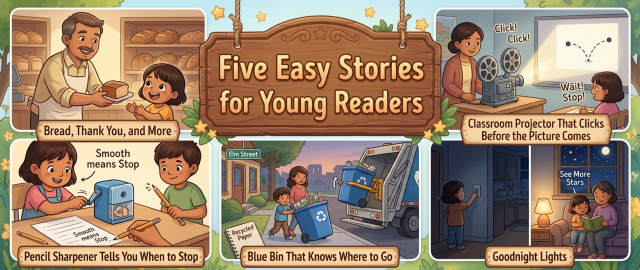
AIで生成したやさしい英文5話をまとめて掲載しています。
英文の難易度
CEFR:Pre-A1
英検:5級
語数:5話合計約1,372語
制作について
本記事の英文・日本語訳・英語難易度の評価は、AIを活用して作成したものです。
内容の正確性を保証するものではありません。
論理的な矛盾・文脈の破綻などが含まれている可能性や、歴史的事実・科学的な正確性・一般常識などに合致しない事柄が含まれている可能性があります。あくまでも英文を読む練習用の素材として考えて下さい。
「んっ?」と思うところがあっても、無視して読み続ける能力を獲得していただければ幸いです…
なお、難易度の評価は目安であり、CEFRや英検による公式な判定ではありません。
Bread, Thank You, and More
英語本文:約273語
Work is more than money.
A man bakes bread. He gets up early. Four in the morning. Still dark.
He makes dough. He waits. Dough gets big.
He bakes it. Hot oven. Good smell. Bread is brown now.
People come in. They buy bread. They give money. Is this work? Yes. But more.
A kid comes in. No money. Just big eyes. Eyes on the bread.
The man cuts a small piece. He gives it. Free.
The kid smiles. Big smile. The man smiles too.
This smile is not money. But it is good. It makes the day good.
Think of a bus driver. She drives the bus. People pay. This is money.
But she also waits. For an old man. He walks slow. She waits. He gets on. He says thank you.
Thank you is not money. But it is good too.
Think of a teacher. He teaches letters. He gets money. Yes.
But now a kid reads. First time. The kid is so happy. The teacher is happy too.
Happiness is not money. But happiness is part of work too.
Think of a farmer. She grows carrots. She sells carrots. She gets money.
But a family eats carrots. Fresh carrots. They say yum. Yum is not money. But yum is good.
Money helps us buy food. This is true.
But work also makes smiles. Work also makes people say thank you. Work also makes people happy. Work also makes yum.
So work is money and more.
People matter more than money. People smile. People say thank you. People read. People eat and say yum.
This is why people work. For money and for more.
日本語対訳
パンとありがとうと、もっと
仕事はお金だけじゃない。
男の人がパンを焼く。早起きする。朝の4時。まだ暗い。
生地を作る。待つ。生地が大きくなる。
焼く。熱いオーブン。良い匂い。パンは今こんがり茶色だ。
人々が入って来る。パンを買う。お金を払う。これは仕事?そうだ。でももっとある。
子どもが入って来る。お金はない。ただ大きな目だけ。パンを見つめる目だ。
男の人は小さく切る。一切れあげる。タダだ。
子どもは笑う。大きな笑顔。男の人も笑う。
この笑顔はお金じゃない。でも良いものだ。一日を良くする。
バスの運転手を考えてみて。彼女はバスを運転する。人々は払う。これはお金だ。
でも彼女は待ってもくれる。おじいさんのために。歩くのが遅い。彼女は待つ。彼は乗る。ありがとうと言う。
ありがとうはお金じゃない。でも良いものだ。
先生を考えてみて。彼は文字を教える。お金をもらう。そうだ。
でも今、子どもが本を読む。初めて。子どもはとてもうれしい。先生もうれしい。
うれしいはお金じゃない。でもうれしいも仕事の一部だ。
農家の人を考えてみて。彼女はニンジンを育てる。ニンジンを売る。お金をもらう。
でも家族がニンジンを食べる。新鮮なニンジン。みんなおいしいと言う。おいしいはお金じゃない。でもおいしいは良いものだ。
お金は食べ物を買うのに役立つ。それは本当だ。
でも仕事は笑顔も作る。ありがとうも作る。うれしいも作る。おいしいも作る。
だから仕事はお金と、もっとだ。
お金よりもっと大切なのは人だ。人は笑う。人はありがとうと言う。人は本を読む。人は食べておいしいと言う。
だから人は働くのだ。お金のため、そしてもっとのために。
Classroom Projector That Clicks Before the Picture Comes
英語本文:約309語
There is an old film projector in the back of the art room. It is big and gray. It has two round arms on top. No one uses it now because the school has a flat screen.
Mrs. Lee brings it to the front one rainy day. She says, “This is how we watched movies long ago.”
She opens the side. Inside, there is a long strip of film. The film has many small pictures, all almost the same, but each a little different.
She plugs in the cord. The projector makes a loud hum. A small lamp inside gets bright. She presses a button. Click, click, click. The film moves fast through a gate. Light shines through each small picture and makes it big on the white wall.
On the wall, a black dot bounces. It is just a dot, but because the pictures move fast, the dot looks like it jumps.
Lena watches the gate. She sees the film stop for a tiny moment, then move, then stop. Stop, move, stop, move. Twenty-four times in one second. Her eyes cannot see the stop, but her ears hear the click.
Mrs. Lee says, “Movies are still pictures that move fast. Your brain puts them together.”
She turns off the lamp. She lets Lena touch the film. The film is cool and smooth. The pictures are tiny. One shows the dot a little higher.
Lena says, “So film is many photos that pretend to be one move?”
Mrs. Lee says, “Yes. And the click is the sound of photos pretending.”
At the end, Mrs. Lee rolls the film back onto its round arm. Click, click, click, slow now. The dot goes back to the start.
The flat screen is quiet and bright. The old projector is loud and clicks. But both make pictures move by showing still pictures fast.
日本語対訳
映像が来る前にカチカチ鳴る教室の映写機
美術室の後ろに古い映写機があります。大きくて灰色です。上に二つの丸いアームがあります。学校に薄型スクリーンがあるので今は誰も使いません。
リー先生がある雨の日にそれを前に持ってきます。「昔はこうやって映画を見たのよ」と言います。
横を開けます。中には長い一続きのフィルムがあります。フィルムには小さな絵がたくさんあり、どれもほとんど同じですが少しずつ違います。
コードを差し込みます。映写機が大きなブーンという音を立てます。中にある小さなランプが明るくなります。ボタンを押します。カチカチカチ。フィルムがゲートの中を速く動きます。光がそれぞれの小さな絵を通して輝き、白い壁に大きく映します。
壁には黒い点が跳ねます。ただの点ですが、絵が速く動くので点が跳ぶように見えます。
レナはゲートを見ます。フィルムがほんの一瞬止まり、それから動き、また止まるのが見えます。止まる、動く、止まる、動く。一秒に二十四回です。目は止まりを見ることができませんが、耳にはカチッという音が聞こえます。
リー先生が言います。「映画は速く動く静止画なの。脳がそれらをつなぎ合わせるのよ」
ランプを消します。レナにフィルムに触らせます。フィルムはひんやりして滑らかです。絵はとても小さいです。一つは点が少し高い位置にあるのを示しています。
レナが言います。「じゃあフィルムは一つの動きのふりをするたくさんの写真なの?」
リー先生が言います。「そうよ。そしてカチッという音は写真がふりをしている音なの」
最後にリー先生はフィルムを丸いアームに巻き戻します。今はゆっくりとカチカチカチ。点は最初の位置に戻ります。
薄型スクリーンは静かで明るいです。古い映写機はうるさくカチカチ鳴ります。しかしどちらも静止画を速く見せることで絵を動かすのです。
Pencil Sharpener Tells You When to Stop
英語本文:約281語
In class, there is a small blue sharpener on the desk. It has one hole. You put a dull pencil in the hole.
Lena puts her pencil in. She turns the handle. Crank, crank, crank. At first, the sound is rough. The sharpener bites hard. Wood dust falls into the clear box.
She keeps turning. The sound gets smooth. Crank, crank. Now it is easy to turn. That means the wood is thin and the black tip is long and sharp.
If she stops too soon, the tip is short and flat. It will make a thick gray line. If she turns too long after the smooth sound, the tip will get too thin and break.
So Lena listens. Rough means keep going. Smooth and easy means stop. She pulls the pencil out. She looks at the tip. It is sharp, not broken. She taps the side of the sharpener. Extra dust falls down.
She tries her pencil on paper. She makes a thin dark line. Good.
Her friend Sam turns and turns without listening. His handle goes click-click when the tip is done, but he keeps turning. Snap. His tip breaks inside the sharpener. He has to shake it out and start again.
Lena says, “Listen for smooth and easy. Then stop.”
Learning to sharpen a pencil is not just about hands. It is about ears. The sharpener tells you when to stop if you listen.
At the end of the day, the teacher empties the clear box of wood dust into the trash. The box is empty again, ready for tomorrow. Pencils will get dull, and the small blue sharpener will teach again: rough means go, smooth means stop.
日本語対訳
いつ止めるかを教えてくれる鉛筆削り
教室には、机の上に小さな青い鉛筆削りがあります。穴が一つあります。丸くなった鉛筆を穴に入れます。
レナは鉛筆を入れます。ハンドルを回します。カリカリカリ。最初は音が荒いです。削り器が強くかじります。木くずが透明な箱の中に落ちます。
回し続けます。音が滑らかになります。カリカリ。今は回すのが簡単です。それは木が薄く、黒い芯が長く鋭いという意味です。
早すぎると、芯は短くて平らです。太い灰色の線になります。滑らかな音の後も長く回しすぎると、芯は細くなりすぎて折れます。
だからレナは耳を澄まします。荒い音は続けるという意味です。滑らかで簡単というのは止めるという意味です。鉛筆を引き抜きます。芯先を見ます。鋭く、折れていません。削り器の側面をトントン叩きます。余分なくずが落ちます。
紙で鉛筆を試します。細い濃い線を引きます。いい感じです。
友だちのサムは聞かずに回し続けます。芯ができあがるとハンドルがカチカチ鳴りますが、回し続けます。ポキッ。芯が削り器の中で折れます。振り出して再び始めなければなりません。
レナは言います。「滑らかで簡単になるのを聞いて。それから止めるの」
鉛筆を削ることを学ぶのは手だけのことではありません。耳のことでもあります。聞けば削り器がいつ止めるかを教えてくれます。
一日の終わりに、先生は木くずの入った透明な箱をゴミ箱に空けます。箱はまた空になり、明日に備えます。鉛筆はまた丸くなり、小さな青い削り器は再び教えるでしょう。荒い音は進め、滑らかな音は止まれ、と。
Blue Bin That Knows Where to Go
英語本文:約253語
On Elm Street, every house has a blue bin. The blue bin lives next to the front door.
On Monday, Mom says, “It is blue bin day.” She brings out clean cans and bottles. She puts them in the blue bin. The cans are empty. The bottles are empty. No food is inside.
Sam helps. He carries a small box of paper. He puts the paper in the blue bin, too. The paper is flat. Flat paper fits well.
Mom rolls the blue bin to the curb. The curb is the low edge between the sidewalk and the street. The bin stands there with its lid closed.
A big truck comes. It stops in front of each house. Two arms come out from the truck. The arms hug the blue bin. They lift the bin up high. The lid opens. Everything falls into the truck. Then the arms put the bin back down on the curb, empty.
The truck drives away. The blue bin is light now.
The next week, Sam sees a new notebook at the store. The label says, “Made from recycled paper.” He smiles. His flat paper came back as a notebook.
Mom says, “Our blue bin goes around the block and comes back to us as new things.”
Sam rolls the empty blue bin back to the front door. It will wait there until next Monday. It knows where to go: from door to curb to truck and back to door. It carries old things that will become new.
日本語対訳
行き先を知っている青い箱
エルム通りでは、どの家にも青い箱があります。青い箱は玄関ドアの横に住んでいます。
月曜日、ママが言います。「青い箱の日よ」きれいに洗った缶や瓶を持ち出します。それらを青い箱に入れます。缶は空です。瓶は空です。中に食べ物はありません。
サムが手伝います。小さな紙の箱を運びます。紙も青い箱に入れます。紙は平らです。平らな紙はよく収まります。
ママは青い箱を縁石まで転がします。縁石は歩道と道路の間の低い段差です。箱は蓋を閉めたままそこに立っています。
大きなトラックが来ます。各家の前で止まります。トラックから二本のアームが出てきます。アームが青い箱を抱えます。箱を高く持ち上げます。蓋が開きます。すべてがトラックの中に落ちます。それからアームが箱を空にして縁石に戻します。
トラックは走り去ります。青い箱は今は軽いです。
翌週、サムは店で新しいノートを見ます。ラベルには「再生紙から作られました」と書かれています。彼は微笑みます。彼の平らな紙がノートとして戻ってきたのです。
ママが言います。「私たちの青い箱はブロックを一周して、新しい物として私たちのところに戻ってくるのよ」
サムは空の青い箱を玄関ドアまで転がして戻します。次の月曜日までそこで待ちます。どこへ行くかを知っています。ドアから縁石へ、トラックへ、そしてドアへ戻る、古い物でいっぱいになって新しい物になるために。
Goodnight Lights
英語本文:約256語
At night the house gets quiet. You brush your teeth. You see lights on in every room. Hall light on. Kitchen light on. Bedroom light on.
Mom says, “Let’s say goodnight to the lights.” You go from room to room. Click. Kitchen dark. Click. Hall dark. Only one small lamp stays on for reading.
Why do we turn lights off? Lights use power. Power comes from far away. Some power comes from burning things that make the air dirty. When we use less power, the air stays cleaner. The Earth stays cooler too.
It also helps animals. At night some birds fly. Some turtles walk to the sea. Too many bright lights can make them lose their way. When we turn off lights we do not need, we help them find their way.
You can be the goodnight helper. You can check the rooms. Is anyone reading there? No? Then click off. Is the closet light on with no one inside? Click off. You can turn off the TV when no one watches too.
Mom gives you a little job. You hold the switch. You say, “Goodnight, kitchen light. Goodnight, hall light. Thank you for today.” It feels nice, like tucking the house into bed.
One small lamp is enough. You sit with Mom and read a book. The room is soft and warm. Outside, the sky is dark and you can see stars. If the whole town turns off extra lights, you can see more stars.
Goodnight lights. Goodnight house. Goodnight stars. You helped a little today.
日本語対訳
おやすみ、でんき
夜になると、家は静かになります。歯をみがきます。どの部屋も電気がついているのが見えます。廊下の電気がついている。キッチンの電気がついている。寝室の電気がついている。
ママが言います。「電気さんにおやすみを言いましょう」。部屋から部屋へ行きます。カチッ。キッチンは暗くなります。カチッ。廊下は暗くなります。読書のための小さなランプだけがついたままです。
なぜ電気を消すのでしょう?照明は電力を使います。電力は遠くから送られてきます。電力の一部は、空気を汚すものを燃やして作られます。使う電力が少なくなると、空気はよりきれいなままです。地球ももっと涼しいままです。
それは動物たちも助けます。夜、鳥の中には飛ぶものもいます。カメの中には海へ歩いて行くものもいます。明るすぎる光がたくさんあると、迷ってしまいます。必要のない電気を消すと、彼らが道を見つけるのを助けることができます。
あなたはおやすみ係になれます。部屋をチェックできます。誰かそこで本を読んでいますか?いいえ?ならカチッと消します。誰も中にいないのにクローゼットの電気がついていますか?カチッと消します。誰も見ていない時はテレビも消せます。
ママがあなたに小さな仕事をくれます。スイッチを持ちます。「おやすみ、キッチンの電気。おやすみ、廊下の電気。今日もありがとう」と言います。家をベッドに寝かしつけるみたいで、気持ちがいいです。
小さなランプ一つで十分です。ママと一緒に座って本を読みます。部屋はやわらかくて温かいです。外は空が暗くて、星が見えます。町中のみんなが余分な電気を消せば、もっとたくさん星が見えます。
おやすみ、でんき。おやすみ、おうち。おやすみ、お星さま。今日は少しだけお手伝いできました。