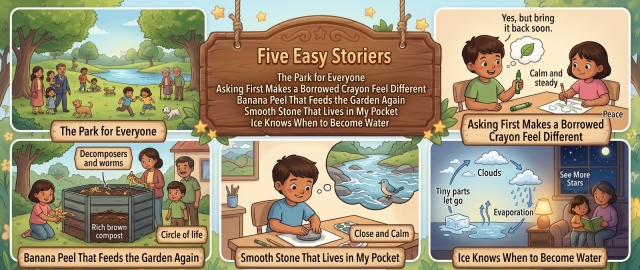
AIで生成したやさしい英文5話をまとめて掲載しています。
英文の難易度
CEFR:Pre-A1
英検:5級
語数:5話合計約1,397語
制作について
本記事の英文・日本語訳・英語難易度の評価は、AIを活用して作成したものです。
内容の正確性を保証するものではありません。
論理的な矛盾・文脈の破綻などが含まれている可能性や、歴史的事実・科学的な正確性・一般常識などに合致しない事柄が含まれている可能性があります。あくまでも英文を読む練習用の素材として考えて下さい。
「んっ?」と思うところがあっても、無視して読み続ける能力を獲得していただければ幸いです…
なお、難易度の評価は目安であり、CEFRや英検による公式な判定ではありません。
The Park for Everyone
英語本文:約256語
There was a big city. The city was noisy. Many people. Many houses. No trees.
Rich people had gardens. Big gardens. With trees. With grass.
Poor people had no gardens. Just streets. Hot streets.
A man saw this. His name was Fred. He was not rich. He was not poor. He thought a lot.
He thought, trees should not be just for rich people. Parks should be for all.
People laughed. They said, parks cost money. Who will pay?
Fred said, we all pay a little. Then we all get a big park.
He drew a park. Big park. In the middle of the city. With lakes. With hills. With paths for all.
He showed his drawing. Some said no. Some said yes.
He walked and talked. He talked to many people. He said, kids need grass. Moms need shade. Dads need fresh air.
More people said yes.
Then workers came. They dug. They moved dirt. They planted trees. Small trees at first. Then big.
Now the park is there. Big trees. Green grass. All can go. Rich and poor. Kids and old.
People sit. People run. People eat lunch on the grass.
No one pays to go in. It is free. For all.
Fred is gone now. Long ago. But his park is still here.
And his idea is still here too. An idea. It says, good things should be for all. Not just for some.
Kids still play there. Dogs still run there. Birds still sing there.
This is why we have parks today.
日本語対訳
みんなの公園
大きな街があった。街はうるさかった。たくさんの人。たくさんの家。木はなかった。
お金持ちは庭を持っていた。大きな庭。木がある。芝生がある。
貧しい人たちは庭がなかった。あるのは通りだけ。暑い通りだ。
一人の男がこれを見た。名前はフレッドといった。お金持ちでも貧しくもなかった。たくさん考える人だった。
彼は考えた。木はお金持ちだけのものであるべきではない。公園はみんなのものであるべきだ、と。
人々は笑った。言った。公園はお金がかかる。誰が払うんだい?と。
フレッドは言った。みんなで少しずつ払おう。そうすればみんなで大きな公園が手に入るよ、と。
彼は公園を描いた。大きな公園。街の真ん中に。湖がある。丘がある。みんなのための道がある。
絵を見せた。だめだと言う人もいた。良いと言う人もいた。
彼は歩いて話した。たくさんの人に話しかけた。言った。子どもには芝生が必要だ。お母さんには木陰が必要だ。お父さんには新鮮な空気が必要だ、と。
良いと言う人が増えた。
それから労働者たちが来た。掘った。土を動かした。木を植えた。最初は小さな木だった。それから大きくなった。
今その公園はそこにある。大きな木。緑の芝生。みんなが行ける。お金持ちも貧しい人も。子どももお年寄りも。
人々は座る。走る。芝生の上で昼ごはんを食べる。
入るのにお金を払う人は誰もいない。無料だ。みんなのためのものだ。
フレッドはもういない。ずっと昔のことだ。でも彼の公園はまだここにある。
そして彼の考えもまだここにある。一つの考えだ。それは言う。良いものはみんなのものであるべきだ。一部の人だけのものではない、と。
子どもたちは今でもそこで遊ぶ。犬は今でもそこで走る。鳥は今でもそこで歌う。
だから今日私たちには公園があるのだ。
Ask First Makes Borrowed Crayon Feel Different
英語本文:約307語
There are two ways to use a crayon that is not yours. One way is to just take it. One way is to ask first. The crayon is same. How you feel is not same.
Lena sees a blue crayon on Sam’s desk. She likes blue. She takes it fast and draws a river. She does not ask. Sam comes back. He says, “Where is my blue?”
Lena feels hot in her face. She gives it back. The blue river looks less pretty now. She was scared Sam would be mad. She did not enjoy drawing.
Next day, Lena sees a green crayon on Sam’s desk. She likes green. She says, “Sam, can I use green?”
Sam says, “Yes, but bring it back soon. I need it for a tree.”
Lena takes green and draws grass. She feels light. She knows she can use it. Sam knows where it is. No one is scared. The grass looks pretty.
Same action: using a crayon that is not yours. Different path.
Taking without asking has a hidden cost. You pay with worry. You worry the owner will come. You worry they will be mad. You cannot enjoy the drawing because worry sits on your hand.
Asking first has a small cost. You wait for yes. You may hear no. But if you hear yes, you get peace. Peace lets you draw free. You enjoy the green.
Some kids think asking is slow. Taking is fast. But fast plus worry is not fast. It feels long. Ask plus peace is faster for the heart, even if you wait two seconds.
So the rule is simple. If it is not yours, ask first. The crayon does not change. How you feel when you hold it changes a lot.
Lena keeps asking. Her drawings get more green, more blue, and more calm.
日本語対訳
先に尋ねることで借りたクレヨンの感じ方が変わる
自分のものではないクレヨンを使うには二つの方法があります。一つはただ取ってしまう方法。もう一つは先に尋ねる方法です。クレヨンは同じです。感じ方は同じではありません。
レナはサムの机の上に青いクレヨンがあるのを見ます。青が好きです。素早く取って川を描きます。尋ねません。サムが戻って来ます。「僕の青はどこ?」と言います。
レナは顔が熱くなるのを感じます。返します。青い川は今はあまりきれいに見えません。サムが怒るのではないかと怖かったのです。描くことを楽しめませんでした。
翌日、レナはサムの机の上に緑のクレヨンがあるのを見ます。緑が好きです。「サム、緑を使ってもいい?」と言います。
サムが言います。「いいよ、でもすぐ返してね。木を描くのに必要なんだ」
レナは緑を取り草を描きます。軽く感じます。使ってよいことが分かっています。サムはどこにあるか知っています。誰も怖がっていません。草はきれいに見えます。
同じ行為、自分のものではないクレヨンを使うこと。違う道筋です。
断りなく取ることには隠れた代償があります。心配という形で支払います。持ち主が来るのではないかと心配します。怒られるのではないかと心配します。心配が手の上に座っているので絵を楽しむことができません。
先に尋ねることには小さな代償があります。イエスを待ちます。ノーと聞くこともあります。しかしイエスと聞けば安心を得られます。安心があれば自由に描けます。緑を楽しめます。
尋ねるのは遅い、取るのは速いと考える子もいます。しかし心配を伴う速さは速くありません。長く感じます。安心を伴う尋ねることは、二秒待ったとしても心にとっては速いのです。
だからルールは簡単です。自分のものでなければ先に尋ねる。クレヨンは変わりません。それを持ったときの感じ方がとても変わるのです。
レナは尋ね続けます。彼女の絵はより緑が多く、より青が多く、そしてより穏やかになります。
Banana Peel That Feeds the Garden Again
英語本文:約268語
A banana peel is not trash if you have a compost bin. A compost bin is a big box with air holes. It sits near the garden.
Lena peels a banana. She eats the soft inside. She has the yellow peel. She cuts the peel into small bits with safe scissors. Small bits break down faster than big bits.
She lifts the lid of the compost bin. Inside, the bin is warm. It smells like wet earth. There are many tiny helpers you cannot see well. Some are worms. Some are much smaller than worms. They are called decomposers.
Lena puts the small peel bits on top. She covers them with dry leaves. Dry leaves keep the bin from smelling bad. They also keep flies away.
The decomposers do not eat fast like us. They eat slow. They chew the peel with tiny mouths. They turn the yellow peel into brown soft stuff. The brown soft stuff is called compost.
After some weeks, Lena looks in the bin. No yellow peel. Only dark brown compost. It looks like rich soil. It feels soft.
She scoops some compost and puts it around her tomato plants. The compost feeds the soil. The soil feeds the tomato roots. The roots make the plant strong. The plant makes new tomatoes.
One tomato will be eaten, and its seeds may go back to the garden. One peel that was trash is now food for plants.
So the banana goes from hand to mouth to bin to soil to plant and back to hand. It is a small circle that helps the garden grow.
日本語対訳
庭に再び栄養を与えるバナナの皮
堆肥箱があれば、バナナの皮はゴミではありません。堆肥箱は空気穴のある大きな箱です。庭の近くに置かれています。
レナはバナナの皮をむきます。柔らかい中身を食べます。黄色い皮が手に残ります。安全なハサミで皮を小さな切れ端に切ります。小さな切れ端は大きな切れ端より速く分解します。
堆肥箱の蓋を持ち上げます。中は暖かいです。湿った土のような匂いがします。よく見えない小さな助け手がたくさんいます。ミミズもいます。ミミズよりずっと小さなものもいます。分解者と呼ばれます。
小さな皮の切れ端を上に置きます。乾いた葉で覆います。乾いた葉は箱が嫌な匂いを出すのを防ぎます。ハエを遠ざける役割もあります。
分解者は私たちのように速く食べません。ゆっくり食べます。小さな口で皮をかじります。黄色い皮を茶色い柔らかいものに変えます。その茶色い柔らかいものは堆肥と呼ばれます。
数週間後、レナは箱の中を見ます。黄色い皮はありません。濃い茶色の堆肥だけです。豊かな土のように見えます。柔らかく感じます。
堆肥を少しすくい、トマトの株の周りに置きます。堆肥は土に栄養を与えます。土はトマトの根に栄養を与えます。根が植物を強くします。植物が新しいトマトを作ります。
一つのトマトは食べられ、その種は庭に戻るかもしれません。ゴミだった一つの皮が今や植物の食べ物です。
つまりバナナは手から口へ、箱へ、土へ、植物へ、そして再び手へと巡ります。それは庭の成長を助ける小さな循環なのです。
Smooth Stone That Lives in My Pocket
英語本文:約308語
There is a smooth gray stone that lives in Sam’s pocket. Sam found it at the river. It is flat and cool. It fits just right in his hand.
Sam does not need the stone to walk or to eat. But he likes to have it when things are new.
On the first day at the new art class, Sam feels shy. Many kids sit at a long table. The room smells like paint. Sam puts his hand in his pocket. He finds the stone. He rubs it with his thumb. Once, twice. The stone is cool and smooth. Rubbing it helps him breathe slow.
The teacher says, “Pick a color and make a line.” Sam takes his hand out of his pocket. He picks blue. He makes a blue line across the paper. His hand feels steady now.
At snack time, a boy says, “What is in your pocket?” Sam takes the stone out. He puts it on the table. The boy touches it. “It is smooth,” the boy says. Sam puts the stone back in his pocket. It goes in easy. It lives there.
Later, the teacher asks kids to show their work. Sam feels shy again. His hand goes back to his pocket. He rubs the stone. He remembers the river where he found it. The river was loud and fast, but the stone was still. Sam stands up. He holds his paper with one hand and keeps the other hand in his pocket around the stone. He shows his blue line.
After class, Sam walks home. The stone taps against his leg as he walks. He knows it is there even when he does not touch it. Some things help just by being close.
At home, he puts the stone on his desk. At night, he puts it back in his pocket for tomorrow.
日本語対訳
ポケットに住む滑らかな石
サムのポケットには滑らかな灰色の石が住んでいます。サムは川でそれを見つけました。平らで冷たいです。手にちょうどぴったり収まります。
サムは歩いたり食べたりするために石を必要としません。しかし新しいことがあるときに持っているのが好きです。
新しい絵のクラスの初日、サムは恥ずかしさを感じます。たくさんの子が長いテーブルの周りに座っています。部屋は絵の具の匂いがします。サムは手をポケットに入れます。石を見つけます。親指でこすります。一度、二度。石は冷たくて滑らかです。こすることがゆっくり呼吸するのを助けます。
先生が言います。「色を一つ選んで線を描いて」サムは手をポケットから出します。青を選びます。紙を横切って青い線を描きます。手は今は安定しています。
おやつの時間に、男の子が言います。「ポケットの中に何があるの?」サムは石を取り出します。テーブルの上に置きます。男の子が触ります。「滑らかだね」と男の子は言います。サムは石をポケットに戻します。簡単に入ります。そこに住んでいます。
後で、先生が子どもたちに作品を見せるように頼みます。サムはまた恥ずかしさを感じます。手がポケットに戻ります。石をこすります。見つけた川のことを思い出します。川はうるさくて速かったけれど、石はじっとしていました。サムは立ち上がります。片手で紙を持ち、もう片方の手をポケットの中で石を包んだままにします。青い線を見せます。
授業の後、サムは家まで歩いて帰ります。歩くと石が足にコツコツ当たります。触っていなくてもそこにあることを知っています。ただ近くにあるだけで助けになるものもあるのです。
家では、石を机の上に置きます。夜、明日のためにポケットに戻します。
Ice Knows When to Become Water
英語本文:約258語
Put an ice cube in your hand. Brrr, cold! Count to thirty. One, two, three. Now look. Your hand is wet. Where did the ice go?
It did not disappear. It changed. Ice knows when to become water.
Ice is water that is very cold and hard. Its tiny parts are holding hands tight, so it stays in one shape. When it gets warm, those tiny parts start to wiggle. They let go of each other’s hands. Then the hard shape turns soft and runny. That is melting. Your warm hand helped it melt.
Put the water in a cup and leave it on the table. On a hot day, later the cup has less water. Where did it go now?
It went up into the air. Tiny water drops so small you cannot see them float up. That is called drying up. The sun helps.
Later, those tiny drops meet high in the sky. They cool down and hold hands again. They make a cloud. When many drops hold hands, the cloud gets heavy and dark. Then they fall down as rain. Pitter-patter on the roof.
Rain fills puddles. Puddles freeze on a cold night and become ice again. Then the trip starts over.
So ice becomes water, water becomes air, air becomes cloud, cloud becomes rain, rain becomes ice.
You can watch the whole trip today. Put one ice cube in a sunny spot. Watch it melt. Watch the wet spot dry. You just saw water take a trip around the world, right in your hand.
日本語対訳
氷は水になる時を知っている
氷のかけらを手に乗せてみましょう。ぶるっ、冷たい!三十まで数えます。一、二、三。今見てください。手が濡れています。氷はどこへ行ったのでしょう?
消えたわけではありません。変わったのです。氷は水になる時を知っています。
氷はとても冷たくて固い水です。小さな粒たちがぎゅっと手をつないでいるので、一つの形を保っています。温かくなると、その小さな粒たちがもぞもぞ動き始めます。お互いの手を離します。すると固い形がやわらかく、さらさらになります。それが溶けるということです。あなたの温かい手が溶けるのを手伝いました。
その水をコップに入れてテーブルの上に置いておきます。暑い日には、あとでコップの水が少なくなっています。今度はどこへ行ったのでしょう?
空気の中へ上って行ったのです。とても小さくて見えないほどの小さな水のしずくがふわふわと上がっていきます。それが乾くということです。太陽が手伝ってくれます。
後で、その小さな水滴は空の高いところで出会います。冷えてまた手をつなぎます。雲になります。たくさんのしずくが手をつなぐと、雲は重く暗くなります。そして雨として落ちてきます。屋根にパラパラと。
雨は水たまりを作ります。水たまりは寒い夜に凍ってまた氷になります。そして旅はまた最初から始まります。
つまり氷は水になり、水は空気になり、空気は雲になり、雲は雨になり、雨は氷になります。
今日、その旅全体を見ることができます。氷のかけらを一つ、日なたに置いてみましょう。溶けるのを見てください。濡れた場所が乾くのを見てください。水が世界を旅するのを、あなたの手の中で見たのです。