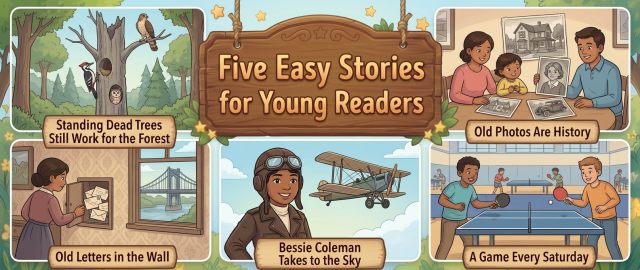
AIで生成した少しやさしい英文5話をまとめて掲載しています。
英文の難易度
CEFR:A1
英検:4級
語数:5話合計約1,368語
制作について
本記事の英文・日本語訳・英語難易度の評価は、AIを活用して作成したものです。
内容の正確性を保証するものではありません。
論理的な矛盾・文脈の破綻などが含まれている可能性や、歴史的事実・科学的な正確性・一般常識などに合致しない事柄が含まれている可能性があります。あくまでも英文を読む練習用の素材として考えて下さい。
「んっ?」と思うところがあっても、無視して読み続ける能力を獲得していただければ幸いです…
なお、難易度の評価は目安であり、CEFRや英検による公式な判定ではありません。
Standing Dead Trees Still Work for the Forest
英語本文:約295語
In the park near town, there is a tree with no leaves. Its bark is gray and rough. It does not grow anymore. It is a dead tree. It still stands tall.
People often think a dead tree should be cut down. But this tree is still working. In the woods, people call it a snag.
First, the snag is a home. A woodpecker flies to the trunk. It hits the wood with its beak. Tap, tap, tap. It makes a small hole. Inside the hole, it builds a nest. A tiny owl can use an old woodpecker hole later. The same tree holds many homes, one above the other.
Second, the snag is a store. Under the bark, there are bugs. Beetles and ants live in the dead wood. They eat the soft wood. Birds come to eat the bugs. The tree does not make new food, but it holds food for others.
Third, the snag is a lookout. Hawks sit on the top branch. From up high, they can see the whole field. They watch for mice. The dead branches have no leaves, so nothing blocks the view.
After many years, the snag will fall. When it falls, it will lie on the ground. Then it will be a log. Moss will grow on it. Mushrooms will grow on it. New seeds will fall on it and start to grow.
A dead tree does not make shade. It does not make fresh leaves. But it still helps the forest. It stands, it feeds, it holds, and then it lies down to feed again.
So when you see a dead tree that is safe and far from houses, do not think it is broken. Think of it as a busy hotel that never closes.
日本語対訳
立ったまま枯れた木は森のためにまだ働いている
町の近くの公園に、葉のない木があります。樹皮は灰色で粗いです。もう成長しません。枯れた木です。それでも高く立っています。
人々はよく枯れた木は切り倒すべきだと思います。しかしこの木はまだ働いています。森では人々はそれをスナッグと呼びます。
一つ目、スナッグは家です。キツツキが幹へ飛んできます。くちばしで木を叩きます。トントントン。小さな穴を作ります。穴の中に巣を作ります。小さなフクロウが後で古いキツツキの穴を使うことができます。同じ木には、上下に重なるようにたくさんの巣穴があります。
二つ目、スナッグは店です。樹皮の下には虫がいます。カブトムシやアリが枯れ木の中に住んでいます。柔らかい木を食べます。鳥が虫を食べに来ます。木は新しい食べ物を作りませんが、他の生き物のために食べ物を蓄えています。
三つ目、スナッグは見張り台です。タカが一番上の枝に止まります。高いところから野原全体が見えます。ネズミを見張ります。枯れた枝には葉がないので、何も視界を遮りません。
何年も経つと、スナッグは倒れます。倒れると地面に横たわります。それから丸太になります。苔が生えます。キノコが生えます。新しい種がその上に落ちて成長し始めます。
枯れた木は日陰を作りません。新鮮な葉も作りません。しかしそれでも森を助けています。立ち、餌を与え、支え、そしてまた横たわって再び餌を与えます。
だから安全で家から遠い枯れた木を見たら、壊れていると思わないでください。決して閉まらない忙しいホテルだと思ってください。
Old Photos Are History
英語本文:約270語
Old photos are important. Many people keep old photos at home. Some photos are 50 or 100 years old. They are not clear. They are black and white. But people keep them.
Why do we keep old photos? There are three reasons.
First, old photos tell us about people. A photo shows a face. You can see your grandma when she was young. You can see her smile. You can see what clothes she wore. A name on paper is only a name. A photo is more.
Second, old photos tell us about life in the past. You can see an old house. You can see an old car. You can see a small town with no big buildings. You can see how people worked and lived. History books tell us about big wars and famous people. Old photos tell us about normal life. Normal life is also history.
Third, old photos help us remember. When you look at an old photo, you remember a story. Your father tells you, “This is my school. I walked to school every day.” Your mother tells you, “This is our first house. It was very small.” Photos help families talk. They help old stories stay alive.
Now many photos are on phones. That is easy. But old paper photos are different. You can hold them. You can put them on the wall. You can give them to your children.
So do not throw away old photos. Keep them in a box. Write the names and dates on the back. One day, your family will want to see them. They will say thank you.
日本語対訳
古い写真は歴史
古い写真は大切です。多くの人が家で古い写真を保管しています。50年や100年前の写真もあります。はっきりしていません。白黒です。でも人々はそれを取っておきます。
なぜ古い写真を取っておくのでしょうか。三つの理由があります。
第一に、古い写真は人々について教えてくれます。写真は顔を見せてくれます。若かった頃のおばあさんを見ることができます。彼女の笑顔を見ることができます。どんな服を着ていたかを見ることができます。紙の上の名前はただの名前です。写真はそれ以上のものです。
第二に、古い写真は昔の暮らしについて教えてくれます。古い家を見ることができます。古い車を見ることができます。大きな建物がない小さな町を見ることができます。人々がどのように働き暮らしていたかを見ることができます。歴史の本は大きな戦争や有名な人々について教えてくれます。古い写真は普通の生活について教えてくれます。普通の生活もまた歴史です。
第三に、古い写真は思い出す助けになります。古い写真を見るとき、物語を思い出します。お父さんが言います。「これは僕の学校だ。毎日歩いて通ったんだ」。お母さんが言います。「これは私たちの最初の家よ。とても小さかったの」。写真は家族が話す助けになります。古い物語を生き続けさせる助けになります。
今では多くの写真が携帯電話の中にあります。それは簡単です。でも古い紙の写真は違います。手に持つことができます。壁に掛けることができます。子どもたちに渡すことができます。
だから古い写真を捨てないでください。箱の中に保管してください。裏に名前と日付を書いてください。いつか家族が見たいと思うでしょう。彼らはありがとうと言うでしょう。
Old Letters in the Wall
英語本文:約321語
Anna is 35 years old. She moves to a new house. The house is very old. It is 100 years old.
On the first day, Anna cleans the house. She looks at the walls. One wall is strange. There is a small door in the wall. Anna opens the small door.
Inside, there are old letters. The letters are from 1920. Anna sits down and reads one letter.
The letter says, “Dear Mama, I work on the big bridge. Work is hard. But I am happy. We build the bridge over the big river. I send you money. Love, Tomas.”
Anna finds many letters. All the letters are from Tomas to his mama. Tomas is a bridge worker.
Anna wants to know more. She goes to the town library. She talks to a man at the library. The man knows about old bridges.
The man says, “Yes, we have a big bridge. It is very old. Many people from this town worked on it. Work was hard. It was dangerous.”
Anna asks, “Do you know Tomas?”
The man looks at old papers. He finds a list. The list includes Tomas Nowak. Tomas worked on the bridge in 1921.
Anna goes to the big bridge. She stands on the bridge. She looks at the river. The bridge is big and strong. Many people use it every day.
Anna thinks about Tomas. Tomas is not famous. No one writes books about him. But his work is still here. People walk and drive on his bridge.
Anna takes the letters home. She puts them in a small box. She wants to keep them. She thinks the letters are important. They tell a story of one man. One man who worked hard.
Now Anna loves her old house more. The house has a story. The bridge has a story. History is not only about famous people. It is also about normal people like Tomas.
日本語対訳
壁の中の古い手紙
アンナは35歳です。彼女は新しい家に引っ越します。その家はとても古いです。築100年です。
初日、アンナは家を掃除します。壁を見ます。一つの壁が奇妙です。壁の中に小さな扉があります。アンナはその小さな扉を開けます。
中には古い手紙があります。手紙は1920年のものです。アンナは座って一通の手紙を読みます。
手紙にはこう書かれています。「親愛なるお母さんへ、僕は大きな橋の建設に携わっています。仕事は大変です。でも幸せです。僕たちは大きな川の上に橋を架けています。お金をお送りします。愛を込めて、トマシュより」。
アンナはたくさんの手紙を見つけます。すべての手紙はトマシュからお母さんへのものです。トマシュは橋の作業員です。
アンナはもっと知りたくなります。彼女は町の図書館に行きます。図書館の男性と話します。その男性は古い橋について知っています。
男性は言います。「ええ、大きな橋があります。とても古い橋です。この町の多くの人がその橋の建設に携わりました。仕事は大変でした。危険でした」。
アンナは尋ねます。「トマシュを知っていますか」。
男性は古い書類を見ます。リストを見つけます。そのリストにはトマシュ・ノバクの名前が載っていました。トマシュは1921年にその橋の建設に携わりました。
アンナは大きな橋に行きます。橋の上に立ちます。川を見ます。橋は大きくて丈夫です。毎日多くの人が使っています。
アンナはトマシュのことを考えます。トマシュは有名ではありません。誰も彼についての本を書きません。でも彼の仕事は今もここにあります。人々は彼の橋を歩き、車で通ります。
アンナは手紙を家に持ち帰ります。小さな箱に入れます。取っておきたいと思います。手紙は大切だと思います。一人の男の物語を語っているからです。一生懸命働いた一人の男の物語です。
今、アンナは古い家がもっと好きになりました。家には物語があります。橋には物語があります。歴史は有名な人だけのものではありません。トマシュのような普通の人々についてのものでもあるのです。
Bessie Coleman Takes to the Sky
英語本文:約269語
Bessie Coleman was born in Texas in 1892. Her family was large, and life was not easy. As a child, she worked in the fields and went to school when she could. She liked learning and hoped for a better life.
When Bessie was older, she moved to Chicago. She worked in a shop and heard stories about people who could fly. She wanted to learn to fly, too. But flight schools in the United States would not teach her because she was a Black woman.
Bessie did not give up. She learned some French so she could study in France. In 1920, she went to France, where she learned to fly. The next year, she got her pilot’s license. She was the first Black woman in the world to do so.
Bessie came back to the United States and became a show pilot. At air shows, she flew high in the sky and did exciting tricks with her plane. Many people came to watch her. She wanted other Black people to have the chance to learn to fly, too. She hoped to open a flight school one day.
Her life was short. In 1926, she died in a plane accident while preparing for an air show. She was only 34 years old. She did not live to see her dream come true, but her story helped others imagine a new future.
Today, people remember Bessie Coleman for her courage and hard work. She faced unfair rules, but she kept moving toward her goal. Her life shows that one person’s dream can help open a door for many others.
日本語対訳
空へ飛び立ったベッシー・コールマン
ベッシー・コールマンは1892年、テキサス州で生まれました。彼女の家族は大家族で、生活は楽ではありませんでした。子どものころ、彼女は畑で働き、できるときには学校に通いました。彼女は学ぶことが好きで、よりよい生活を望んでいました。
ベッシーは大人になると、シカゴに引っ越しました。店で働きながら、空を飛べる人たちの話を耳にしました。彼女も飛ぶことを学びたいと思いました。しかし、アメリカの飛行学校は、彼女が黒人女性だったため、教えてくれませんでした。
ベッシーはあきらめませんでした。フランスで学べるように、フランス語を少し勉強しました。1920年、彼女はフランスへ行き、そこで飛行を学びました。翌年、彼女はパイロットの免許を取得しました。彼女は世界で初めて、その免許を取得した黒人女性でした。
ベッシーはアメリカに戻り、曲芸飛行のパイロットになりました。航空ショーでは、空高く飛び、飛行機で見事な曲芸を披露しました。多くの人が彼女を見に来ました。彼女は、ほかの黒人たちにも飛行を学ぶ機会があってほしいと願っていました。いつか飛行学校を開くことを望んでいたのです。
彼女の人生は短いものでした。1926年、航空ショーの準備をしているときに飛行機事故で亡くなりました。まだ34歳でした。彼女は自分の夢が実現するのを見ることはできませんでしたが、その物語はほかの人々が新しい未来を思い描く助けとなりました。
今日、人々はベッシー・コールマンの勇気と努力をたたえています。彼女は不公平な規則に直面しましたが、目標に向かって進み続けました。彼女の人生は、一人の夢が多くの人々のために道を開くことがあると教えてくれます。
A Game Every Saturday
英語本文:約213語
Last spring, I wanted to do more exercise. I sat at a desk all day, and I often felt tired after work. My friend Mark asked me to play table tennis with him at a sports center near our homes. I had not played for many years, but I said yes.
On Saturday, I got up early and put on my old sports shoes. At the center, Mark showed me how to hold the bat. We started slowly and hit the ball back and forth. At first, I missed the ball many times. I felt silly, but Mark smiled and said, “It takes time. Just keep trying.”
After a short break, we played a game. Mark was much better than I was, and he won easily. Still, I had fun. I ran from side to side, and soon I was warm and out of breath. I did not know that a simple game could be such good exercise.
Now we meet every Saturday morning. I am getting better, but I still lose most games. That is fine with me. I enjoy moving, laughing, and spending time with a friend. I have learned that sports do not have to be about winning. Sometimes, the best part is showing up and having a good time.
日本語対訳
毎週土曜日のゲーム
昨年の春、私はもっと運動をしたいと思った。一日中机に向かって座っていて、仕事の後にはよく疲れを感じていた。友人のマークが、家の近くにあるスポーツセンターで一緒に卓球をしようと誘ってくれた。何年も卓球をしていなかったが、私は誘いを受けることにした。
土曜日、私は早起きして古い運動靴を履いた。センターで、マークはラケットの持ち方を教えてくれた。私たちはゆっくり始め、ボールを打ち合った。最初は何度もボールを打ち損ねた。自分が少し恥ずかしく感じたが、マークは笑顔で「時間がかかるものだよ。とにかく続けてみて」と言った。
短い休憩の後、私たちは試合をした。マークは私よりずっと上手で、楽々と勝った。それでも、私は楽しかった。左右に走り回り、すぐに体が温まり、息が切れた。こんな単純なゲームが、これほど良い運動になるとは知らなかった。
今では毎週土曜日の朝に会っている。私は上達してきているが、今でもほとんどの試合で負ける。それでも構わない。体を動かし、笑い、友人と時間を過ごすのが楽しいのだ。スポーツは勝つことだけが目的でなくてもよいのだと学んだ。時には、参加して楽しい時間を過ごすことこそが、いちばん大切なのだ。