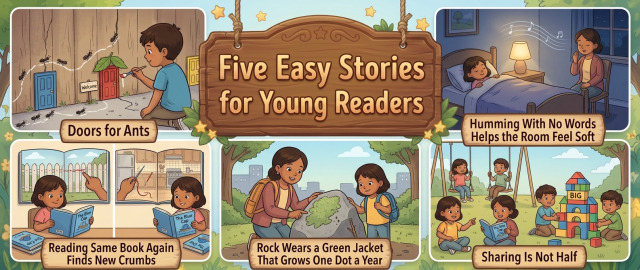
AIで生成したやさしい英文5話をまとめて掲載しています。
英文の難易度
CEFR:Pre-A1
英検:5級
語数:5話合計約1,362語
制作について
本記事の英文・日本語訳・英語難易度の評価は、AIを活用して作成したものです。
内容の正確性を保証するものではありません。
論理的な矛盾・文脈の破綻などが含まれている可能性や、歴史的事実・科学的な正確性・一般常識などに合致しない事柄が含まれている可能性があります。あくまでも英文を読む練習用の素材として考えて下さい。
「んっ?」と思うところがあっても、無視して読み続ける能力を獲得していただければ幸いです…
なお、難易度の評価は目安であり、CEFRや英検による公式な判定ではありません。
Doors for Ants
英語本文:約261語
There was a wall behind the garage. Old wood. Many ants lived there.
A boy named Leo watched them. Ants went in and out of small cracks. Like doors.
Leo thought, “Cracks are not good doors. Let me make doors.”
He took small bits of wood. Flat bits. From a craft box. He painted them. Red, blue, yellow.
He glued a red door over a crack. Small. Just for ants. He made a tiny roof too. With a leaf.
Next day, ants used the red door. They went in. Out. They touched the paint.
Leo made more. A blue door on another crack. A yellow door near the ground.
He made windows too. Tiny white dots. Not real windows. Just paint. But they looked like windows.
Mom saw him. She said, “You made a town.”
Leo said, “Ant town.”
He added streets. He drew lines with chalk on the wood. Lines from door to door.
Ants followed chalk lines. Chalk dust stuck to feet. White feet.
It rained. Chalk washed away. Paint doors stayed. Ants still knew where doors were.
Leo added a small sign. It said, “Welcome.” Very small letters. Ants cannot read. But Leo could read it.
Summer ended. Wood got cold. Ants went deep inside. No more in and out.
Doors stayed there. Red, blue, yellow. On old wood behind the garage.
Leo knew ants would come back the next warm day. Doors waiting.
He built houses for ants. Not for people. Small houses that fit in cracks.
The old wall looked like a town now. Because one boy made doors.
日本語対訳
アリのためのドア
ガレージの裏に壁があった。古い木だ。たくさんのアリがそこに住んでいた。
レオという男の子が彼らを見ていた。アリは小さなひび割れから出たり入ったりしていた。まるでドアのようだった。
レオは思った。ひび割れは良いドアではない。ドアを作ろう。
小さな木片を持って来た。平らな切れ端だ。工作箱からだ。色を塗った。赤、青、黄色。
赤いドアをひび割れの上に貼り付けた。小さい。アリのためだけの。小さな屋根も作った。葉っぱで。
次の日、アリは赤いドアを使った。中へ入った。出てきた。塗料に触れた。
レオはもっと作った。別のひび割れに青いドア。地面の近くに黄色いドア。
窓も作った。とても小さな白い点。本物の窓ではない。ただのペンキだ。でも窓のように見えた。
ママが彼を見た。言った。町を作ったのね。
レオが言った。アリの町だよ。
通りも足した。チョークで木の上に線を描いた。ドアからドアへの線だ。
アリはチョークの線に沿って進んだ。チョークの粉が足にくっついた。白い足だ。
雨が降った。チョークは洗い流された。ペンキのドアは残った。アリはまだドアがどこか分かっていた。
レオは小さな看板も足した。そこにはいらっしゃいと書いてあった。とても小さな文字。アリは読めない。でもレオは読めた。
夏が終わった。木は冷たくなった。アリは奥深くへ入っていった。もう出入りはしなくなった。
ドアはそこに残った。赤、青、黄色。ガレージの裏の古い木の上に。
レオは分かっていた。次の暖かい日にアリは戻って来るだろうと。ドアは待っている。
彼はアリのために家を建てたのだ。人間のためではない。ひび割れに収まる小さな家だ。
古い壁は今では町のようだった。一人の男の子がドアを作ったからだ。
Humming With No Words Helps the Room Feel Soft
英語本文:約273語
At night, Mom does not always sing words. Sometimes she hums. Her mouth is closed. The sound comes from her nose and chest. Hmm, hmm, hmm.
A hum has no words, so it cannot tell a story. But it can tell the body to slow down.
When we hear words, our brain tries to understand them. What does cat mean? What does sleep mean? Our brain works hard. When we hear a hum, our brain does not need to work on words. It just hears the tone. The tone goes up a little and down a little.
Lena is tired but not sleepy. She lies in bed. Her eyes are open. Mom sits near the bed. Mom does not say, “Close your eyes now.” Mom hums. The hum is low and soft. It is the same note again and again, with a small rise at the end.
Lena’s breath starts to follow the hum. Mom hums out, Lena breathes out. Mom hums in, Lena breathes in. The hum is like a slow swing.
After a while, Lena hums, too. Her hum is small and shaky. Mom’s hum is steady. The two hums meet in the room. They do not need to match perfectly.
Scientists say humming makes a soft shake in the chest. The shake is called vibration. The vibration can help the heart go slow.
Mom stops humming. The room is quiet, but the quiet feels soft now, not empty. Lena’s eyes close.
In the morning, Lena asks, “Why did you hum with no words?” Mom says, “Words tell you what to think. A hum tells you it is safe to rest.”
日本語対訳
言葉のない鼻歌が部屋を柔らかくする
夜、ママはいつも歌詞を歌うわけではありません。時々鼻歌を歌います。口は閉じています。音は鼻と胸から来ます。フンフンフン。
鼻歌には言葉がないので、物語を語ることはできません。しかし体にゆっくりするよう伝えることはできます。
言葉を聞くと、脳は理解しようとします。猫とはどういう意味?眠るとはどういう意味?脳は一生懸命働きます。鼻歌を聞くと、脳は言葉に取り組む必要がありません。ただ音の高さを聞きます。その高さは少し上がり少し下がります。
レナは疲れていますが眠くはありません。ベッドに横になっています。目は開いています。ママはベッドの近くに座ります。ママは「もう目を閉じて」とは言いません。鼻歌を歌います。鼻歌は低くて柔らかいです。同じ音が何度も繰り返され、最後に少し高くなります。
レナの呼吸が鼻歌についていき始めます。ママが鼻歌を歌いながら息を吐くと、レナも息を吐きます。ママが鼻歌を歌いながら息を吸うと、レナも息を吸います。鼻歌はゆっくりしたブランコのようです。
しばらくするとレナも鼻歌を歌います。彼女の鼻歌は小さくて震えています。ママの鼻歌は安定しています。二つの鼻歌が部屋で出会います。完全に一致する必要はありません。
科学者は鼻歌が胸に柔らかい震えを作ると言います。その震えは振動と呼ばれます。振動は心臓がゆっくりになるのを助けます。
ママは鼻歌を止めます。部屋は静かですが、静けさは今は柔らかく感じられ、空っぽではありません。レナの目が閉じます。
朝、レナは尋ねます。「どうして言葉なしで鼻歌を歌ったの?」ママは言います。「言葉はあなたに何を考えるべきかを伝えるの。鼻歌は休んでも安全だということを伝えるのよ」
Reading Same Book Again Finds New Crumbs
英語本文:約286語
Some kids think reading the same book again is boring. They say, “I already know what happens.” But rereading is not the same as reading the first time.
The first time you read a book, you read fast to know the story. Does the bear find honey? Does the boat get home? Your brain is busy chasing the end.
The second time, you know the end. So your brain can look around. You see crumbs you missed.
Lena reads The Blue Cap. First time, she reads to see if Sam finds his cap. He does. The end.
Second time, she reads again. Now she knows Sam finds the cap. So she sees a small thing on page two: a red thread on the fence. The thread is Sam’s cap string. She missed it the first time because she was in a hurry.
Third time, she reads again. She sees Mom’s hand in the kitchen picture. Mom holds a needle. Mom will fix the cap. Lena did not see the needle before. Now she knows Mom helps, not just Sam.
Same book, new eyes.
Books do not change. Readers change. After a day at the park, you know what a fence looks like. After you lose your own hat, you know how Sam feels. The book stays the same, but you bring new crumbs from your day into it.
So rereading is not going back. It is like walking the same path after rain. The path is the same, but you see puddles, footprints, and a worm you did not see before.
Lena keeps The Blue Cap on her shelf. She knows the end. She still opens it. Each time, she finds one more small thing and smiles.
日本語対訳
同じ本を再び読むと新しいかけらが見つかる
同じ本を再び読むのは退屈だと考える子もいます。「もう何が起こるか知っている」と言います。しかし再読は初めて読むのと同じではありません。
初めて本を読むときは、物語を知るために速く読みます。クマはハチミツを見つける?ボートは家に帰る?脳は結末を追いかけるのに忙しいです。
二回目は結末を知っています。だから脳は周りを見回すことができます。見逃していたかけらが見えます。
レナは『青い帽子』を読みます。最初はサムが帽子を見つけるかを知るために読みます。見つけます。終わりです。
二回目は再び読みます。今はサムが帽子を見つけることを知っています。だから二ページ目にある小さなものが見えます。柵の上の赤い糸です。その糸はサムの帽子の紐です。急いでいたので最初は見逃しました。
三回目は再び読みます。台所の絵の中にお母さんの手が見えます。お母さんは針を持っています。お母さんが帽子を直すでしょう。以前は針が見えませんでした。今はサムだけでなくお母さんも手伝っていることが分かります。
同じ本、違う目。
本は変わりません。読み手が変わります。公園で一日過ごした後、柵がどんなふうに見えるか分かります。自分の帽子をなくした後、サムがどんな気持ちか分かります。本は同じままですが、あなたはその日の経験から新しいかけらを持ち込むのです。
だから再読は後戻りではありません。雨の後に同じ道を歩くようなものです。道は同じですが、水たまりや足跡や前には見なかったミミズが見えます。
レナは『青い帽子』を棚に置いておきます。結末を知っています。それでも開きます。毎回、もう一つ小さなものを見つけて微笑みます。
Rock Wears a Green Jacket That Grows One Dot a Year
英語本文:約281語
There is a big gray rock behind the school. The rock does not move. On its north side, where the sun is soft, there is a green jacket. The jacket is not cloth. It is lichen.
Lena touches the lichen. It feels dry and a little bumpy, like old paint. It does not peel off easy. It holds tight to the rock.
Mr. Patel, the science teacher, says, “Lichen is two living things together. One is like algae, very small and green. It makes food from the sun. One is like fungus, like tiny threads. It holds water and holds on to the rock. Together they live where no one else can.”
Lena asks, “Does it grow?”
Mr. Patel says, “Yes, but very slow. In one year, it may grow as much as one dot made by a pencil tip. So this patch may be older than the school.”
Lena looks at the patch. It is the size of her hand. If one dot a year, that hand took many, many years.
Rain comes. Lena watches the lichen. Dry lichen is light green and hard. Wet lichen turns dark green and soft. It soaks up rain like a sponge and keeps it.
A small ant walks over the rock. The rock is slick when wet. The lichen gives the ant a rough road to grip.
After rain, the sun comes out. The lichen dries again. Light green and hard again.
Lena puts a small stick next to the edge of the lichen. “Next year, I will see if you grew past the stick,” she says.
The rock does not move. The green jacket does not hurry. One dot a year is enough.
日本語対訳
一年に一点ずつ成長する緑のジャケットを着た岩
学校の裏に大きな灰色の岩があります。岩は動きません。太陽が柔らかい北側に緑のジャケットがあります。そのジャケットは布ではありません。地衣類です。
レナは地衣類に触ります。古いペンキのように乾いていて少しでこぼこした感じがします。簡単には剥がれません。岩にしっかりとくっついています。
理科の先生のパテルさんが言います。「地衣類は二つの生き物が一緒になったものなんだ。一つは藻のようなもので、とても小さくて緑色。太陽から食べ物を作る。もう一つは菌類のようなもので、小さな糸のよう。水を保持し岩にしがみつくんだ。一緒にいることで他では誰も住めない場所に住めるんだよ」
レナが尋ねます。「成長するの?」
パテルさんが言います。「ああ、でもとてもゆっくりだ。一年で鉛筆の先で作る一点ほどしか成長しないかもしれない。だからこの一枚は学校よりも古いかもしれないよ」
レナはその一枚を見ます。手のひらほどの大きさです。一年に一点なら、その大きさになるのに何年も何年もかかったことになります。
雨が降ってきます。レナは地衣類を見ます。乾いた地衣類は薄い緑で硬いです。濡れた地衣類は濃い緑で柔らかくなります。スポンジのように雨を吸い込み保持します。
小さなアリが岩の上を歩きます。岩は濡れるとつるつる滑ります。地衣類は、アリがつかまりやすいでこぼこした道になります。
雨の後、太陽が出てきます。地衣類は再び乾きます。また薄い緑で硬くなります。
レナは地衣類の端の隣に小さな棒を置きます。「来年、棒を越えて成長したか見てみるね」と言います。
岩は動きません。緑のジャケットは急ぎません。一年に一点で十分なのです。
Sharing Is Not Half
英語本文:約261語
Sharing is not half.
Some people think sharing is half.
I have a cookie. I cut it. You get half. I get half.
That is one way. But not the best way.
Think of a swing.
I swing. Then you swing. We both swing. The swing is not half.
Think of a book.
I read it. Then you read it. We both read it. The book is not half.
Think of light.
I see light. You see light. We both see light. Light is not half.
Some things go down when you share. Cookies go down. Juice goes down.
Some things do not go down. Swings do not go down. Books do not go down. Light does not go down. Songs do not go down. Love does not go down.
Good sharing is like that.
I have a song. I sing it. You hear it. Now you have it too. I still have it.
I have a smile. I give it. You smile back. Now we both smile. My smile is still here.
I have a block. You add one. I add one. Now we have a big house. Big!
So sharing is not always half.
Sharing is making more.
How? You let someone use it too.
You say, “Your turn.”
You say, “Read it after me.”
You say, “Come see this light.”
You say, “Let’s make it big.”
You do not cut it. You let them in.
That is why sharing is not half.
Sharing is more.
More fun. More light. More love. More big houses.
And more is good.
日本語対訳
共有は半分じゃない
共有は半分じゃない。
半分だと思う人もいる。
クッキーがあるよ。切るよ。半分はあなた。半分はわたし。
それも一つのやり方。でも一番良いやり方じゃない。
ブランコを考えてみて。
わたしがこぐ。次はあなたがこぐ。二人ともこげる。ブランコは半分じゃない。
本を考えてみて。
わたしが読む。次はあなたが読む。二人とも読む。本は半分じゃない。
光を考えてみて。
わたしは光を見る。あなたも光を見る。二人とも光を見る。光は半分じゃない。
分けると減るものもある。クッキーは減る。ジュースは減る。
減らないものもある。ブランコは減らない。本は減らない。光は減らない。歌は減らない。愛は減らない。
良い共有はそういうものだ。
歌があるよ。わたしが歌う。あなたが聞く。あなたもそれを持つ。わたしもまだ持っている。
笑顔があるよ。わたしがあげる。あなたが笑い返す。二人とも笑う。わたしの笑顔はまだここにある。
積み木があるよ。あなたが一つ足す。わたしが一つ足す。大きな家ができた。大きい!
だから共有はいつも半分じゃない。
共有はもっと作ることだ。
どうやって?誰かにも使わせるんだ。
「あなたの番だよ」と言う。
「わたしの次に読んで」と言う。
「この光を見に来て」と言う。
「大きくしよう」と言う。
切らない。仲間に入れる。
だから共有は半分じゃない。
共有はもっと、だ。
もっと楽しい。もっと光。もっと愛。もっと大きな家。
そして、もっと多いほうがいい。