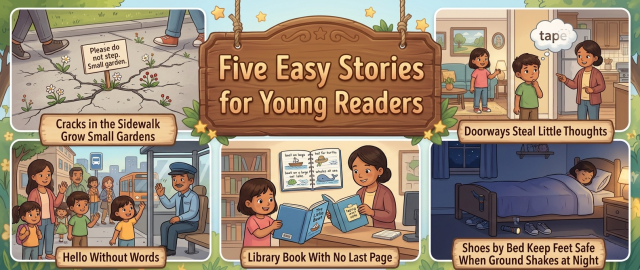
AIで生成したやさしい英文5話をまとめて掲載しています。
英文の難易度
CEFR:Pre-A1
英検:5級
語数:5話合計約1,417語
制作について
本記事の英文・日本語訳・英語難易度の評価は、AIを活用して作成したものです。
内容の正確性を保証するものではありません。
論理的な矛盾・文脈の破綻などが含まれている可能性や、歴史的事実・科学的な正確性・一般常識などに合致しない事柄が含まれている可能性があります。あくまでも英文を読む練習用の素材として考えて下さい。
「んっ?」と思うところがあっても、無視して読み続ける能力を獲得していただければ幸いです…
なお、難易度の評価は目安であり、CEFRや英検による公式な判定ではありません。
Cracks in the Sidewalk Grow Small Gardens
英語本文:約257語
On Oak Street, the sidewalk has many cracks. The cracks are thin lines in the gray stone.
Wind blows seeds down the street. Some seeds fall into the cracks. A crack is a good home. It holds dust and rain. It is safe from feet.
In spring, a little green line shows in one crack. The green line grows up. It opens two small leaves. It is a plant from a seed that fell in winter.
People walk past. Their shoes go left and right of the crack. The plant stays low. It does not get stepped on.
Rain comes. Water runs down the sidewalk and into the crack. The crack drinks the water and gives it to the roots below. Sun comes. The sun warms the gray stone. The stone holds heat at night and keeps the roots warm.
By summer, there are five small gardens on Oak Street. All in cracks. One has white flowers. One has a tall green stem. One has tiny red berries.
Mrs. Lee, who lives at number 12, puts a small sign next to one crack. The sign says, “Please do not step. Small garden.”
Kids stop and look down. They count the flowers. They do not pick them. They know the garden lives in a crack, so it needs all its parts.
In fall, the plants make new seeds. Wind blows the seeds down the street. Some seeds fall into new cracks. The sidewalk will have new gardens next spring.
The cracks are not broken. They are plant homes.
日本語対訳
歩道のひび割れに小さな庭が生える
オーク通りでは、歩道にたくさんのひび割れがあります。ひび割れは灰色の石の中の細い線です。
風が種を通りに吹き下ろします。いくつかの種がひび割れの中に落ちます。ひび割れは良い家です。埃と雨を保ちます。足から安全です。
春に、一本の小さな緑の線が一つのひび割れに現れます。緑の線は上に伸びます。二枚の小さな葉を開きます。冬に落ちた種からの植物です。
人々は通り過ぎて歩きます。靴はひび割れの左右を通ります。植物は低いままです。踏まれません。
雨が来ます。水が歩道を流れ落ちてひび割れの中に入ります。ひび割れは水を飲み、下の根に与えます。太陽が来ます。太陽は灰色の石を温めます。石は夜に熱を保ち、根を暖かく保ちます。
夏までには、オーク通りに五つの小さな庭があります。すべてひび割れの中です。一つは白い花を持っています。一つは背の高い緑の茎を持っています。一つは小さな赤い実を持っています。
12番地に住むリーさんが一つのひび割れの横に小さな看板を置きます。看板には「踏まないでください。小さな庭です」と書かれています。
子どもたちは止まって下を見ます。花を数えます。摘みません。庭がひび割れに住んでいることを知っているので、すべての部分が必要だと知っています。
秋には植物が新しい種を作ります。風が種を通りに吹き下ろします。いくつかの種が新しいひび割れに落ちます。歩道には来年の春に新しい庭ができるでしょう。
ひび割れは壊れているのではありません。植物の家なのです。
Doorways Steal Little Thoughts
英語本文:約338語
Milo walks from the living room to the kitchen. Halfway there, he stops. What did I come for? He cannot remember. He looks at the fridge. He looks at the sink. Nothing rings a bell.
He walks back to the living room. Oh! He needed tape. He walks to the kitchen again and forgets again. The doorway seems to wipe his head clean.
Milo thinks his brain is broken. His big sister laughs, but not in a mean way. “That happens to everyone,” she says. “It is called the doorway effect.”
She explains. When you move from one place to another, your brain makes a little cut. It files away what happened in the last room, to make space for the new room. Sometimes it files away the thing you were holding in your mind too, like the word tape.
“It is not a bug,” she says. “It is how your mind tidies up. Rooms are like folders.”
Milo tries a test. He says his job out loud: “Tape, tape, tape.” He holds a small picture of tape in his head. He walks through the doorway while still saying it. This time he remembers.
Later he learns two more tricks. One is to go back to the first room. When he stands where the thought first came, the thought often pops back up. The room brings it back.
The other trick is to carry a clue. He points his finger or holds his hand like he is holding tape. The body helps the brain keep the file open.
That night Milo walks to the kitchen and does not forget. He brings back the tape. He sticks a note on the doorway. It says, “Did you forget? Go back or say it out loud.”
The doorway still steals little thoughts sometimes. But now Milo knows why. A room is a folder. When you cross the line, the folder closes a bit. If you want to keep a thought, hold it tight, say it, or take the folder with you.
日本語対訳
出入り口が小さな考えを盗む
ミロは居間から台所へ歩きます。途中で止まります。何を取りに来たんだっけ?思い出せません。冷蔵庫を見ます。シンクを見ます。何も心当たりがありません。
居間に戻ります。あ!テープが必要だったんだ。台所へまた歩きますが、また忘れます。出入り口が頭をきれいに拭い去ってしまうようです。
ミロは自分の脳が壊れたと思います。お姉さんは笑いますが、意地悪な笑い方ではありません。「誰にでも起こることよ」と彼女は言います。「それはドアウェイ効果って呼ばれてるの」
お姉さんは説明します。ある場所から別の場所へ移動すると、脳は小さな切れ目を作るの。前の部屋で起こったことを片付けて、新しい部屋のために場所を作るの。時には心の中に持っていたもの、例えばテープという言葉まで片付けてしまうこともあるの。
「バグじゃないのよ」と彼女は言います。「心が片付ける方法なの。部屋はフォルダみたいなものなの」
ミロは試してみます。自分の仕事を声に出して言います。「テープ、テープ、テープ」頭の中にテープの小さな絵を持ちます。まだ言いながら出入り口を通ります。今度は覚えていられます。
後で二つ別のコツも学びます。一つは最初の部屋に戻ることです。考えが最初に浮かんだ場所に立つと、考えがしばしばふと戻ってきます。部屋がそれを連れ戻してくれるのです。
もう一つのコツは手がかりを持ち歩くことです。指をさしたり、テープを持っているように手を握ったりします。体は、脳がファイルを開いたままにするのを助けます。
その夜、ミロは台所へ歩いても忘れません。テープを持ち帰ります。出入り口にメモを貼ります。「忘れた?戻るか声に出して言ってみて」と書いてあります。
出入り口は今でも時々小さな考えを盗みます。でも今は、ミロにはその理由がわかっています。部屋はフォルダなのです。線をまたぐと、フォルダは少し閉じます。考えを保ちたいなら、しっかり持って、口に出して言うか、フォルダごと持っていくのです。
Hello Without Words
英語本文:約257語
You can say hello with no words.
You wave. Your hand goes up and down. That is hello.
You nod. Your head goes down and up. That is hello too.
You smile. Your mouth goes up. That is hello also.
No words. But people know.
How do they know? They see your face. They see your hand. They know the signs.
Signs are old. Very old. Before words, we had signs.
A wave can mean hi. A wave can mean bye. Same hand. But we know. We look at when it happens.
In the morning, a wave is hi. At the door, a wave is bye.
A nod can mean yes. A small nod means yes, I hear you.
A big smile can mean I like you. A small smile can mean thank you.
We do this all day. We talk with no words.
Think of a bus. You get on. You nod to the driver. He nods back. No words. But you said thank you and he said you are welcome.
Think of a friend far away. You wave big. Big wave means I see you! Come here!
Think of a library. It is quiet. You cannot say hi loud. So you do a small wave. Small wave means hi, but quiet.
Words are good. But signs are fast. And signs work when it is loud. Or far. Or quiet.
You can say hello with no words. And people will know.
Try it today. Wave. Nod. Smile. No words.
See who says hello back with no words too.
日本語対訳
言葉なしのこんにちは
言葉がなくてもこんにちはが言える。
手を振る。手が上下に動く。それがこんにちはだ。
うなずく。頭が下がって上がる。それもこんにちはだ。
笑う。口が上がる。それもこんにちはだ。
言葉はない。でもみんな分かる。
どうして分かるの?顔を見るから。手を見るから。合図が分かるから。
合図は古い。とても古い。言葉の前から合図はあった。
手を振るのはやあという意味になる。手を振るのはバイバイという意味にもなる。同じ手だ。でも分かる。いつ振るかを見て分かるのだ。
朝は、手を振るのはやあだ。ドアのところでは、手を振るのはバイバイだ。
うなずくのは、はいという意味になる。小さくうなずくのは、うん、聞こえてるよという意味だ。
大きな笑顔は、好きだよという意味になる。小さな笑顔は、ありがとうという意味になる。
私たちは一日中こうしている。言葉なしで話しているのだ。
バスを考えてみて。乗る。運転手にうなずく。運転手もうなずき返す。言葉はない。でもありがとうと言って、いえどういたしましてと返したのだ。
遠くにいる友だちを考えてみて。大きく手を振る。大きく振るのは、見えたよ!こっち来て!という意味だ。
図書館を考えてみて。静かだ。大きな声でやあとは言えない。だから小さく手を振る。小さく振るのは、やあ、でも静かにねという意味だ。
言葉は良い。でも合図は速い。そしてうるさいときも、遠いときも、静かなときも使える。
言葉なしでこんにちはが言える。そしてみんな分かる。
今日やってみよう。手を振って。うなずいて。笑って。言葉なしで。
誰が言葉なしでこんにちはを返してくれるか見てみよう。
Library Book With No Last Page
英語本文:約283語
There is a library book with a blue cover. The title says The Little Boat. Many kids have read it. The last page is gone. Someone tore it out long ago.
Lena checks out the book. She reads it at her desk. A little boat leaves a pond. It goes down a small river. It meets a duck. It meets a turtle. It goes over a small fall. Then the pages stop. No last page. Where did the boat go?
Lena goes to the library. She tells Mrs. Kim, “The last page is gone.”
Mrs. Kim says, “I know. The last page has been gone for many years. What do you think happens?”
Lena thinks. She says, “I think the boat finds the big lake and stops. It likes the quiet.”
Mrs. Kim takes out a small notebook. She says, “Other kids wrote what they think. Do you want to read?”
Lena opens the notebook. One kid wrote: The boat goes to the sea and sees whales. Another wrote: The boat turns back and goes home to the pond. Another wrote: The boat becomes a hat for the turtle.
Lena laughs. She writes her own ending on a new page in the notebook: The boat finds the big lake and rests near the reeds. The duck and turtle visit it.
Mrs. Kim tapes a note inside the blue cover. It says: Last page missing. See notebook for many endings. Pick one you like, or write your own.
Lena puts the blue book back on the shelf. It still has no last page. But now it has many last pages, in the notebook next to it. The book is not broken. It is open.
日本語対訳
最終ページのない図書館の本
青い表紙の図書館の本があります。タイトルは『小さなボート』とあります。たくさんの子が読んできました。最終ページがなくなっています。誰かがずっと前に破り取ったのです。
レナは本を借ります。机で読みます。小さなボートが池を出ます。小さな川を下ります。アヒルに出会います。カメに出会います。小さな滝を越えます。それでページが終わります。最終ページがありません。ボートはどこへ行ったのでしょう?
レナは図書館へ行きます。キムさんに言います。「最終ページがありません」
キムさんは言います。「知っているわ。最終ページは何年も前からなくなっているの。どうなると思う?」
レナは考えます。「ボートは大きな湖を見つけて止まると思う。静かなのが好きなの」
キムさんは小さなノートを取り出します。「他の子たちは、どうなると思うかを書いたわ。読んでみる?」
レナはノートを開きます。一人の子はこう書きました。ボートは海に行ってクジラを見る。別の子はこう書きました。ボートは引き返して池の家に帰る。別の子はこう書きました。ボートはカメの帽子になる。
レナは笑います。ノートの新しいページに自分なりの結末を書きます。ボートは大きな湖を見つけ葦の近くで休む。アヒルとカメが訪ねてくる。
キムさんは青い表紙の内側にメモをテープで貼ります。そこにはこう書かれています。最終ページ欠落。多くの結末はノートを見てください。好きなものを選ぶか、自分で書いてください。
レナは青い本を棚に戻します。まだ最終ページはありません。しかし今はその隣のノートの中にたくさんの最終ページがあります。本は壊れていません。開かれているのです。
Shoes by Bed Keep Feet Safe When Ground Shakes at Night
英語本文:約279語
At night, the ground can shake. Things fall off shelves. Glass can break. The floor may have small sharp bits.
If you wake up in the dark and step with bare feet, those bits can cut your feet. Then you cannot walk fast to go outside.
So keep shoes by your bed. Not in the closet. By your bed.
Lena has shoes by her bed every night. She puts them under the bed, toes facing out. So she can slide her feet right in, even in the dark. She also tapes a small flashlight to the side of the bed frame. The flashlight has fresh batteries.
Mom says, “Why by the bed?”
Lena says, “If the ground shakes at night, the floor will be messy. I need shoes before I walk. And I need light to see the floor.”
When the ground shakes, lights may go out. Glass from a picture frame may fall. A shelf may tip and drop things. The floor is not safe for bare feet.
With shoes on, Lena can walk over small bits. With light, she can see a big piece and step around it. She can walk to Mom and Dad. She can go outside if they need to.
In the morning, she checks. Are shoes still under the bed? Toes out? Is the flashlight still taped? Does it turn on?
Some nights, no shake. Shoes stay there. Light stays there. That is okay. Ready is not waste.
Keeping shoes by the bed does not stop the shake. It keeps feet safe so you can move after the shake.
Shoes by bed, light by bed, every night. Two small steps that help when the ground shakes at night.
日本語対訳
夜に地面が揺れたときに足を守るベッド脇の靴
夜、地面が揺れることがあります。物が棚から落ちます。ガラスが割れることがあります。床には小さな鋭い破片があるかもしれません。
暗闇で目が覚めて素足で踏み出すと、その破片が足を切ることがあります。そうなると外へ行くために速く歩けません。
だから靴をベッドのそばに置いておきます。クローゼットの中ではなく。ベッドのそばに。
レナは毎晩ベッドのそばに靴を置いています。ベッドの下に、つま先を外向きにして置きます。暗闇でも足をすっと入れられるように。さらに小さな懐中電灯をベッドフレームの側面にテープで貼り付けています。懐中電灯には新しい電池が入っています。
お母さんが言います。「なぜベッドのそばなの?」
レナが言います。「夜に地面が揺れると、床は散らかるの。歩く前に靴が必要なの。そして床を見るために明かりが必要なの」
地面が揺れると、電気が消えることがあります。額縁のガラスが落ちることがあります。棚が傾いて物を落とすことがあります。床は素足では安全ではありません。
靴を履いていれば、小さな破片の上を歩けます。明かりがあれば、大きな破片を見て避けて歩けます。お父さんとお母さんのところへ歩いて行けます。必要なら外へ行けます。
朝、確認します。靴はまだベッドの下にある?つま先は外向き?懐中電灯はまだ貼り付けてある?点くの?
揺れない夜もあります。靴はそこにあります。明かりもそこにあります。それでよいのです。備えは無駄ではありません。
ベッドのそばに靴を置いておいても揺れは止まりません。揺れた後に動けるように足を守るのです。
ベッドのそばに靴、ベッドのそばに明かり、毎晩。夜に地面が揺れたときに役立つ二つの小さな備えです。