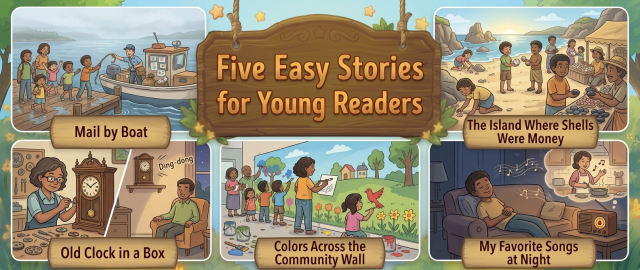
AIで生成した少しやさしい英文5話をまとめて掲載しています。
英文の難易度
CEFR:A1
英検:4級
語数:5話合計約1,369語
制作について
本記事の英文・日本語訳・英語難易度の評価は、AIを活用して作成したものです。
内容の正確性を保証するものではありません。
論理的な矛盾・文脈の破綻などが含まれている可能性や、歴史的事実・科学的な正確性・一般常識などに合致しない事柄が含まれている可能性があります。あくまでも英文を読む練習用の素材として考えて下さい。
「んっ?」と思うところがあっても、無視して読み続ける能力を獲得していただければ幸いです…
なお、難易度の評価は目安であり、CEFRや英検による公式な判定ではありません。
Mail by Boat
英語本文:約286語
There was a town with no roads to it.
No cars could drive there. No trucks.
How did people get mail?
By boat.
The town was on a small island. Water all around. No bridge.
Every morning, a boat left the big town. On the boat, bags of mail. Letters. Boxes. Newspapers.
The boat driver knew every wave. He knew when wind was strong. He went slow then. When fog came, he went slower.
Kids on the island waited. They knew the boat time. Ten o’clock. If fog, eleven.
When the boat came, it blew its horn. Toot toot.
People walked down to the dock. The wood dock. Wet and cold.
The mailman on the boat threw a rope. People caught the rope. Pulled the boat close.
Then the mail bags came off. Heavy. One bag for the north side. One for the south side. Kids helped carry them.
If someone ordered something big, like a chair, a big box came on the boat too. The boat tilted a little to one side.
In winter, the water had ice. Thin ice. The boat had to push ice. Crack crack. Slow.
Sometimes the ice was too thick. The boat could not go. No mail that day. People waited. Next day, double mail. Two more bags.
People on the island did not mind. They said, “Mail by boat is better than no mail.”
They wrote letters to thank the boat driver. The driver taped the letters in the boat cabin. Many letters now on the wall.
He liked that.
There is still no road to the island. No bridge. So mail still comes by boat.
Ten o’clock. Toot toot. Rope. Bags. Every day the water is a road.
日本語対訳
船で届く郵便
そこへ行く道がない町があった。
車では行けない。トラックも行けない。
人々はどうやって郵便を受け取っていたのだろう?
船でだ。
町は小さな島にあった。周りは全部水。橋はない。
毎朝、船が大きな町から出た。船には郵便の袋。手紙。箱。新聞。
船の運転手はすべての波を知っていた。風がいつ強くなるかも知っていた。そのときはゆっくり進んだ。霧が出るともっとゆっくり進んだ。
島の子どもたちは待っていた。船の時間を皆知っていた。十時だ。霧なら十一時だ。
船が来ると警笛を鳴らした。ブーッブーッ。
人々は波止場へ歩いて下りた。木の波止場。濡れていて冷たい。
船の上の郵便屋さんがロープを投げた。人々はロープをつかんだ。船を近くへ引き寄せた。
それから郵便袋が降ろされた。重い。北側に一つ。南側に一つ。子どもたちが運ぶのを手伝った。
誰かが椅子のような大きなものを注文すれば、大きな箱も船で来た。船は少し片側に傾いた。
冬には水に氷が張った。薄い氷だ。船は氷を押して進まなければならなかった。パリパリ。ゆっくりだ。
時々氷が厚すぎた。船は行けなかった。その日は郵便なしだ。人々は待った。翌日は郵便が二倍。二つ多く袋が来た。
島の人々は気にしなかった。言った。郵便が船で来る方が郵便が来ないより良いよ、と。
彼らは船の運転手に感謝の手紙を書いた。運転手は手紙を船室に貼った。今では壁にたくさんの手紙がある。
彼はそれが気に入った。
今でも島へ行く道はない。橋もない。だから郵便は今でも船で来る。
十時。ブーッブーッ。ロープ。袋。毎日水が道になる。
The Island Where Shells Were Money
英語本文:約298語
Far out in the blue sea there was a small island. The people there did not have dollars. They used smooth white shells. A big fish cost three shells. A new hat cost ten shells.
One day a boy named Milo found a whole beach of white shells. He filled his bag. He thought he was rich. But when he went to the market, no one would take his shells anymore. Everyone had found the same beach.
The old woman who fixed nets said, “Shells work because they are hard to find. If they are everywhere, they are not special.”
So the people sat down and picked a new kind of shell. It was tiny and pink, and it only lived deep under rocks. It was hard to find. One pink shell was worth ten white shells. The market started again.
Milo asked, “Why is a little pink shell worth more than a big fish? You cannot eat a shell.”
His mother said, “You are right. A shell has no taste. A dollar has no taste either. Paper money is just paper. It works because we all agree it does. If I give you this pink shell, you can trust that the fisher will take it tomorrow. Money is a promise we share.”
Milo understood. The pink shell was not magic. The magic was trust. People agreed to believe in the same thing.
Months later, some people wanted to trade with the next island. That island used black stones. The two islands had to agree again. How many pink shells for one black stone? They talked and talked until they made a new promise together.
That is how money works anywhere. It is not the paper or the shell or the stone. It is the agreement behind it.
日本語対訳
貝殻がお金だった島
青い海のずっと向こうに小さな島がありました。そこでは人々はドルを持っていませんでした。彼らは滑らかな白い貝殻を使っていました。大きな魚は貝殻3つ、新しい帽子は貝殻10個でした。
ある日、ミロという男の子が白い貝殻でいっぱいの浜辺を見つけました。彼は袋いっぱいに詰めました。自分はお金持ちになったと思いました。でも市場に行くと、もう誰も彼の貝殻を受け取ってくれませんでした。みんなが同じ浜辺を見つけていたのです。
網を直すおばあさんが言いました。「貝殻が使えるのは、見つけるのが難しいからだよ。もし至る所にあれば、特別ではなくなるのさ」
そこで人々は座って、新しい種類の貝殻を選びました。それは小さくてピンク色で、岩の深い下にしかいませんでした。見つけるのが難しい貝でした。ピンクの貝1つは白い貝10個分の価値になりました。市場はまた動き始めました。
ミロは尋ねました。「どうして小さなピンクの貝が大きな魚より価値があるの?貝は食べられないのに」
お母さんは言いました。「その通りね。貝に味はないわ。ドルにも味はないの。紙のお金はただの紙よ。みんながそうだと同意するから使えるの。もし私があなたにこのピンクの貝をあげれば、漁師さんが明日それを受け取ってくれると信じられるでしょう。お金はみんなで分かち合う約束なのよ」
ミロは分かりました。ピンクの貝は魔法ではありませんでした。魔法は信頼だったのです。人々は同じものを信じることに同意したのでした。
何ヶ月か後、何人かの人々が隣の島と取引したいと思いました。その島では黒い石を使っていました。2つの島はまた同意しなければなりませんでした。ピンクの貝何個で黒い石1個なのか。彼らは一緒に新しい約束を作るまで、ずっと話し合いました。
それがどこでもお金が働く仕組みです。それは紙でも貝でも石でもありません。その背後にある合意なのです。
Old Clock in a Box
英語本文:約267語
Maya is 50 years old. She works with old things. She fixes old clocks.
One day, a man comes to her shop. He has a big box. In the box, there is a very old clock. The clock is from 1900.
The man says, “This clock is from my grandma. It does not work now. Can you fix it?”
Maya looks at the clock. The clock is brown. It has small numbers. The glass is dirty. Maya opens the back of the clock. Inside, there are many small parts.
Maya says, “I will try.”
For three days, Maya works on the clock. She cleans each part. She uses small tools. She works slowly and carefully. Some parts are broken. She makes new parts.
On day four, Maya puts all the parts together again. She puts the clock on the table. She waits.
Tick-tock. Tick-tock. The clock starts to work.
Maya smiles. She calls the man.
The man comes to the shop. He sees the clock. The clock works. He is very happy.
He says, “My grandma loved this clock. Every hour, it made a nice sound. Ding-dong. I heard it when I was a small boy.”
Maya says, “Now you can hear it again.”
The man takes the clock home. He puts it in his living room.
That night, the clock makes a sound. Ding-dong. The man hears it. He thinks of his grandma. He feels warm.
Maya loves her work. She does not make new things. She makes old things work again. Old things have stories. When she fixes a clock, she also keeps the story.
日本語対訳
箱の中の古時計
マヤは50歳です。彼女は古いものを扱う仕事をしています。古い時計を修理します。
ある日、一人の男性が彼女の店に来ます。大きな箱を持っています。箱の中にはとても古い時計があります。その時計は1900年製です。
男性は言います。「この時計は祖母のものです。今は動きません。直せますか」。
マヤは時計を見ます。時計は茶色です。小さな数字があります。ガラスは汚れています。マヤは時計の裏を開けます。中にはたくさんの小さな部品があります。
マヤは言います。「やってみます」。
三日間、マヤは時計の修理に取り組みます。部品一つ一つをきれいにします。小さな道具を使います。ゆっくり丁寧に作業します。いくつかの部品は壊れています。新しい部品を作ります。
四日目に、マヤはすべての部品を再び組み立てます。時計をテーブルの上に置きます。待ちます。
チクタク、チクタク。時計が動き始めます。
マヤは微笑みます。男性に電話をかけます。
男性が店に来ます。時計を見ます。時計は動いています。彼はとても喜んでいます。
彼は言います。「祖母はこの時計が大好きでした。一時間ごとに素敵な音がしました。ディンドン。小さな男の子だったときに聞きました」。
マヤは言います。「今また聞けますよ」。
男性は時計を家に持ち帰ります。居間に置きます。
その夜、時計が音を鳴らします。ディンドン。男性はそれを聞きます。祖母のことを思います。温かい気持ちになります。
マヤは自分の仕事が大好きです。新しいものを作るのではありません。古いものを再び動くようにします。古いものには物語があります。時計を修理するとき、彼女はその物語も守っているのです。
Colors Across the Community Wall
英語本文:約322語
Last spring, I joined a small art project at our community center. The center had a long, gray wall near the front door. It looked plain, so a group of local people decided to paint it with bright colors. I liked the idea, but I was not sure I could help. I had not painted anything since I was in school.
On the first day, we met in a room and looked at a few pictures. Our leader, Nina, asked us what made our town special. People talked about the river, the farmers market, the old train station, and the trees in the park. Nina drew simple shapes on a large sheet of paper. Soon, we had a plan for the wall.
The next Saturday, we put on old clothes and went outside. Nina gave each person a job. Some people painted the sky blue, while others made green trees and small houses. I was asked to paint a row of yellow flowers near the bottom. At first, my flowers looked different from one another. I wanted to start again, but Nina smiled and said, “That is fine. Real flowers are not all the same.”
As we worked, people shared stories and laughed. A few children stopped to watch. One girl asked if she could add a red bird, so Nina showed her a safe place to paint it. By the end of the afternoon, the wall was full of color.
We came back the following week to finish the small parts. When the paint was dry, the gray wall had become a picture of our town. People who walked by stopped to look at it. One man said it made the entrance feel more welcoming.
I learned that art does not have to be perfect to bring people together. I still do not think of myself as an artist, but now I am happy to pick up a brush and try.
日本語対訳
地域の壁を彩る
昨年の春、私は地域センターで行われた小さな芸術プロジェクトに参加しました。センターには、正面玄関の近くに長くて灰色の壁がありました。地味な壁だったので、地元の人たちが集まり、明るい色で塗ることにしました。私はそのアイデアを気に入りましたが、自分にも手伝えるかどうか自信がありませんでした。学校に通っていたころから、絵を描いたことがなかったのです。
初日は、私たちは部屋に集まり、何枚かの写真を見ました。リーダーのニナは、私たちの町を特別なものにしているのは何かと尋ねました。人々は、川やファーマーズマーケット、古い駅、公園の木々について話しました。ニナは大きな紙に簡単な形を描きました。まもなく、壁に描く絵の計画ができました。
次の土曜日、私たちは古い服を着て、外に出ました。ニナは一人ひとりに仕事を割り当てました。空を青く塗る人もいれば、緑の木々や小さな家を描く人もいました。私は壁の下のほうに黄色い花を一列に描くことになりました。最初、私が描いた花は一つひとつ違って見えました。最初からやり直したいと思いましたが、ニナはほほ笑んで言いました。「それでいいのよ。本物の花だって、全部が同じではないでしょう」
作業をしながら、人々は自分の話をしたり、笑ったりしました。何人かの子どもたちが立ち止まって見ていました。ある女の子が赤い鳥を描き加えてもよいかと尋ねたので、ニナは安全に描ける場所を教えてあげました。その日の午後が終わるころには、壁は色でいっぱいになっていました。
私たちは翌週も戻ってきて、細かい部分を仕上げました。絵の具が乾くと、灰色だった壁は私たちの町を描いた絵になっていました。通りかかった人たちは立ち止まり、その絵を眺めました。ある男性は、絵のおかげで入口が以前よりも親しみやすい雰囲気になったと言いました。
私は、芸術は人々を結びつけるために、完璧である必要はないのだと学びました。今でも自分を芸術家だとは思っていません。それでも今は、筆を手に取って挑戦してみることをうれしく思います。
My Favorite Songs at Night
英語本文:約196語
I like music very much. I am not a good singer, but I love to listen to old songs. Every night, I turn on my small radio in my living room.
My father gave me this radio ten years ago. It is old, but the sound is very warm and clear. I usually sit down on my sofa at nine o’clock and turn it on.
Last winter, I found a new music show on the radio. A young woman plays old jazz songs and talks about the singers. Her voice is very kind. I started to listen to her show every Sunday night.
One Sunday, she played a song from the 1970s. It was a song my mother often sang when I was a little boy. I remembered my mother’s kitchen. She sang that song when she made dinner. I called up my mother and told her about the song. She was very happy.
Now, listening to music at night is my favorite time. I turn off my phone, close my eyes, and listen to the songs. Sometimes I sing along quietly. Music brings back many good memories. It helps me get through a long day.
日本語対訳
夜のお気に入りの曲
私は音楽がとても好きです。歌は上手ではありませんが、古い曲を聴くのが大好きです。毎晩、リビングにある小さなラジオをつけます。
このラジオは十年前、父が私にくれたものです。古いですが、音はとても温かく、はっきりしています。普段は九時にソファに座って、ラジオをつけます。
去年の冬、ラジオで新しい音楽番組を見つけました。若い女性が古いジャズの曲をかけて、歌手について話す番組です。彼女の声はとても優しいです。毎週日曜の夜に彼女の番組を聴くようになりました。
ある日曜日、彼女は一九七〇年代の曲をかけました。それは私が小さな男の子だった頃、母がよく歌っていた曲でした。私は母の台所のことを思い出しました。母は夕食を作る時にその曲を歌っていました。私は母に電話をかけて、その曲のことを話しました。母はとても喜んでくれました。
今では、夜に音楽を聴く時間が私の一番好きな時間です。携帯の電源を切り、目を閉じて、曲を聴きます。時々、静かに一緒に口ずさみます。音楽はたくさんの良い思い出を呼び戻してくれます。長い一日を乗り越える助けになります。