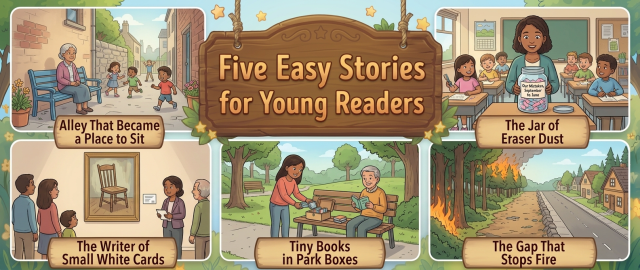
AIで生成した少しやさしい英文5話をまとめて掲載しています。
英文の難易度
CEFR:A1
英検:4級
語数:5話合計約1,577語
制作について
本記事の英文・日本語訳・英語難易度の評価は、AIを活用して作成したものです。
内容の正確性を保証するものではありません。
論理的な矛盾・文脈の破綻などが含まれている可能性や、歴史的事実・科学的な正確性・一般常識などに合致しない事柄が含まれている可能性があります。あくまでも英文を読む練習用の素材として考えて下さい。
「んっ?」と思うところがあっても、無視して読み続ける能力を獲得していただければ幸いです…
なお、難易度の評価は目安であり、CEFRや英検による公式な判定ではありません。
Alley That Became a Place to Sit
英語本文:約330語
Old Mrs. Kline kept the alley clean.
Not her alley. Everyone’s alley.
The alley behind Main Street had trash. Papers, bottles, old chairs.
The city said the alley was not a city road. So the city did not clean it.
The shops said it was not their land.
So trash stayed.
Mrs. Kline was seventy. She walked down the alley each morning with a bucket.
She picked one bag of trash. Only one. Not all.
Neighbors saw her. They said, “Why only one bag? The alley is still dirty.”
She said, “One bag each day means one less bag.”
She did it each day. Monday one bag, Tuesday one bag.
After a week, there were seven fewer bags. The alley had less trash.
A boy from the pizza shop saw her. He started picking one bag after work.
Then a girl from the bookshop. Then a man from the bike shop.
Each person picked up one bag.
The alley got clean in one month. Not perfect. But clean.
Mrs. Kline put a bench in the alley. It was an old bench she had fixed. She painted it blue.
She sat there in the morning. People sat with her.
The alley was now a place to sit, not a place for trash.
The city saw the clean alley. It put up a sign: “Community Alley. Keep It Clean.”
Mrs. Kline said, “A sign is not needed. People keep it clean because they use it.”
She still walks each morning with a bucket. Even when the alley is clean, she finds one small bag. Bottle cap, paper.
One bag each day.
The alley that was no one’s land is now everyone’s place.
Because one woman picked up one bag, not all the trash.
And others saw one less bag and thought, “I can do one bag, too.”
A clean alley from one bag each day.
Now kids play there after school. An alley with a bench, a blue bench, and no trash.
日本語対訳
座る場所になった路地
老クラインさんは路地をきれいに保っていた。
彼女の路地ではない。皆の路地だ。
メインストリートの裏の路地にはゴミがあった。紙、瓶、古い椅子だ。
市は路地は市の道路ではないと言った。だから市は掃除しなかった。
店は私たちの土地ではないと言った。
だからゴミはそのままだった。
クラインさんは七十歳だった。毎朝バケツを持って路地を歩いた。
ゴミを一袋拾った。一つだけだ。全部ではない。
近所の人は見た。なぜ一袋だけなのかと言った。路地はまだ汚いのに、と。
彼女は言った。一日一袋で一袋少なくなるのよ、と。
彼女は毎日そうした。月曜に一袋、火曜に一袋だ。
一週間後七袋少なくなった。路地のゴミが少なくなった。
ピザ屋の男の子が見た。仕事の後に一袋拾い始めた。
それから本屋の女の子。それから自転車屋の男性だ。
それぞれが一袋ずつ。
路地は一か月できれいになった。完璧ではない。だがきれいだ。
クラインさんは路地にベンチを置いた。直した古いベンチだ。青く塗った。
朝そこに座った。人々も彼女と一緒に座った。
路地は今やゴミの場所ではなく座る場所になった。
市はきれいな路地を見た。市は看板を立てた。コミュニティの路地、きれいに保ちましょう、と。
クラインさんは言った。看板は必要ないわ。人々が使うからきれいに保たれるのよ、と。
彼女は今でも毎朝バケツを持って歩く。きれいなときでも小さな一袋を見つける。瓶の蓋、紙だ。
一日一袋だ。
誰の土地でもなかった路地は今や皆の場所だ。
一人の女性が全てのゴミではなく一袋を拾ったからだ。
そして他の人々は一袋少なくなったのを見て、私も一袋できるかもと思ったのだ。
一日一袋できれいになった路地。
今では子どもたちが放課後にそこで遊ぶ。ベンチのある路地、青いベンチ、ゴミなしの。
The Jar of Eraser Dust
英語本文:約359語
There was a classroom where eraser dust was saved.
Not thrown away. Saved in a jar.
A teacher named Ms. Rivera had a big jar on her desk. A clear jar with a lid.
When students erased something, they brushed the dust into the jar.
Why? Because Ms. Rivera said, “Dust is proof of learning.”
She said, “When you erase, you find a better answer. The old answer is gone, and the new answer is there. The dust left behind is a sign that you tried again.”
Kids thought it was funny at first. The jar was empty in September.
But soon, the jar had a little pink dust. Then more.
By October, the jar was half full. Pink, white, and blue dust from different erasers.
Ms. Rivera put a label on the jar. The label said, “Our Mistakes, September to June.”
She never said mistakes were bad. She said mistakes show effort.
One day, a boy named Sam erased a whole page. He wrote the wrong numbers. He wanted to throw the page away.
Ms. Rivera said, “Do not throw the page away. Erase it and try again. Put the dust in the jar.”
Sam erased hard. Dust fell. He wrote again. Right numbers this time.
He brushed the dust into the jar. He said, “My dust is in there.”
Later, when a test was hard, the kids looked at the jar. The jar was almost full.
Ms. Rivera said, “See how much you have tried? The jar is full of your tries.”
At the end of the year, the jar was full. Pink and white dust reached the top.
She did not throw the jar away. She kept it on a shelf. Next to a new, empty jar for the next class.
She said, “The last class tried many times. Now it is your turn.”
The new class saw the full jar. They knew it was okay to erase.
Because erasing is not failing. Erasing is learning again.
One jar, many tries, dust from mistakes.
A classroom where dust is saved, not thrown away.
Proof that trying again leaves a mark, even if the answer is gone.
日本語対訳
消しゴムのかすの瓶
消しゴムのかすが取っておかれる教室があった。
捨てられない。瓶の中に取っておかれるのだ。
リベラ先生という名の先生が机の上に大きな瓶を持っていた。蓋付きの透明な瓶だ。
生徒たちが何かを消したときかすを瓶の中に払い入れた。
なぜ。リベラ先生が言ったからだ。かすは学習の証拠だ、と。
彼女は言った。消すときはより良い答えを見つけたのだ。古い答えはなくなり新しい答えがある。残ったかすはもう一度やってみたという印なのだ、と。
子どもたちは最初はおかしいと思った。九月に瓶は空だった。
だがすぐに瓶には少しのピンクのかすが入った。それからもっと。
十月までには瓶は半分いっぱいになった。違う消しゴムからのピンク、白、青のかすだ。
リベラ先生は瓶にラベルを貼った。ラベルには私たちの間違い、九月から六月までと書かれていた。
間違いが悪いと彼女は決して言わなかった。間違いは努力を示すのだと言った。
ある日サムという名の男の子が一ページ全部を消した。間違った数字を書いたのだ。ページを捨てたくなった。
リベラ先生は言った。ページを捨てないで。消してもう一度やってごらん。かすは瓶の中へ、と。
サムは一生懸命消した。かすが落ちた。もう一度書いた。今度は正しい数字だった。
かすを瓶の中に払い入れた。言った。僕のかすが中にあるよ、と。
後でテストが難しいとき子どもたちは瓶を見た。瓶はほとんどいっぱいだった。
リベラ先生は言った。どれだけやってみたか見てごらん。瓶は挑戦でいっぱいよ、と。
学年末に瓶はいっぱいになった。ピンクと白のかすが上まで。
彼女は瓶を捨てなかった。棚に取っておいた。次のクラスのための新しい空の瓶の隣に。
言った。前のクラスはたくさん挑戦したの。今度はあなたたちの番よ、と。
新しいクラスは満杯の瓶を見た。消しても大丈夫だと分かった。
なぜなら消すことは失敗ではないからだ。消すことは再び学ぶことなのだ。
一つの瓶、たくさんの挑戦、間違いからのかす。
かすが捨てられず取っておかれる教室。
もう一度やってみることは答えがなくなっても跡を残すという証拠だ。
The Writer of Small White Cards
英語本文:約327語
There is a writer who writes not books, but small cards.
Cards next to art in a museum.
You know them. White cards on the wall. A few lines. Name of art, name of artist, year.
Her name is Lena. Her job is to write those cards.
It sounds easy. But hard.
A card must be short. Very short. About fifty words. People do not read long cards while standing.
So Lena must pick which facts matter most.
She looks at a painting. A big painting of the sea. Who made it? When? Why blue?
She talks to the artist if the artist is still alive. She asks, “What did you think when you painted the sea?”
The artist says, “I thought of cold water in winter.”
Lena writes the card. Not just, sea, 2020, oil on canvas. She writes, “The artist painted the sea in winter, with cold water and the feeling of wind.”
She tests the card. She watches people read it. If people read it and then look again at the painting, the card is good.
If people read it and walk away fast, the card is not good.
She rewrites.
One painting was of an old chair. Just a chair. People walked past fast.
Lena changed the card. The old card said, “Chair, 2018, wooden chair.”
The new card says, “The artist’s father’s chair. His father sat here every evening to read. The chair is empty now.”
After the new card went up, people stopped. They looked at the chair longer.
Lena says, “Small cards are small stories. Not about paint. About people.”
The museum has two hundred cards. She wrote most of them.
The next time you go to a museum, read the small white cards. They are short, but they take a lot of work.
If you look at the art again after reading the card, Lena did a good job.
Writer of small cards, not books.
But books inside cards.
日本語対訳
小さな白いカードの書き手
本ではなく小さなカードを書く作家がいる。
美術館で芸術作品の隣にあるカードだ。
あなたはそれを知っている。壁にある白いカード。数行。作品の名前、芸術家の名前、年だ。
彼女の名前はレナ。仕事はそれらのカードを書くことだ。
簡単そうに聞こえる。だが難しい。
カードは短くなければならない。とても短く。約五十語。人々は立ったまま長いカードを読まない。
だからレナはどの事実が最も重要かを選ばなければならない。
絵を見る。海の大きな絵だ。誰が作ったのか。いつ。なぜ青いのか。
芸術家がまだ生きていれば話をする。聞く。海を描いたとき何を考えましたか、と。
芸術家は言う。冬の冷たい水のことを考えたよ、と。
レナはカードを書く。ただ海、2020年、キャンバスに油彩、というだけではない。書く。芸術家は冬に海を描いた。冷たい水。風の感覚、と。
カードをテストする。人々がカードを読むのを観察する。もし人々が読んでそれからもう一度絵を見ればカードは良い。
もし読んで急いで立ち去ればカードは良くない。
書き直す。
一つの絵は古い椅子の絵だった。ただの椅子だ。人々は足早に通り過ぎた。
レナはカードを変えた。古いカードには椅子、2018年、木の椅子と書いてあった。
新しいカードには芸術家の父親の椅子。父親は毎晩ここに座って本を読んだ。今は空の椅子、と書いてある。
新しいカードの後、人々は立ち止まった。より長く椅子を見た。
レナは言う。小さなカードは小さな物語なの。絵の具についてではなく人々についての、と。
美術館には二百枚のカードがある。そのほとんどを彼女が書いた。
次に美術館へ行くときは小さな白いカードを読んでごらん。短いけれど多くの仕事がかかっている。
カードの後に芸術作品をもう一度見ればレナは良い仕事をしたのだ。
小さなカードの書き手で本の書き手ではない。
だがカードの中に本があるのだ。
Tiny Books in Park Boxes
英語本文:約287語
There is a writer who makes very small books.
Not small like thin. Small like a coin. Tiny books you can hold on one finger.
Her name is Mei. She lives in a room with many papers.
She makes books for ants? No. For people. But people who like tiny things.
Each book has ten pages. Each page has one word and one small drawing.
One book is called Rain. Page one: cloud. Page two: drop. Page three: puddle. Page ten: sun.
Another book is called Night. Page one: moon. Page two: owl. Page three: sleep.
She cuts paper with tiny scissors. She draws with a tiny pen. Very thin pen.
Why tiny? She says, “A big book takes a long time to read. A tiny book takes one minute. You can read while waiting for the bus.”
She puts tiny books in small boxes. She leaves the boxes in the park. On benches. Free.
People find a box. Open it. See a tiny book. Read it in one minute. Smile.
Some people take a book home. Some leave a new tiny book in the box. So the box is never empty.
Mei makes fifty tiny books a year. Not many. Each one takes a week.
She says, “I do not want to make big books. Big books need a big desk. I have a small desk. Small desk, small books.”
Her books are not in a library. They are in boxes in the park. Or in pockets.
If you see a small box in the park, open it slowly. A tiny book is inside. Rain, Night, Bread, Cat.
Read it in one minute. Then put it back or keep it.
Small book, small story, small smile.
日本語対訳
公園の箱の中の小さな本
とても小さな本を作る作家がいる。
薄いという意味で小さいのではない。コインのように小さいのだ。一本の指の上に乗せられる小さな本だ。
彼女の名前はメイ。たくさんの紙がある部屋に住んでいる。
アリのために本を作っているの?いいえ、人間のためにだ。でも小さな物が好きな人々のために。
一冊の本は十ページある。各ページには一つの単語と一つの小さな絵がある。
一冊は雨と呼ばれている。一ページ目は雲。二ページ目はしずく。三ページ目は水たまり。十ページ目は太陽。
別の本は夜と呼ばれている。一ページ目は月。二ページ目はフクロウ。三ページ目は眠り。
彼女は小さなはさみで紙を切る。小さなペンで絵を描く。とても細いペンだ。
なぜ小さいの?彼女は言う。大きな本は読むのに時間がかかる。小さな本は一分かかる。バスを待っている間に読めるわ、と。
彼女は小さな本を小さな箱に入れる。箱を公園に置く。ベンチの上に。無料だ。
人々は箱を見つける。開ける。小さな本を見る。一分で読む。微笑む。
本を家に持ち帰る人もいる。新しい小さな本を箱に残していく人もいる。だから箱は決して空にならない。
メイは一年に五十冊の小さな本を作る。多くはない。一冊に一週間かかる。
彼女は言う。大きな本を作りたくはないの。大きな本は大きな机が必要。私は小さな机を持っている。小さな机、小さな本、と。
彼女の本は図書館にはない。公園の箱の中にある。あるいはポケットの中に。
公園で小さな箱を見たらゆっくり開けて。小さな本が中にある。雨、夜、パン、猫。
一分で読みなさい。それから戻すか取っておくかしなさい。
小さな本、小さな物語、小さな微笑み。
The Gap That Stops Fire
英語本文:約274語
Long ago, towns had many fires.
Houses were made of wood. Roofs were made of wood. One fire could eat many houses fast.
People tried to stop fires with water. Water helped. But fire jumped from one roof to another.
Then someone had an idea. Make a gap.
If a fire needs wood to burn, take the wood away in one line. Then the fire cannot jump.
They made firebreaks. A firebreak is a long gap with no houses. No trees. Just dirt or stone.
The first firebreaks were in big cities. In Japan, after big fires, people made wide streets. Wide streets were firebreaks.
If a fire came, a wide street stopped it. No wood to burn. The fire stopped at the edge of the street.
In America, people made firebreaks in forests, too. Long lines cut through the forest. No trees there. So if a forest fire came, the fire lost its fuel and slowed down.
Did it work? Most of the time, yes. The fire came to the gap and slowed down. Then people could put water on it.
Not every fire is stopped. Wind can lift sparks over the gap. So firebreaks are not magic. But they help a lot.
Today we still have them. You may see a wide road in town with no houses. That may be a firebreak from long ago.
Or a dirt line in a forest. That is a firebreak, too.
Long ago, people learned that sometimes, to stop a fire, you do not add more water. You take away what the fire eats.
A gap can be strong. An empty line can save houses.
日本語対訳
火を止める隙間
昔、町では火事が多かった。
家は木だった。屋根も木だった。一つの火がたくさんの家を速く食べてしまうことがあった。
人々は水で火を止めようとした。水は役に立った。でも火は屋根から屋根へ飛び移った。
それから誰かが考えついた。隙間を作ろう、と。
火が食べるために木が必要なら、一列だけ木を取り除けばいい。そうすれば火は飛び移れない。
彼らは防火帯を作った。防火帯とは家のない長い隙間のことだ。木もない。ただ土や石だけだ。
最初の防火帯は大きな町にあった。日本では大きな火事の後、人々は広い通りを作った。広い通りが防火帯だった。
火が来ても広い通りが止めた。食べる木がない。火は通りの端で止まった。
アメリカでも古い森で人々は防火帯を作った。森の中に切り開かれた長い線だ。そこには木がない。だから森の火事が来ても火は食べ物を失い遅くなった。
うまくいったのだろうか。たいていはうまくいった。火は隙間まで来て遅くなった。それから人々は水をかけることができた。
すべての火が止まるわけではない。風が火の粉を隙間の向こうへ持ち上げることがある。だから防火帯は魔法ではない。でもとても役に立つ。
今日でも私たちはそれを持っている。町で家のない広い道を見かけることがあるかもしれない。それは昔の防火帯かもしれない。
あるいは森の中の土の線だ。それも防火帯だ。
昔の人々は学んだ。時には火を止めるために水をもっと足すのではなく、火が食べるものを取り除くのだということを。
隙間は強くなれる。空っぽの線が家を救うことができるのだ。